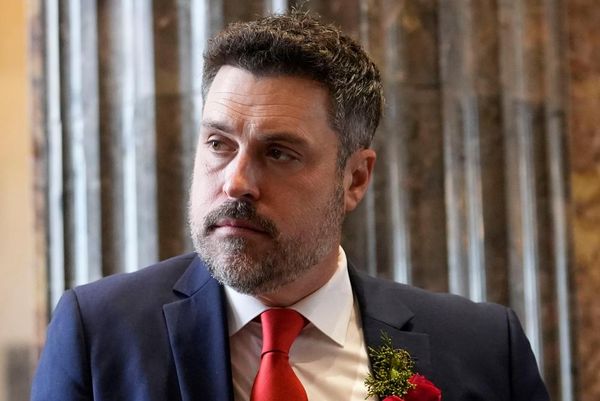
Derryn Hinch and the Greens are negotiating a move to force all foreign-born senators to show proof of revocation ahead of the referral of three senators to the high court over their dual citizenship.
The Justice party senator told Guardian Australia: “The Greens and I are talking about a move for all foreign-born senators to show proof of revocation.”
Parliament returns from a winter recess on Tuesday and referrals are expected for former Greens senators Larissa Waters and Scott Ludlam as well as the Nationals senator Matt Canavan over their dual citizenship, which has placed them in contravention of section 44.
But a cloud remains over the One Nation senator Malcolm Roberts, who has said he wrote to British officials on 6 June last year – three days before nominations closed for the federal election – saying that if he had British citizenship, he fully renounced it. According to the senator, the British high commission did not confirm Roberts had renounced his citizenship until 5 December.
Hinch previously said he would refer Roberts to the high court to clear up the citizenship issue but on Monday he told Guardian Australia he would talk to Roberts before confirming any move.
It is likely the citizenship referrals will happen when the Senate returns on Tuesday shortly after midday.
While the the marriage equality debate has blown a hole in the Turnbull government’s agenda, there are several major bills and reports expected in parliament this week.
The corrupting benefits bill is the first government item in the Senate. It would outlaw making or receiving payments that encourage unions to improperly trade off workers’ rights.
The media reform bill is also due before the Senate this week and the Greens’ communications spokeswoman, Sarah Hanson-Young, has said the Greens could consider supporting the package if there were safeguards to encourage quality independent journalism.
The Greens and One Nation are negotiating on the government attempts to change cross-media ownership laws, including the scrapping of the two out of three rule, which would mean media moguls could control television, newspapers and radio stations in the same market.
Greens support would be contingent on protections for the public broadcasters ABC and SBS against attempts by One Nation to cut the public broadcasters and tax incentives to support journalism.
“It’s no surprise that News Corporation and Rupert Murdoch want to expand their empire,” Hanson-Young told the Australian Financial Review. “We are, of course, worried about media diversity but we are also very concerned about making sure we find ways to retain quality, independent journalism and not seeing smaller players hung out to dry.”
The Turnbull government also wants to dump the 75% reach rule, which prevents Nine Entertainment, Seven West Media and the Ten Network from owning their regional affiliates, due to restrictions on a TV network broadcasting to more than 75% of the population.
Labor supports scrapping the reach rule but not the two out of three rule, on the grounds that Australia already has one of the most concentrated media markets in the developed world.
For the bill to pass, the Turnbull government needs the Greens or One Nation, the Nick Xenophon Team and two other crossbench senators.
The Senate will also debate competition laws, otherwise known as the effects test – an issue that has long split the Liberal and National parties.
The bill relates to section 46 of the Competition and Consumer Act to prohibit corporations with substantial market power from engaging in conduct that has the effect of substantially lessening competition in markets in which they directly or indirectly participate.
Labor is opposed to the effects test but it has the support of the Greens and expected to pass.
The Senate report into the government’s university changes that amount to $2.8bn in cuts to universities is due out on Wednesday.
Under the changes, university students’ course fees will rise from between $2,000 to $3,600, students will have to repay student loans when their income reaches $42,000 instead of $55,000 and they will have to repay 46% of the total course cost instead of 42%.
Universities will face an efficiency dividend or cuts of 2.5% in 2018 to 19. The new proposal replaces the 2014 Abbott government budget plan to cut the sector by 20%.
In spite of the Senate report, the higher education bill is yet to pass even the lower house.
Also on the notice paper is the bill to remove the investment ban on carbon capture and storage technologies under the Clean Energy Finance Corporation (CEFC). Labor is opposed to the move, describing it as a hollow gesture given the Coalition’s $460m cut to research and development in the area.