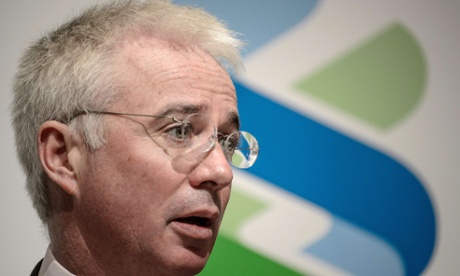
Peter Sands, the outgoing chief executive of Standard Chartered, is waiving a a multimillion pound bonus to demonstrate leadership after overseeing a 30% fall in profits and embarking on further cost-cutting measures.
Sands, who is being replaced by veteran investment banker Bill Winters in June, said the last set of results was clearly disappointing and that he took responsibility for the slide in performance.
Profits fell to $4.2bn (£2.7bn) – owing in part to a 32% rise in bad debt charges, extra compliance costs, a $300m fine from the US authorities for breaches of money-laundering rules and continuing problems with its Korean arm.
The emerging markets-focused bank issued its results after last week’s dramatic boardroom clearout, which will also see the chairman, Sir John Peace, and four other directors leave.
After 13 years at Standard Chartered, Sands insisted that the bank did not need to embark on a major fundraising exercise to bolster its capital levels. Despite the fall in profits, the bank held its dividend at last year’s level of 82 cents a share.
Sands and four other executive directors on the board will forgo their bonuses, but Andy Halford, who became finance director in August, is taking his. Sands said the scale of the payments the executives had waived was irrelevant, but details will be released on 16 March.
It was not clear if the directors had meet the criteria required to be awarded, but the maximum Sands and three colleagues could have received was up to £16.5m in shares.
He declared that the executive directors were not taking bonuses in order to “show leadership”.
However, the total bonus pool across the bank is only down 9% – less than the fall in overall profits. Sands said 98% of Standard staff were based outside the UK and working in markets where they risked being poached by rivals.
The reassurance over the dividend supported the shares, which rose 5% to £10.29.
Sands said: “There are no plans to raise capital. We have maintained the dividend. We understand the importance of the dividend to our shareholders ... We start from a very strong capital position.”
Yet he added: “I am clearly disappointed with our performance in 2014. I’m taking responsibility for that as the CEO. The buck stops here, but I’m also proud of what the bank has achieved during the 13 years I have been both finance director and CEO.”
Until 2012, Standard Chartered reported 10 consecutive years of rising revenue and profits, but this came to a halt in 2013 as problems in South Korea and increasing bad debts started to dent profits. The bank wrote off a further $726m from the value of its Korean business, on top of $1bn last year, underlining that it had overpaid when it bought Korea First Bank in 2005.
Sands said of last year’s difficulties: “We faced a perfect storm: negative sentiment towards emerging markets, a sharp drop in commodity prices, persistent low interest rates and surplus liquidity, low volatility, and a welter of regulatory challenges.”
He navigated the bank through the financial crisis after being promoted from finance director to chief executive in 2006. “This will be my last group chief executive’s review, and it is obviously one of the more challenging sets of numbers I have had to explain. In my 13 years at the group, I have seen lots of ups and downs,” Sands said.
Peace defended the bonus pool at the bank, which has endured protests over pay at its annual general meetings. “We are, of course, mindful of the external sentiment in some markets on bankers’ pay, and conscious of our disappointing performance in 2014, but it is essential that we remain able to pay competitively in the markets where we operate and where wage inflation, on average, is around 5%,” he said.
Sandy Chen, an analyst at Cenkos, said: “The big news is that there isn’t big news – no ballooning of bad debts, no emergency rights issue. There’s just a lot of basic bank restructuring for the new CEO to lead.”