Baseball, going into the 1950s, was a drab affair, if we’re being honest. America – and the world – were barely recovering from the horrors of World War II. The quintessential dynasty of that decade – the New York Yankees – were just getting started. Jackie Robinson and the Brooklyn Dodgers had only just breached the sport’s execrable color line, but Robinson’s majestic figure still trod the basepaths with scarce a companion.
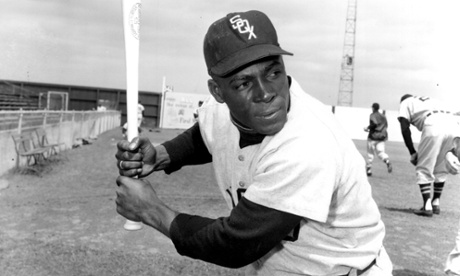
This was the stage upon which Minnie Miñoso entered. Before Rickey Henderson, before Reggie Jackson and Manny Ramirez, there was Minnie. Nicknamed the “Cuban Comet”, dressed to impress, flashing the gold, cash, and a blazingly incandescent smile, Miñoso turned baseball from black and white into glorious technicolor.
He wasn’t just about the glowing smile and fancy threads, though. What doesn’t get mentioned nearly enough as we memorialize Miñoso – who died on Sunday – was that Minnie could flat out play. It is, perhaps, fitting that only five weeks after the legendary Ernie Banks died – “Mr Cub” – his South Side Chicago partner, “Mr White Sox”, joins him in the field of dreams.
Minnie Miñoso didn’t start playing in the major leagues until he was 28 years old. His playing career began in Cuba in 1945, before he moved to New York and the Negro National League, where he played with the New York Cubans, where he starred as a third baseman. He joined the Cleveland Indians in 1948, and played in nine games for them in 1949, before moving on to the San Diego Padres of the Pacific Coast League, where he stayed through 1950. After playing another eight games for the Indians, they traded him to the Chicago White Sox in April of 1951, where he became their first black player.
It was there that Miñoso set the sport afire. By now presumably 28 years old, Minnie Miñoso proceeded to have a better career after that age than nearly any other Hall of Fame right/left fielder. A right-handed batter who mostly hit to the opposite field, Miñoso was sufficiently quick and powerful to reach the left-field stands at Comiskey Park, the White Sox home stadium. In the first pitch of his first at-bat for the White Sox, facing the New York Yankees, Miñoso crushed a ball to those stands that traveled 415 feet – the first of 135 home runs he would hit for them, a total that still ranks him 12th in the team record books.
That was just an appetizer, though. Miñoso maintained his batting average over .350 through the vast majority of the first half of the season; he would eventually bat .324, finishing second in the batting average race. He earned a spot on the American League All-Star team, the first of seven, making him one of the first Latinos ever honored in that manner. He would go on to score 112 runs in 138 games played – nearly a run per game appearance – and led the American League in both triples and stolen bases, hitting 15 of the former and swiping 31 of the latter, and was even hit 16 times by pitchers. Miñoso’s exploits weren’t just limited to offense; he played six positions that season for the White Sox. Weirdly, he finished second to the Yankees’ Gil McDougald in the Rookie of the Year race, despite beating him in the balloting for the American League MVP award, where he finished fourth.
By the time the season ended, his skills spectacularly on display, Minnie Miñoso had become the most popular player on the White Sox. It was that combination of on-field dash and off-field flash that made Miñoso “Mr White Sox”.
He was no flash-in-the-pan, either. Miñoso had a career .389 on-base percentage – better than Willie Mays or Hank Aaron or Harmon Killebrew, his contemporaries; better than Carl Yastrzemski, Pete Rose, Mike Piazza, Derek Jeter or Ken Griffey Jr. His career slugging average was .459, higher than those of Enos Slaughter, Ryne Sandberg or Cal Ripken Jr. In the American League, Miñoso hit exactly .300 for his career; only a 19-for-97 performance with the St Louis Cardinals in 1962, in the twilight of his career, kept him from hitting above .300 for the entirety of his major league career. Whether it was hitting for power or for average, Miñoso made it count, scoring 1,136 runs and driving in another 1,023. Miñoso led the American League at different times in hits, doubles, triples, total bases, hit by pitch – in which category he ranks ninth all-time, and led the league 10 times – sacrifice flies, stolen bases, stolen base percentage, on-base percentage and slugging percentage.
The positional flexibility he demonstrated that rookie season extended throughout his career. Minnie Miñoso started 1,461 games in left field, 93 in right field, 88 at third base, 80 in center field, and two at first and at shortstop. Put into terms that football fans would recognize, it’s like a center-back also lining up at left back, right back, center forward, right wing, and left midfield and right midfield – and succeeding in all of those positions. Miñoso was a driven, striving, aggressive player whose hustle and aggression utterly entranced the fans for whom this consummate showman performed. If Minnie Miñoso had started his career at, say, 18 or 20, he would have easily been one of the 20 greatest players in the history of baseball.
No less a figure than Ted Williams, widely considered one of the greatest hitters in baseball history and the last player to hit .400 in a season, had praise for Miñoso’s skill, in a 1955 interview:
Sooner or later, whenever we talk about hitting, someone will ask me if there will ever be another .400 hitter in the major leagues. Of all the so-called ‘sluggers’ in the big time today, the only one I can think of who really qualifies in all respects is Minnie Miñoso.
Born Saturnino Orestes Armas Miñoso Arrieta in Perico, Cuba, sometime between 1922 and 1925, Miñoso lived his life the hard way – nothing came to him, but in the hard way, growing up in the sugar cane fields of Cuba. He said as much in an interview late in life with Rich Wescott, for a book titled Diamond Greats:
What more could I ask of life? I came from nowhere. I worked in the sugar fields as a boy. It was a tough life. I had one pair of shoes and one pair of pants. But, I always had a smile on my face. My mother and father taught me many things … they taught me to be a good citizen, a good human being, and to love life.
He loved life – and the game – so much, that after his retirement in 1964, Minnie Miñoso moved to Mexico, where he continued playing. He played first base, and hit .360 and .348 in his first two seasons there; he finally closed out his career at the age of 47, in 1973. He rejoined the White Sox as a first and third base coach in 1976 – and he appeared in three games for them. On 12 September, he hit a single off pitcher Sid Monge of the California Angels. That hit, at age 50, made him the third-oldest player to get a hit in the majors. In 1980, at age 54, he was activated for another two games. That made Miñoso the third-oldest player to play in major league baseball, behind Nick Altrock, who at age 57 pinch hit in 1933, and Satchel Paige, who at age 59 pitched three shutout innings in one game in 1965.
With that appearance, Minnie Miñoso joined Altrock as just the second player in major league baseball history to play in five different decades. Altrock played between the 1890s and the 1930s; Miñoso between the 1940s and 1980s. He was the last of the players who broke baseball’s color line to appear in the majors, and the last player who played in the ‘40s to do so.
Despite his feats, Miñoso never was elected to the Hall of Fame. Baseball historian Bill James selected Miñoso as the 10th greatest left fielder of all time in his ratings of baseball players; but general sentiment holds that his “publicity stunt” appearances in the ‘70s, ‘80s, ‘90s, and last decade damaged his candidacy in the eyes of Hall of Fame voters, however unfairly. Regardless of whether or not he’s enshrined, the numbers do not lie: Minnie Miñoso was one of the sport’s all-time greatest players, and it is a greyer, poorer sport for his absence.