
Breaking: Danish prime minister concedes defeat and resigns as party leader
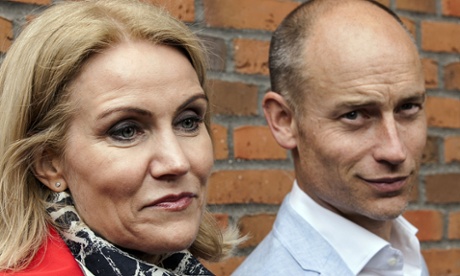
Helle Thorning-Schmidt has just resigned, Lars Hinnerskov Eriksen reports. In her resignation speech she said: “Every single day the responsibility has been mine. I stand by the decisions I have made. Also tonight.”
“I was Denmark’s first female prime minister, but I won’t be the last.”
Updated
Aisha Gani's evening summary
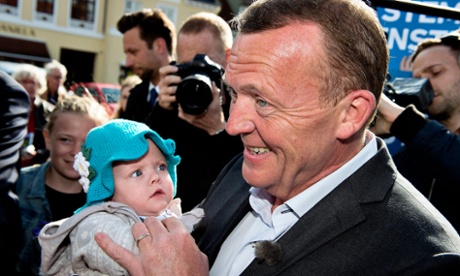
From handing out red roses, to driving about in tractors. From tiresome Borgen references, to wooing fishermen on islands. From clashing on TV debates, to red and blue blocs. Yet in the end, after what has been a tightly fought contest in the Scandinavian nation, the centre-right has been voted in to govern the Folketing.
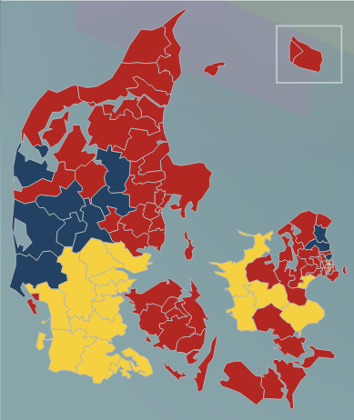
Danish voters have ousted the centre-left government of Prime Minister Helle Thorning-Schmidt, and have today voted for an opposition in which the anti-immigration Danish People’s Party has emerged as the biggest force.
The final results were as follows:
Red bloc
- The Social Democrats (A) – 47
- Radikale, the Danish Social Liberal party (B) – 8
- Socialist People’s party (F) – 7
- Red-Green Alliance (Ø) – 14
- The Alternative (Å) –9
Blue bloc:
- Venstre (V) – 34
- Danish People’s party (O) – 37
- The Liberal Alliance (I) – 13
- The Conservative People’s party (C) – 6
“What’s key for us is that we get the most influence,” Kristian Thulesen Dahl, leader of the People’s Party, said earlier in an interview.
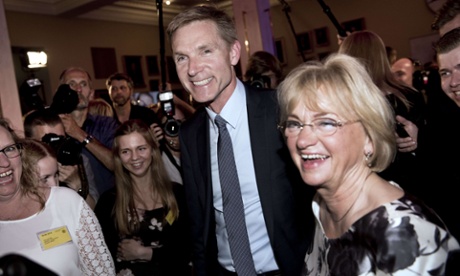
Up until polling day the incumbent centre-left coalition of Social Democrat prime minister Helle Thorning-Schmidt had hoped to score a spectacular comeback – her government was trailing by 17% two years ago, after unpopular reforms and broken campaign promises, since taking office in 2011.
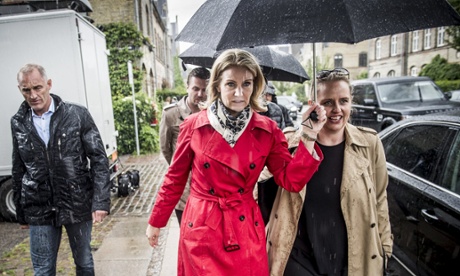
Yet on the eve of Thursday’s poll the result was seen as too close to call, with barely a single percentage point separating the two blocs.
The blue opposition bloc led by Lars Loekke Rasmussen, leader of the Liberal Party, has 90 seats in the parliament, versus 85 for the red bloc.
The Danish People’s Party won about one-fifth of the votes, almost doubling its backing since the previous election in 2011, after promising Danes tougher immigration laws.
The populist right-wing is also skeptical toward Denmark’s membership in the European Union and has argued in favour of border controls to defy the single market’s free movement of labor. The right-wing party will also the British prime minister, David Cameron, in his quest for EU renegotiations.
Thanks for staying up with the Guardian team on this Denmark election result liveblog special. That’s it from me Aisha Gani, and our correspondents on the ground Lars Eriksen and David Crouch.
Hej hej.
Updated
Profile: Lars Løkke Rasmussen
Lars Løkke Rasmussen, 51, the leader of the right-wing Venstre party, is set to become Denmark’s next prime minister. The Local has a very useful profile:
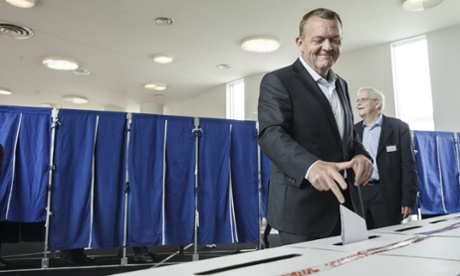
He is seen to be a seasoned political operator with over 20 years in parliament, compared to Helle Thorning-Schmidt, 48, who is almost certain to become former prime minister and who cut her political teeth in Brussels, and elected to the Danish parliament a decade ago.
Apart from experience, the Rasmussen charm has often gone down better with voters in contrast to the more formal, almost stiff approach of his Social Democrat adversary.
He took over as the country’s youngest-ever prime minister in 2009 when Anders Fogh Rasmussen (no relation) stepped down to become Nato Secretary General, but was ousted by the leftist coalition two years later when voters rejected his government’s austerity policies.Despite the defeat, which ended a decade of conservative rule, Rasmussen held on to the party leadership.
He has since survived a series of relatively minor expenses scandals, which nonetheless hit his popularity ratings.
Our correspondent David Crouch reports:
Liberal party MP Søren Pind said his party would back David Cameron the British prime minister in Brussels, and said: “we do not want the EU developing into a social union ... with people travelling without contributing to the countries they are in.”
Danish far-right second largest party in general election
Denmark’s anti-immigration Danish People’s Party (DPP) has become the second largest party in Thursday’s general election as the centre-left government was ousted by the right-wing bloc.

The DPP has become the largest right-wing party for the first time with more than 21 percent of the vote - a record score - as the right-wing bloc secured 90 seats in parliament.
That compared to 85 for Prime Minister Helle Thorning-Schmidt’s centre-left bloc.
The DPP, which backed right-wing governments between 2001 and 2011, has yet to say whether it would seek to join a right-wing government. It could opt to remain outside government and provide informal support to the right-wing bloc in parliament to pass legislation.
Updated
Party members and local media await the arrival of Helle Thorning-Schmidt, who appears to be the ousted former prime minister:
Social Democrats await Helle Thorning-Schmidt's imminent arrival pic.twitter.com/AvLbJgK6aJ
— The Local Denmark (@TheLocalDenmark) June 18, 2015
Denmark’s Helle Thorning-Schmidt just briefly appeared along with her husband, British Labour MP Stephen Kinnock.
Speculation has begun as to whether Thorning-Schmidt will resign as leader of her party, according to The Local.
Updated
Pia Kjærsgaard, former leader of the Danish People’s Party, has told TV2 the Danish broadcaster she’s surprised by the extent of her party’s success:
Did anyone think we would have been in this position? Even we didn’t.
Here is a photo of the DPP leader Kristian Thulesen Dahl speaking earlier today at his election party:

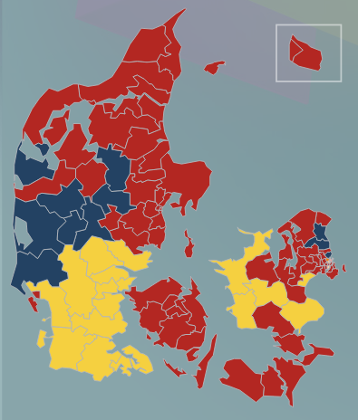
With 99% of the votes counted, this is how the forecast for the whole country appears to look according to DR.DK the national broadcasters. It shows the centre-right blue bloc appearing to have 90 seats in the country:
Updated
Lars Eriksen adds:
On Danish TV, they are drawing comparisons with the British elections in which people expected there to be a tight race.
This result tonight has taken everyone by surprise, from politicians to political pundits.
With the four seats from Greenland and Faroe Islands going to the red bloc, the final result looks to be 91 for the blue bloc and 88 for the red.
Lars Eriksen our reporter on the ground has sent this report:
The DPP party leader, Kristian Thulesen Dahl, has just been addressing the jubilant crowds at their Christiansborg HQ. “It’s so unreal what is happening today for the Danish People’s party.”
The party’s MEP, Morten Messerschmidt, echoed that sentiment: “It’s quite stunning and surprising,” Messerschmidt told the Guardian.
“We all hope for the best result but this is beyond what I ever imagined. None of the polls indicated this was possible. And I’m not just talking about my party, I’m talking about the centre-right bloc. We are foreseeing to have a centre-right majority and Mr Rasmussen is able to form a government. It’s really a stunning turn in Danish politics, not that it’s surprising that the electorate have rejected Helle Thorning-Schmidt. She is beyond compare the weakest prime minster we’ve ever had.
Asked what role the DPP should play in forming a new government, he said: “I’ll be very frank, we’ll play the role where we get the most influence. Honestly speaking, as we see it now, that’s to support a government, not joining it. That’s what we did for 10 years, from 2001 to 2011, and we had huge influence.”
Updated
Peter Skaarup, a senior Danish People’s Party MP, was asked by Danish media outlet The Local whether the party had ever expected such an election result, and said:
No. It’s gone beyond my wildest expectations. I know we often fare better in these elections than the polls suggest since people often aren’t willing to admit that they vote for the Danish People’s Party, but it really does look fantastic so far.”
Updated
This is how the latest prognosis for the blocs appears to be:
Centre-left red bloc: 85 seats
Centre-right blue bloc: 90 seats
#Denmark Red/Blue standings pic.twitter.com/QsG2dYXloy
— Electograph (@Electograph) June 18, 2015
With 90% of the votes counted, it appears that the right-wing Danish People’s Party are overtaking the centre-right Liberal Party as Denmark’s second largest, with over 21% of the vote:
#Denmark Results forecast (90% counted) #valg2015 #dkpol pic.twitter.com/ELYFolhjcf
— Electograph (@Electograph) June 18, 2015
Updated
Breaking: National broadcaster DR has called the election for the blue bloc
BREAKING #Denmark #fv15 #dkvalg https://t.co/8aTzMJxvnJ
— Nordic News (@Nordic_News) June 18, 2015
Updated
More reaction to what is happening in the Danish election results:
Denmark Elections Result Forecast (70% votes counted) Centre-Right Bloc: 93 Seats Centre-Left Bloc: 82 seats pic.twitter.com/Q8E8DYfhGE
— Shayan Billbas (@shayanbillbas) June 18, 2015
Seismic Danish election. Populists set to be largest in coalition. First PM from Danish People’s Party? http://t.co/C22ZhmZJxS #dkpol #fv15
— James Savage (@SavLocal) June 18, 2015
A UK Lib Dem candidate has tweeted:
Feel like I'm in an episode of #borgen at Danish election results party in Brussels with @Lassehg #dkpol #fv15 pic.twitter.com/ULK5YDLI7U
— Giles Goodall (@GoodallGiles) June 18, 2015
Shift to the right in #Denmark will aid David Cameron in #EU negotiations #dkpol
— Angus Walker (@anguswalkertalk) June 18, 2015
A supporter of the Danish People’s Party is in a good mood and celebrates with these cupcakes:
Valgkager 😄👏#fv15 pic.twitter.com/Vqad6kt07i
— Liselott Blixt (@Blixt22) June 18, 2015
Some more twitter reactions to the Denmark forecasted results –
The former Swedish prime minister has tweeted:
At the moment it looks like Denmark is heading for a Finnish-style non-socialist coalition government. Third of votes counted.
— Carl Bildt (@carlbildt) June 18, 2015
Meanwhile a British Tory MEP has tweeted:
It looks as if the Danish Centre-Right might just - just - have edged it. Good news if true. #dkpol pic.twitter.com/rFcEp3F4XQ
— Daniel Hannan (@DanHannanMEP) June 18, 2015
The FT’s Richard Milne has tweeted this photo:
Undoubtedly the winner of the Danish elections: Kristian Thulesen Dahl, head of Danish People's Party, set to be 2nd pic.twitter.com/cQdwrHqH2Z
— Richard Milne (@rmilneNordic) June 18, 2015
50% of the votes have now been counted and here is a forecast of results:
#Denmark Result forecast (50% counted) A 26.5 O 21.6 V 19.5 Ø 8.1 I 7.3 B 4.5 Å 4.2 F 4.1 C 3.4 K 0.9 R 84 / B 91 http://t.co/BV1UVITGuR
— Electograph (@Electograph) June 18, 2015
With over 40% of the votes counted, here are the forecasted results – which appear to show the red bloc with 84 seats and the blue bloc with 91:
#Denmark Result forecast (40% counted) A 26.4 O 21.6 V 19.5 Ø 8.3 I 7.2 B 4.5 Å 4.1 F 4.1 C 3.4 K 0.8 R 84 / B 91 http://t.co/vml02hHH7J
— Electograph (@Electograph) June 18, 2015
Updated
Lars Eriksen has this to add on his exit poll analysis:
DR’s forecast, based on 22% of the vote, is even more remarkable: 92 seats for the blue bloc and 83 for the red.
“It’s completely incredible”, the DPP leader was quoted as saying on TV.
“We are not afraid of joining a government,” the DPP leader told TV2, “if that’s where we gain the most influence.”
Many pundits here are left speechless by the way the exit polls and forecasts are heading.
Updated
Back to Brit-Danish relations: Daniel Hannan, the Tory MEP had earlier shown support for the anti-EU and anti-immigration Danish People’s Party (DPP).
The senior Tory had visited Copenhagen earlier and in an interview with Berlingske Tidende is reported to have said:
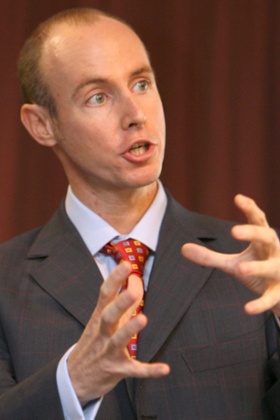
“I agree with the DPP’s view of Europe. They were right in their criticism of the euro”
“Their analysis of the EU was right and they deserve recognition. One should listen to them when they talk about what is going on with the EU.”
Last week, the four right-wing opposition parties in Denmark agreed that if they win the general election today, the country will make changes to its otherwise pro-EU affairs agenda (see 17:21).
Instead, a new blue bloc right-wing government will support British prime minister David Cameron’s call for EU reform, particularly on migration and ‘benefits tourism’.
Richard Milne of the FT has tweeted how significant the exit polls appear to be for the Danish right-wing:
DR increasingly calling this as a centre-right victory in Denmark with Danish People's Party in 2nd pic.twitter.com/1uG1YCrdxg
— Richard Milne (@rmilneNordic) June 18, 2015
Lars Eriksen provides this analysis of broadcaster TV2’s exit poll (see 19:31):
It shows a much clearer lead for the centre-right blue bloc, putting them on 90 seats, versus 85 for the centre-left. That would mean a win for the opposition – no matter how results go in Greenland and the Faroe Islands.
Here’s our video of Danish prime minister Helle Thorning-Schmidt, casting her vote on the day polls remain tight:
With DR exit polls now showing that turnout was 85.7% with 3.5 million people voting, the Social Democrats (A) appears to have a 1.9% increase in share of votes.
The main opposition Venstre (V) appears to have dropped 6.3% share of votes.
In contrast, the right-wing Danish People’s Party (O) appear to have an increase of 9.6%.
Exit poll projection of the vote share will continue to shift throughout the night:
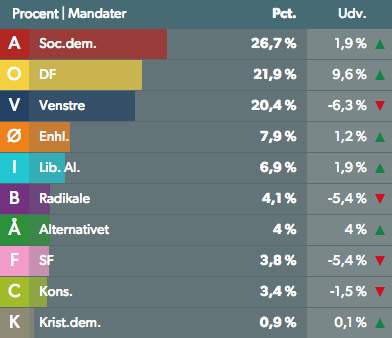
Kristian Thulesen Dahl the DPP leader, arrived at his group headquarters at Christiansborg to thunderous applause and the tune of You’ll Never Walk Alone, reports Lars Eriksen.
Dahl sang the chorus of the Liverpool FC anthem before addressing the crowd:
This day is fantastic day of celebration. We have fought hard to get to this day when the Danes can cast their vote and decide how much influence we will have on the agenda for the next three or four years.
The Danish people’s party is becoming the real people’s party which we have fought so many years for ... We are a party that needs to be taken seriously in this country.
Updated
Our reporter Lars Eriksen has sent this report from the ground:
A restrained cheer went up in the room where the Social Democrats had gathered, as the two exit polls were announced simultaneously on big screens.
The finance minister, Bjarne Corydon, was crowded by TV crews and reporters: “It looks like what we have been seeing in the polls for almost three weeks so I think everybody should prepare for a long night ahead,” he said.
“And I’m happy that it looks like my party once again will be the biggest in Folketinget.”
Meanwhile, Morten Messerschmidt, the MEP for the Danish People’s party, said when asked whether his party would be prepared to join a new government: “Talking about forming government is premature.”
“What we aim for is maximum influence.”
Here are some reactions on the exit poll:
If distribution of Danish seats is so tight, outcome could be decided by the 4 seats from Greenland and the Faroe Is. http://t.co/ZqGRSJtg7e
— Alberto Nardelli (@AlbertoNardelli) June 18, 2015
Danish election night tonight. Exit poll is unwittingly funny. 😂 Fåck. #dkpol #fv15 #ValgAmok pic.twitter.com/N54G9npNoX
— Michael Flarup (@flarup) June 18, 2015
The ice is melting at the Exitpolls #fv15
— Thomas Woldiderich (@Digital_Agenda) June 18, 2015
First Danish exit polls report 87 to the Red (Left) and 88 to the Blue (Right) ... Nail biting finish... #dkpol Please God not #LarsLokke
— Sony Kapoor (@SonyKapoor) June 18, 2015
TV2 exit poll
An exit poll by Danish broadcaster TV2 shows prime minister Helle Thorning-Schmidt’s governing coalition and the centre-right opposition in a dead heat in the country’s parliamentary election.
The poll results gave the opposition 88 seats, and 87 for the centre-left government.
Her er mandatfordelingen fra den første måling. Hvis Thorning får sine tre støtter i Nordatlanten, så vinder hun pic.twitter.com/5ZVieo2SDe
— TV 2 NEWS (@tv2newsdk) June 18, 2015
Updated
Exit poll seat projection
In the exit poll by DR.DK it appears that the seats could look like this:
Red bloc
- The Social Democrats (A) – 45
- Radikale, the Danish Social Liberal party (B) – 9
- Socialist People’s party (F) – 9
- Red-Green Alliance (Ø) – 14
- The Alternative (Å) –9
Blue bloc:
- Venstre (V) – 36
- Danish People’s party (O) – 33
- The Liberal Alliance (I) – 14
- The Conservative People’s party (C) – 6
- The Christian Democrats (K) – 0
Updated
According to the exit poll:
Social Democrats would be the largest party with 25.7% of the vote.
However the centre-right bloc would have the most seats if the results confirm the exit poll, with Venstre taking 20% of the seats and the rightwing People’s party 18.5%.
As a reminder, the main parties in the red bloc are:
- The Social Democrats (A), led by the incumbent prime minister, Helle Thorning-Schmidt.
- Radikale, the Danish Social Liberal party (B). Leader: Morten Østergaard.
- The leftwing Socialist People’s party (F). Leader: Pia Olsen Dyhr.
- The socialist Red-Green Alliance (Ø).
- The Alternative (Å), a green party founded in 2013.
And in the blue bloc:
- The centre-right Venstre (V), currently the main opposition party. Led by Lars Løkke Rasmussen.
- The rightwing Danish People’s party (O). Leader: Kristian Thulesen Dahl.
- The Liberal Alliance (I). Leader: Anders Samuelsen.
- The Conservative People’s party (C). Leader: Søren Pape Poulsen.
- The Christian Democrats (K). Leader: Stig Grenov.
Updated
Exit polls: neck and neck
It is just an exit poll, so treat with caution, but:
Blue bloc appears to edge just ahead with 89 seats
Red bloc appears to have 86 seats
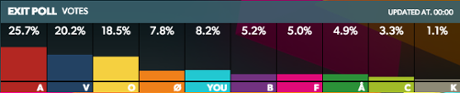
Updated
Our correspondent in Copenhagen has sent this dispatch:
I’ve just been outside in Christiansborg Palace Square where it was quite the festival atmosphere. A group of Socialist People’s party supporters were singing next to a sea of coloured balloons, while a food stall sold valgflæsk, or election pork. This is a traditional Danish election night supper of fried pork belly, potatoes and parsley sauce – which is proving quite popular with the hungry political reporters.
Valgflæsk -fried pork belly with potatoes and parsley sauce - is the traditional election night supper in Denmark. pic.twitter.com/dMqk8fwdnE
— Lars H Eriksen (@larshinnerskov) June 18, 2015
Danes are soaking up election fever. Here are some tweets in the few hours before polls close:
Two hours untill the polls close in #Denmark - the exitement can be felt in #Copenhagen ! #dkpol | #Borgen pic.twitter.com/xhzuOczRdR
— Anders Adamsen (@anderspreben) June 18, 2015
Meghan offers her thoughts on the issues that have been raised during the election:
The Danish People's party is now terrifyingly massive. The anti-immigrant & refugee rhetoric has eclipsed the entire election. #fv15 #dkpol
— Meghan Kathryn (@megsDK) June 18, 2015
Jack, who says he is a Scottish journalist in Denmark, has tweeted this:
Danish election today. If you believe the tabloids, it's a choice between the plague or cholera. #dkpol #valg2015 pic.twitter.com/Rljvxs0C8Y
— Jack Cairns (@JackCairns_) June 18, 2015
Updated
We’ll learn the exit polls at 7pm (BST) or 8pm local time.
In the meantime Twittprognosis has shared this handy Gallup poll, conducted before voting began:
Denmark: Latest poll before election #fv15 (Gallup). Change of government expected. #dkpol #tv2valg pic.twitter.com/MxI78gVQHf
— twittprognosis/eu (@twittprognosis) June 17, 2015
Updated
Lars Eriksen has sent in this report:
Voting is still underway here until 8pm local time, including at a school in Frederiksberg where reporters are waiting for the leader of the Alternative party, Uffe Elbæk, to turn up and cast his vote.
I caught up with him at a nearby cafe before he cycled off to the voting station. There were no high-fives but plenty of well wishers:
Updated
Denmark’s green The Alternative party could be significant in the centre-left blue bloc. They are the organic, meat-free party who are poised for breakthrough and led by Uffe Elbæk.
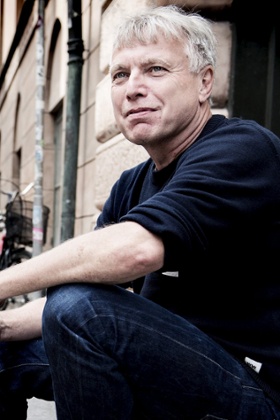
A member of the Folketing since 2011 and initially a member of the Danish Social Liberal party, Elbæk co-founded The Alternative in November 2013.
According to the party’s website, its core values include courage, generosity, transparency, humility, humour and empathy.
In its manifesto the party states that “The Alternative is a positive countermeasure” and a “shout out.”
According to Martin Krasnik, a TV anchor for national broadcaster Danmark’s Radio, personality has never before played such a crucial role in Danish elections, something which he says has generated fertile ground for new political parties, including The Alternative.
Updated
Thanks to Denmark’s proportional representation system, the DPP is likely to be a key pillar in a coalition led by the right-of-centre Liberal party, which could boost David Cameron’s campaign to renegotiate European Union membership terms.
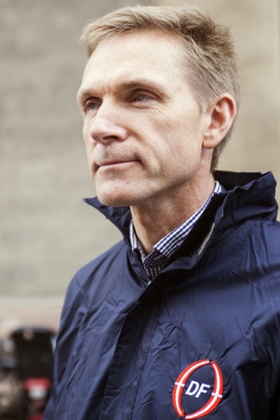
So who is Kristian Thulesen Dahl, the party’s leader?
Dahl, who was born July 30, 1969, has been a member of the Folketing (Danish parliament) since 1994 and became the Danish People’s party leader in 2012. He was among the party’s founders and is a member of its executive committee. Married with three children, Dahl previously graduated from Aalborg University in 1995.
In an interview two years ago he said Denmark should accept more refugees coming from non-Muslim countries and fewer from Muslim countries. In the same interview, though he declared himself a supporter of freedom of religion, he said he believes there is no room in Denmark for more people with a Muslim background.
Updated
From handing out red roses to filing into school halls – here are some of the photo highlights from the last 24 hours:


Updated
Our reporter on the ground, Lars Hinnerskov Eriksen, has filed this report:
On a grey, cloudy morning in Copenhagen, there was applause inside the city hall building as the ceremonial bell rang at 9am local time to mark that voting had begun in Denmark’s general election. A few miles away at Islands Brygge school, 56-year-old Claus Kjær said he had cast his vote for Helle Thorning-Schmidt’s Social Democrats: “I think the prime minister has stature, she is skilful and we can be proud that she represents us abroad,” he said.
Shortly after 11am, Thorning-Schmidt, along with her husband, the British Labour MP Stephen Kinnock, went to Kildevælds school to vote. A throng of reporters and photographers followed her every move, before she found some privacy behind the blue curtains sealing off the voting booth.
Both Thorning-Schmidt and her opponent, the Liberal leader Lars Løkke Rasmussen, had campaigned since early morning at Copenhagen’s central station, where the two main parties tried to swing the vote by handing out roses, flags and bags with breakfast rolls. A few hundred metres away, Uffe Elbæk, the leader of the environmentalist Alternative party, which looks to set to be one of the big success stories of the election, was handing out high fives to cyclists.
Cardboard cutouts of the cast for this evening's real-life Borgen drama pic.twitter.com/RJbSQh32Jm
— Lars H Eriksen (@larshinnerskov) June 18, 2015
Danish broadcasters will not release any exit polls until 8pm local time (7pm BST) when voting is over, by which stage we might have a better idea of who is going to take charge of Borgen for the next four years.
Updated
The race to Borgen has been on a knife edge, with the economy, welfare and immigration key issues.
There has been anger directed at perceived benefit tourism. Even the traditionally pro-immigration centre-left Social Democrats launched an advertising campaign with the slogan: “If you come to Denmark you should work.”
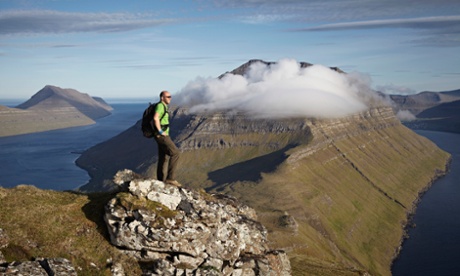
Voters in Greenland and the Faroe Islands may decide the vote: with issues like the Faroes fishing dispute influencing the result. The islands’ fishing community is still angry at Thorning-Schmidt for barring its boats from Danish ports over two years ago in a dispute over alleged overfishing.
Updated
Danish party blocs
Denmark has 10 political parties, but broadly speaking the parties can be divided into two main blocs: a red bloc on the left of the political spectrum, and a blue bloc to the right of centre.
The main parties in the red bloc are:
-
The Social Democrats (A), led by the incumbent prime minister, Helle Thorning-Schmidt.
-
Radikale, the Danish Social Liberal party (B). Leader: Morten Østergaard.
- The leftwing Socialist People’s party (F). Leader: Pia Olsen Dyhr.
- The socialist Red-Green Alliance (Ø).
- The Alternative (Å), a green party founded in 2013.
And in the blue bloc:
- The centre-right Venstre (V), currently the main opposition party. Led by Lars Løkke Rasmussen.
- The rightwing Danish People’s party (O). Leader: Kristian Thulesen Dahl.
- The Liberal Alliance (I). Leader: Anders Samuelsen.
- The Conservative People’s party (C). Leader: Søren Pape Poulsen.
- The Christian Democrats (K). Leader: Stig Grenov.
Profiles: the main political parties
In the red bloc:
Social Democrats (A)

This is the current ruling party, and tends to have centre-left politics. It is led by Prime Minister Helle Thorning-Schmidt.
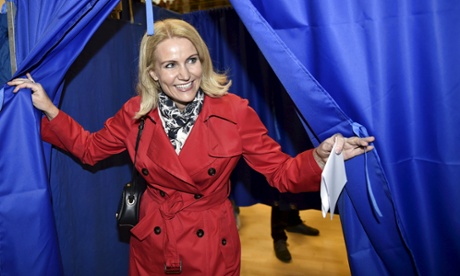
It was founded in in 1871 by Louis Pio, Harald Brix and Poul Geleff. The party’s main policies include plans to increase social spending, including on health, childcare and environment by 39 billion Danish crowns (€5.2bn) by 2020. On asylum, the party has said temporary residence permits should only be given to people who have been personally persecuted.
Radikale (B)

The Danish Social Liberal party is led by economy minister Morten Ostegaard. Radikale is part of the Alliance of Liberals and Democrats in Europe. It is the only party to propose further cuts in unemployment benefits as a way of encouraging people to work. The party wants to switch to green energy alternatives and targets phasing out of coal within 10 years. Its leaders also say they want to increase spending in mental health, education and poverty.
In the blue bloc:
Venstre (V)

The centre-right “liberal party” is led by Lars Løkke Rasmussen, the former prime minister. It is the main opposition party, which wants to set an upper limit for individuals on welfare payments to encourage employment.
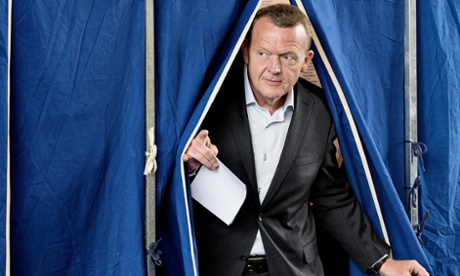
The party also wants a spending cap on the public sector spending, effectively reducing spending increases to less than inflation in an attempt to gradually reduce the tax burden. Venstre has also said that only people from countries with similar cultures and development should have easy access to work.
The Danish People’s party (O)

Led by Kristian Thulesen Dahl, this party is rightwing on political issues, leftwing on the economy, and has supported Venstre when it has governed but has never itself been in coalition. The Danish People’s party wants to follow the UK and renegotiate Denmark’s relationship with the EU then put it to a yes-no referendum. Two of its policies are giving refugees temporary residence permits only and limiting access to benefits for both non-EU and EU migrants. Finally, despite Denmark’s membership of the passport-free Schengen Zone covering most of Europe, the party wants to re-establish land-border controls between Denmark and Germany to reduce what it says is increased crime and smuggling.
Updated
Lars Eriksen, our correspondent in Copenhagen, has some analysis on what the Danish election results could mean for Europe and David Cameron:
In what many saw as a concession to the Eurosceptic Danish People’s party (DPP), the four parties of the rightwing bloc – Venstre, DPP, Conservatives and Liberal Alliance – last week announced their joint support for Cameron’s bid to renegotiate the terms of Britain’s membership of the EU, in particular with regard to welfare benefits for EU migrants.
“We will stand behind Great Britain and like-minded nations’ efforts to ensure that the EU doesn’t turn into a social union,” said the statement, titled Danish Welfare in Europe.
“We want an EU where people can go wherever workers are needed, but we don’t want an EU where people go wherever the social benefits are good,” the Venstre leader, Lars Løkke Rasmussen, said last week.
Updated
What happened in the last election?
No party in Denmark has won an overall majority since since 1903. This means that governments in Denmark tend to be coalitions, often even minority alliances with parliamentary support from other parties.
2011 election results
As demonstrated in the graphic below, at the last election, Venstre won the most votes (26.7%) and seats (47).
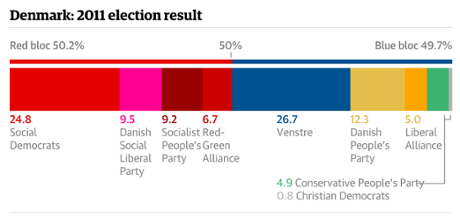
However, the incumbent centre-right coalition lost power to the centre-left because the red bloc emerged as the larger of the two groups in parliament. It won 50.2% of the Danish vote, which translated into 89 seats against the blue bloc’s 86.
It’ll be a close race this time around too.
Afternoon briefing
Hello and welcome to our Danish elections results liveblog. I am Aisha Gani and I’ll be taking you through the exit polls and results as they come through this evening.
Danes have headed to the polls today to determine whether the centre-left government of Prime Minister Helle Thorning-Schmidt will continue, or whether the centre-right opposition party – led by Lars Løkke Rasmussen – will return to helm.
Some 4.1 million Danes are eligible to vote and can take their pick from 10 parties. There are 799 candidates in total, including 16 independents.
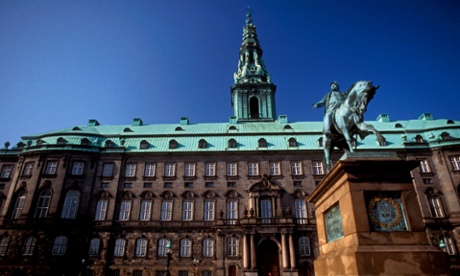
A total of 179 lawmakers will be elected: 175 in Denmark, two in the Faroe Islands and two in Greenland, which are semi-autonomous Danish territories. The politicians sit in Christiansborg Palace, also known as Borgen (“the castle”).
Both Thorning-Schmidt’s Social Democrats and opposition leader Lars Løkke Rasmussen’s Venstre depend on other parties to build a majority in the 179-seat Folketing, or parliament.
Ahead of the vote, polls had showed the red centre-left bloc and blue centre-right bloc neck and neck, with their campaigns focusing on the impact of immigration on the welfare system. Both sides have promised to further tighten Denmark’s controls on immigration.
You can follow me on Twitter, and keep tracks on my colleague Lars Eriksen, who is on the ground in Copenhagen. Please feel free to leave comments or questions below the line, and I’ll include the best ones in the blog.
Updated













