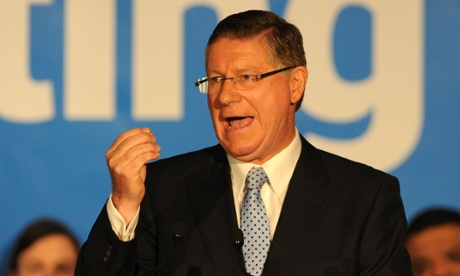
The Victorian premier, Denis Napthine, has not ruled out preferencing a hard-right party, whose fundamentalist Christian leader once blamed bushfires on legalised abortion, above the Greens at this month’s state election.
The state Liberal party leader announced on Wednesday his party would be “putting the Greens last” on its how-to-vote cards in all upper and lower house seats for the 29 November poll. The decision is a major setback to the Greens’ hopes of winning four inner-Melbourne seats and possibly clinching the balance of power in the state.
Napthine said the Greens couldn’t be trusted on issues such as jobs, infrastructure and the economy.
“The Greens simply don’t understand that a strong economy is the key to a better Victoria for all Victorian families,” he said. “The Greens will threaten the future of our strong economy. They will destroy jobs and put Victorian families at risk.”
Asked if that meant the Rise Up Australia party, led by firebrand preacher Danny Nalliah, could receive Liberal preferences ahead of the Greens, Napthine said: “We’ve got to see where they’ve got candidates.”
“We reserve the right, if there’s an extremist candidate who is perhaps a racist candidate, that they would not be above the Greens,” he said.
Nalliah caused uproar in 2009 after suggesting the Black Saturday bushfires, in which 173 Victorians died, were the result of the state losing God’s “conditional protection” after it formally legalised abortion.
Last week Labor also ruled out making any deals with the Greens in the event of minority government.
A similar decision by the Victorian Liberals to preference Labor above the Greens in 2010 effectively killed off the minor party’s chance of winning the inner-city seats of Brunswick, Richmond, Melbourne and Northcote. Liberal preferences allowed Labor’s candidate in Brunswick, Jane Garrett, to hang onto her seat despite suffering a nearly 12% swing.
But the Victorian Greens leader, Greg Barber, shrugged off the preference decision. “We know from experience that 60% of Liberals in the inner city ignore the how-to-vote cards because they’re desperate to see some action on climate change,” he said.
“Adam Bandt [the Greens member for the federal seat of Melbourne] got elected when Liberal voters ignored their party’s how-to-vote cards and preferenced the Greens second,” Barber said.
A Lonergan poll last week found the Greens on track to win Melbourne and Richmond for the first time. The Greens candidate in Melbourne, former young environmentalist of the year Ellen Sandell, said her Labor opponent, Jennifer Kanis, was now the seat’s “Liberal-endorsed candidate”.
She said if the Greens secured the balance of power they would use it to block the controversial $18bn East West Link road project that will see homes in the city’s inner-north torn up.
“We’ve been very clear that we won’t support the East-West toll road, and we’ll require action on climate change if we’re supporting the government,” Sandell said.
When a Greens-Liberal preference deal was in place in 2006, three-quarters of Liberal votes flowed to the Greens in the four inner-city seats in question, according to ABC election analyst Antony Green. Four years later, in the absence of such a deal, those same votes went 67% to Labor, he said.
Meanwhile a Fairfax-Ipsos poll, also released on Wednesday, found the prime minister, Tony Abbott, was a significant drag on his Victorian counterparts, with 23% of those polled saying the federal leader’s performance made them less likely to vote for Napthine.