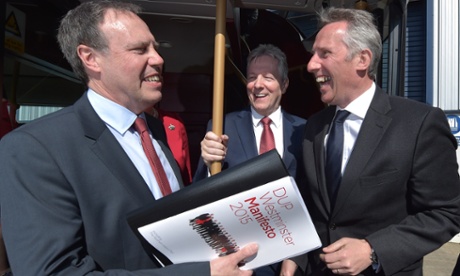
The Democratic Unionists say they would place the renewal of the BBC charter on the table in talks with Labour or the Tories in a hung parliament, after accusing the corporation of distorting UK politics in its handling of the television election debates.
Nigel Dodds, the leader of the Northern Irish party at Westminster who was furious at the DUP’s exclusion from the debates, believes the future of the BBC should be decided by a royal commission rather than the traditional deal negotiated between ministers and the corporation.
The DUP gave a taste of its demands in possible hung parliament negotiations after Dodds entered the wider UK general election campaign by raising concerns about the Tories’ handling of Scotland. In a Guardian article Dodds warned that the Tories risk “abusing” the House of Commons by trying to boost their vote in England by giving English MPs a veto over some legislation.
Labour and the Tories, which both hope to woo the DUP in a hung parliament, were shown the challenge of dealing with a highly socially conservative party when the DUP’s health minister in Northern Ireland’s power-sharing executive resigned over allegedly homophobic remarks. Jim Wells stepped down on Monday after saying that a child brought up by gay men “is far more likely to be abused and neglected”.
His resignation highlights one of the major problems that Ed Miliband or David Cameron would face if they chose to form a minority government backed by DUP votes in the Commons. The party hopes to win at least nine seats, potentially allowing the party to act as kingmaker if the two main parties fall a long way short of forming a majority.
The comments by Wells expose the deep strain of evangelical Christian hostility towards gay people from within the DUP, drawing accusations from the likes of the Liberal Democrats that it is not fit to determine the shape of the next government. Nick Clegg said Wells’s comments showed that the DUP “mask had slipped”.
Dodds will attempt to move on from the Wells resignation on Tuesday when he attacks the BBC over its handling of the television debates, signalling that the DUP is focused on possible hung parliament negotiations.
The BBC and ITV declined to invite the DUP on the grounds that they would be failing in their duty of impartiality if they invited only one of the five main parties in Northern Ireland to a UK-wide debate. The broadcasters also said that voters in Northern Ireland, which is part of the UK but not part of Great Britain, have a different set of priorities to those in the rest of the UK. The Conservatives are the only party among the three main Westminster parties to field candidates in Northern Ireland.
But Dodds will accuse the BBC of creating a surge in support for Nicola Sturgeon. He will say: “The decision of the broadcasters, led principally by the BBC, to invent a format for the UK-wide television debates that included the SNP has had entirely predictable results. Last time, a Clegg bubble was created by the TV debates. This time, a Sturgeon surge has been the consequence. The SNP are entitled to fair coverage by the national media: they did not require utterly disproportionate coverage for reasons the BBC still hasn’t fully explained.
“My party believes that pro-union politicians from all parties must behave responsibly in the next parliament when it comes to addressing the challenge posed by the SNP. One key thing we need to do is ensure the BBC does not exert such a distorting influence on British politics in this way again.”
Dodds would like to see the charter renewal process referred to a royal commission to ensure that the DUP is guaranteed fair treatment by the BBC. The DUP believes that the BBC failed to deliver on commitments to ensure the party would feature more prominently in network news programmes. He believes that David Elstein, the former chief executive of Channel 5 who called for the BBC Trust to be abolished and for its news and current affairs division to be broken up after the Jimmy Savile enquiry, would be a suitable chairman of the royal commission.
BBC sources pointed out that the corporation ran a special Newsnight programme from Northern Ireland, which featured the DUP, after the challengers’ debate on 16 April. A BBC source said: “We will always deal with any complaint from whatever party fairly. But we would not allow a debate over the charter or the licence fee to get in the way of doing our job for the public, which is reporting on the election in a fair and balanced way.”