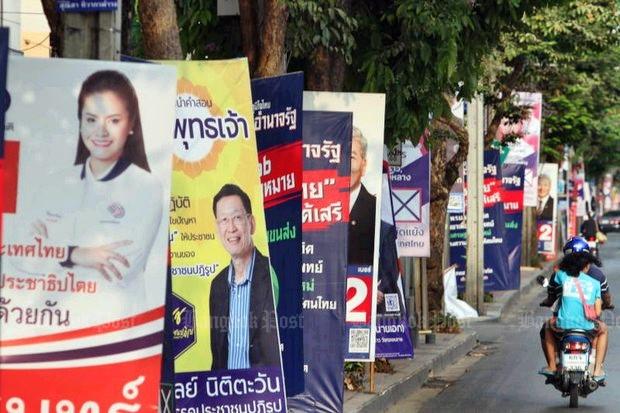
Thailand’s road to democracy is of universal interest for two reasons. First, the country is in the process of creating and testing new structures for a democratic government. Second, the kingdom explicitly calls for moderation and immunity in its endorsement of the Sufficiency Economy Philosophy (SEP).
Linking the SEP to democratisation gives even pessimists hope sustainability can be achieved -- not only in Thailand, but everywhere.
Democratisation requires ongoing social learning about the ways in which large societies can make decisions, not only to enable people to get along with each other, but also decisions that are in, what planners call, “the public interest”.

Peter Boothroyd is Professor Emeritus, University of British Columbia.
Today, the public interest is, for reasons given by natural scientists, to achieve ecological sustainability. More specifically, for reasons given by social scientists and spiritual leaders, it is to achieve socially just sustainability.
Sustainability needs to be established democratically. Although for a short time, reductions in consumption can be autocratically imposed, in the long run, over-consuming cheaters will not be stopped unless most people accept and agree on the need for moderation. In the absence of democratically agreed upon sustainability rules, there will be a vicious spiral of selfinterest and thus unsustainable consumption.
Democracy is not sufficient to produce sustainability. To be sufficient, democracy (namely, the people who make decisions, including decisions about who should be selected as representatives, and how) must be informed by the kind of thinking that the SEP provides.
People must be willing not only to reduce their individual private consumption; they must also be willing to promote and vote for the public interest, and they must be knowledgeable about what it is. If, as most scientists argue, carrying capacity has been reached, then sustainability requires voters to favour people and policies promoting moderation and immunity. Home owners, for example, need to vote for zoning and housing policies that serve the greater good -- not to protect their investments and privacy. Some policies in the public interest will likely cost home owners financially and (for example, in terms of privacy) socially.
Votes lead to structures that feed back to reinforce voters’ attitudes. For example, votes for representatives who support automobile-dependency in cities promote a more favourable attitude toward cars from voters as expressways are expanded and public transit alternatives cut back.
Alternatively, votes motivated by pro-sustainability attitudes can result in improved public transit (less crowded, more frequent/reliable/ extensive), which makes transit-riding easier. This in turn generates more voter support for it.
Voting for the public interest, even if considered by some a democratic ideal, has not commonly been a democratic reality. In today’s circumstances, however, when sustainability is widely seen as both desirable and problematic, voting for the public interest needs to become a reality as well as an ideal. The SEP helps to motivate such voting: it promotes good citizenship. The SEP enhances prospects for democratic sustainability by encouraging sustainability-favouring attitudes. It also enhances prospects for sustainable democracy by encouraging votes and structures that prevent scapegoating, inequality and system failure. By encouraging democratic attention to the public interest, the SEP provides a sustainable basis for achieving security while maximising opportunities for reasonable choice.
Today, environmental limitations are top-of-the-mind for many people. At the same time, they compete for attention with continuing social problems such as poverty and violence, and with new problems related to migration and aging.
The global reach of social problems and their environmental links has led the United Nations to adopt, unanimously, 17 sustainable development goals (SDGs). Unfortunately, these are not only breathtakingly ambitious, for example, calling for poverty to be ended by 2030. They are also explicitly predicated on the dubious ecological assumption that they can be met “by a world in which every country enjoys sustained, inclusive and sustainable economic growth”. Such a world would promise already-rich countries they can continue consumption growth even as global carrying capacity is exceeded.
The idea that we should try to solve social problems such as poverty by growing our way out of them continues to be based on a willingness to remain dependent on economic growth. However, as the SEP points out, dependency reduces resilience. Whenever and wherever continued reliance on growth is assumed, social disaster results if growth significantly declines for any reason -- structural, sociological, political or ecological.
By definition, dependency diminishes human capacity to choose and plan. It is more human, and safer, to work on social problems directly rather than relying on growth to take care of them. Growth as a social goal need not be abandoned. But it should be approached rationally as one of many social goals. A likely result would be that we come to see GDP growth as a bonus earned for diligence and creativity rather than as an inevitable outcome upon which we depend. (If we find ways to continue economic growth at the same time as we redistribute, then we can always find ways to use any extra wealth generated.)
Another likely result would be that impacts of growth alternatives will be systematically assessed: we will stop making the dubious assumption that the benefits of growth inevitably trickle down to the most materially deprived.
The SEP provides a spiritual, cultural and social basis not only for sustainable economic development, but also for the democracy on which such development depends. It encourages people to think about the public interest whenever they act -- including when they vote.