
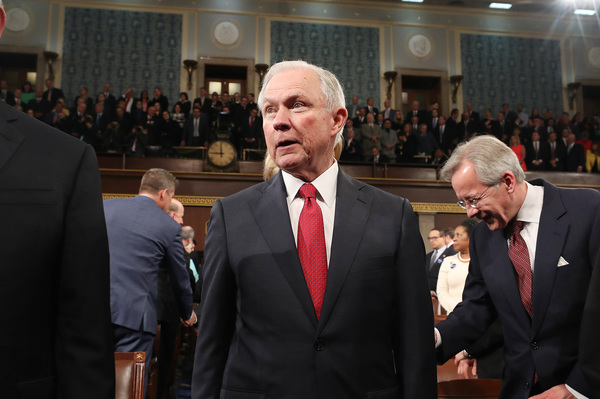
WASHINGTON _ Attorney General Jeff Sessions, under rapidly mounting pressure from Republican members of Congress, indicated Thursday that he would be open to stepping aside from any role in the investigation of Russian involvement in the presidential election.
Sessions quickly came under fire after reports late Wednesday that he had met with Russia's ambassador to the U.S. last year, which appeared to contradict a statement Sessions made in his confirmation hearing to be attorney general.
In the hearing, Sessions said flatly: "I did not have communications with the Russians." In statements late Wednesday and early Thursday morning, he added significant caveats to that denial, saying he had not met with Russian officials to discuss campaign issues.
"I have not met with any Russians at any time to discuss any political campaigns," Sessions told MSNBC as he left his Washington home Thursday. "Those remarks are unbelievable to me and false."
But Republicans started to move away from Sessions, with two House GOP leaders calling for him to recuse himself from any investigation into Russian interference in the election, as Democrats demanded he resign altogether.
The FBI and other U.S. law enforcement agencies have been looking into whether people associated with the Trump campaign may have had contacts with Russian officials during the election year. Sessions, as attorney general, oversees the FBI.
Sessions met in his Senate office with Russian Ambassador Sergey Kislyak in September, Justice Department officials confirmed. He also met briefly with Kislyak after a speech in the summer at the conservative Heritage Foundation in Washington.
At his Senate confirmation hearings in January, however, Sessions did not disclose those meetings. When asked by Sen. Al Franken, D-Minn., whether anyone on the Trump campaign had contacts with Russian government officials, Sessions said he was "unaware of those activities."
"I have been called a surrogate at a time or two in that campaign," he said, "and I didn't have, did not have communications with the Russians, and I'm unable to comment on it."
He also denied it in a written questionnaire, responding to a question from Sen. Patrick Leahy, D-Vt., about whether Sessions "had been in contact with anyone connected to any part of the Russian government about the 2016 election, either before or after election day."
Sessions replied, "No."
Justice Department officials aggressively defended Sessions, categorizing his meeting with the ambassador in his Senate office in his capacity as a member of the Armed Services Committee. They discussed relations between the two countries, but did not delve into the campaign, the officials said.
"There was absolutely nothing misleading about his answer," said spokeswoman Sarah Isgur Flores, adding that the former senator routinely met with representatives of foreign governments. "He was asked during the hearing about communications between Russia and the Trump campaign _ not about meetings he took as a senator and a member of the Armed Services Committee."
But top Republicans nonetheless began calling for him to recuse himself from any role in the investigation of potential contacts between the Trump campaign and Russian officials.
"I think (for) the trust of the American people, you recuse yourself in these situations," House Majority Leader Kevin McCarthy, R-Calif., said Thursday on MSNBC's "Morning Joe."
McCarthy's remarks made him the highest-ranking member of his party to say that Sessions should step aside from the investigation. His comments highlighted the growing unease in Congress over the Trump administration's ties to Russia.
Top Democrats, including House Minority Leader Nancy Pelosi of California, said Sessions had perjured himself and must resign.
Republicans did not go that far, but several influential members of the party said Sessions should play no role in the Russia investigation.
McCarthy, in the "Morning Joe" interview, said that while he did not want to "prejudge" the situation, "for any investigation going forward, you want to make sure everybody trusts the investigation."
Obtaining that trust "would be easier" if Sessions recused himself, McCarthy said. Recusal is the legal term for an official stepping aside from any role in a specific matter.
Rep. Jason Chaffetz, R-Utah, chairman of the House Oversight Committee, tweeted Thursday that Sessions "should clarify his testimony and recuse himself."
Many lawmakers want an independent commission or special prosecutor to investigate Russian involvement in the campaign and the question of whether anyone close to President Donald Trump was involved.
The House and Senate Intelligence Committees are conducting separate investigations. Republican leaders in Congress have resisted efforts to broaden the investigation or create a special panel, preferring to keep the investigations more closely held in the intelligence committees.
Even Texas GOP Sen. Ted Cruz, while dismissing calls for the attorney general to step aside as "political theater," declined to say he was confident Sessions could lead the probe.
"His answer at the hearing could have been more clear," Cruz said.
Other senators said they were monitoring the situation.
Sen. Jim Risch, R-Idaho, who serves on the Intelligence Committee, said he did not believe Sessions misled senators in his testimony. "Not at all."
A spokeswoman for Sessions downplayed the meetings he had with Kislyak as routine business that he had conducted in his capacity as a senator and a member of the Senate Armed Services Committee, not related to his role as the main senator backing Trump's bid for president.
Pelosi, however, accused Sessions of having lied under oath.
"Attorney General Sessions has never had the credibility to oversee the FBI investigation of senior Trump officials' ties to the Russians. That is why Democrats have consistently called for Sessions to recuse himself from any oversight of the investigation," Pelosi said.
"Now, after lying under oath to Congress about his own communications with the Russians, the attorney general must resign," she said.
The U.S. intelligence community issued a report in January, shortly before Trump took office, saying that the Russian government was seeking to harm Hillary Clinton's campaign in the hopes of boosting Trump's chances.
The Russians targeted the Democratic National Committee and a top Clinton campaign official, stole emails and leaked them, officials have said.
Sessions is the second top Trump administration official to come under fire for his discussions with the Russian ambassador.
Former national security adviser Michael Flynn resigned after he admitted misleading Vice President Mike Pence about the nature of his contacts with Kislyak.
Flynn spoke to Kislyak shortly after the Obama administration levied sanctions against Moscow in December after concluding it had interfered in the election. Flynn initially denied discussing the sanctions, and Pence repeated those assurances on national television. Later, Flynn admitted he had indeed discussed the matter with Kislyak, triggering his resignation just three weeks into Trump's presidency.





._Patrick_s_Day_Parade_94380.jpg?w=600)



