As seen across companies' second quarter results, the coronavirus outbreak has been a scourge for some and a profit blessing for others.
The latter group achieved high profit growth on the back of increased consumption from those staying at home and the expansion of teleworking. Believing that this tailwind may not be temporary, some companies have boldly decided to increase production.
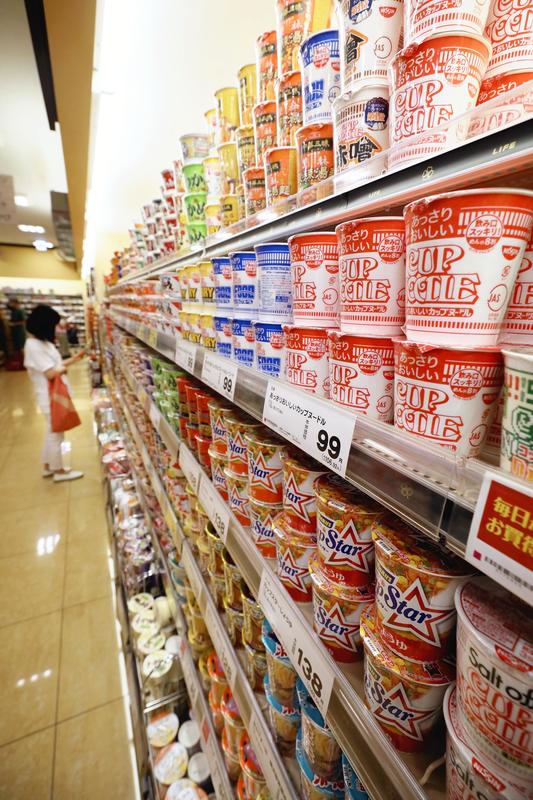
Nissin Foods Holdings Co. recently posted its highest-ever second-quarter net profit -- 12 billion yen -- nearly twice as much as the same period last year. With more people staying at home, instant noodles and other products have sold well.
At supermarket chain Life Corp., year-on-year sales of instant noodles rose 70% in April and 45% in May. The unexpected rush on supplies led the company to restrict purchases of instant noodles to one per family for a while.
Snack maker Natori Corp.'s net profit increased by 80% from a year earlier. Because most bars and restaurants were prompted to close temporarily as the outbreak spiked, consumers suddenly had more opportunities to drink at home. With that, sales increased for snacks such as Cheese-Tara, or cheese sandwiched between cod sheets.
Online flea market operator Mercari Inc. posted its first quarterly operating profit growth since it became listed in 2018. Fumiaki Koizumi, the chairman of the company, said, "With people staying at home more, the number of new sellers increased."
Many people around the world seem to have spent their stay-at-home time playing video games. Square Enix Co., which owns popular video game franchises such as "Final Fantasy" and "Dragon Quest" saw a 3.5-fold increase in net profit. "Thanks to the growth in the digital department dealing in software programs to be downloaded and other products, our rate of profitability has improved," an official of the company said at a press conference.
Nintendo Co.'s video game "Animal Crossing: New Horizons" became a smash hit, and the company posted a record high second-quarter operating profit. For Capcom Co., its new "Resident Evil" offering has sold well, more than doubling sales from last year, giving the company a 40% boost to net profit.
-- Higher quality
Backed by an increasing number of people working from home, sales of laptop PCs and office furniture have also been strong. Since many people want to create a better working environment at home and increase work efficiency, higher quality products have become popular.
Net profit at consumer electronics retailer Yamada-Denki Co. grew 3.4-fold, while that for K's Holdings Corp. nearly doubled. Amid the stay-at-home requests, consumers refrained from bargain-hunting visits to multiple stores, which helped ease price competition, according to K's Holdings President Tadashi Hiramoto.
Sharp Corp., which produces cooking appliances and air purifiers, forecasts that its net profit for the year ending March 2021 will grow 2.4-fold year on year.
Home furnishings seller Nitori Holdings Co. saw its net profit grow 25.4% in March to May. In addition to sales of desks and chairs for teleworking, storage organizers and kitchen tools were in high demand due to the increased time spent at home.
-- Eyeing further expansion of infection
Given the recent increase in the number of coronavirus infection cases, the outbreak shows no sign of ending, and sanitary supplies are likely to continue to be in high demand.
Daio Paper Corp. posted a record high second-quarter net profit. While the company's income fell due to the declined demand for printing paper as a result of the expansion of teleworking and the closure of schools, paper towels, wet tissues have sold well, which led to the high growth of profit.
Lion Corp. posted a 2.1-fold net profit growth in its half-year results in June. Along with strong sales of hand cleansers and antiseptic solutions, sales of kitchen detergents also increased because people refrained from going out and ate more at home. At a press conference on Aug. 5, Lion President Masazumi Kikukawa said the company would increase its production capacity believing that the strong demand for sanitary articles would continue for a while.
Read more from The Japan News at https://japannews.yomiuri.co.jp/