With international events such as the Rugby World Cup, the Group of 20 summit, and a series of ministerial-level meetings held at various places in the nation last year, the importance of ensuring adequate security has once again become clear.
In preparation for the Tokyo Olympic and Paralympic Games slated for this summer, demand for drones and security robots has grown. The many spectators from both home and abroad will be unknowingly protected by an upgraded security system.
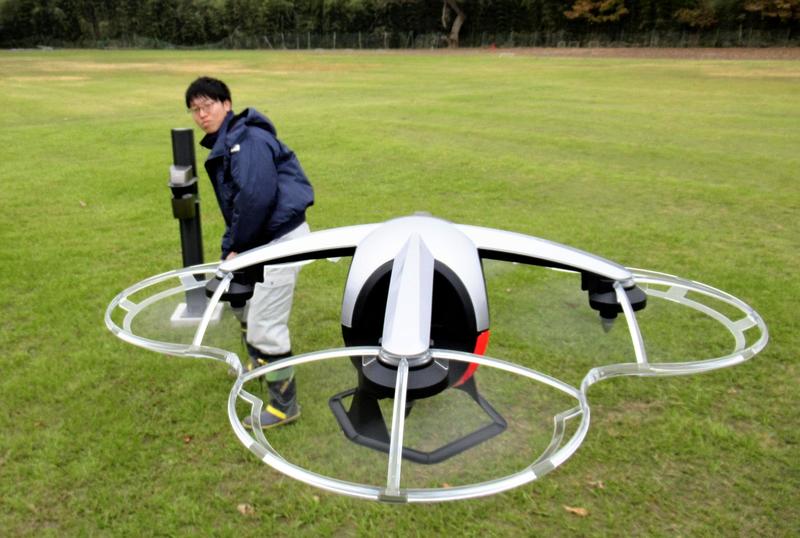
Secom Co., a major security company, tested its security service in December using a drone in a field in Saitama Prefecture. Roaring like a swarm of wasps, the drone, measuring about 60 centimeters square, relentlessly pursued a "fugitive" -- illuminating him with a searchlight and recording his appearance with a camera.
Secom launched their drone security service in 2015. At that time, when an infrared sensor installed on a subscriber's premises detected a suspicious person, a fully automated drone saved an image of the person and their car's registration number, and sent the information to the security center.
The next-generation machine, which is scheduled to be put into practical use in fiscal 2021, will use artificial intelligence and preregistered information to identify people and cars.
"We'll improve the safety of drone flights, and implement security measures that fit with the times," Secom President Ichiro Ozeki said.
However, there are growing concerns that drones -- which are readily available online and at mass electronics retailers -- could also be used in terrorist attacks.
There also is an urgent need to take measures to prevent drone intrusion. Secom now provides customers with a system that will detect drone intrusions using radar and microphones to continue bolstering current security levels.
Robots boost 'manpower'
The security industry is facing a labor shortage ahead of the Tokyo Games as security firms will have to guard many venues in addition to their regular duties.
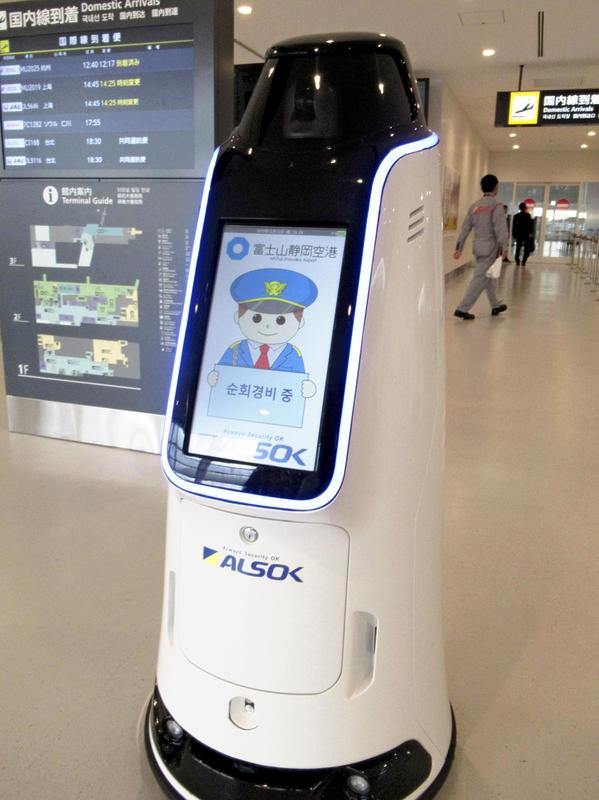
Security robots are now being seen as an attractive solution for labor shortage. A self-piloting cylindrical robot as tall as an average adult has been making the rounds at Mt. Fuji Shizuoka Airport in Makinohara, Shizuoka Prefecture, since September.
The security robot, developed by Sohgo Security Service Co. (ALSOK), works as a guide using four languages -- Japanese, English, Chinese, and Korean -- providing visitors with building information. For example, it might recommend a restaurant with a fine view that is located on the third floor.
It also monitors the area with its onboard camera that rotates 360 degrees, sending images immediately to the security office.
Customers can customize their robot by adding their preferred functions such as an automated external defibrillator (AED), fire detection, a fire extinguisher and poison gas detection.
The robot also is able to find suspicious people whose information is registered in advance. "It acts as a deterrent against crime while helping us to save manpower," said Shigeaki Fukushima, an official of the airport's operation department.
Lights, camera, safety
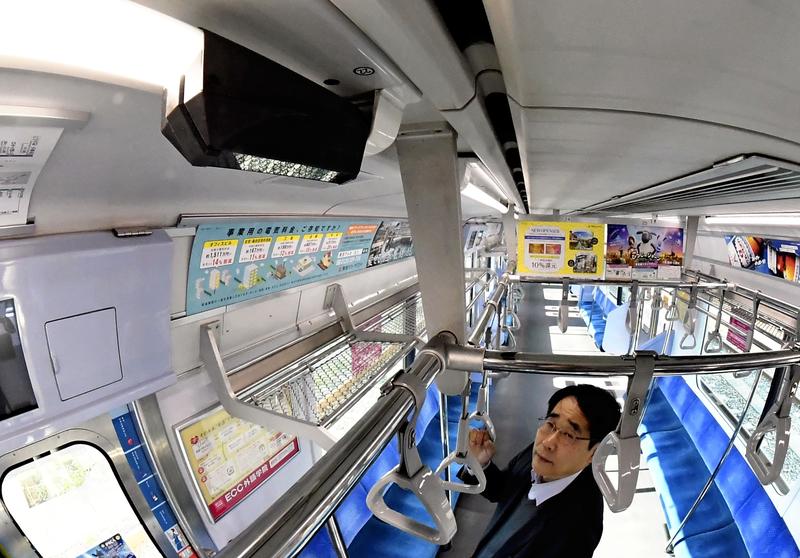
Security cameras installed in the lighting of trains is becoming widespread in Tokyo as an added security measure.
"An old car -- even if it is 45 years old -- can be turned into a car with a security camera," said Akira Kimura, 53, an official of Tokyu Corp, one of the railway operators in Tokyo metropolitan area.
It takes only 15 seconds to attach the fluorescent lights which functions as a security camera and a data transmission device, to the ceiling of each car. The light sends the recorded images to operation centers located elsewhere.
The company will install the new fluorescent lights, called IoTube, in all of its 1,257 cars before the Tokyo Olympic Games start. The light can be installed without removing the wall and ceiling panels, and the most attractive point of the light is the low cost, the company said.
The company is expecting the new technology to not only be effective in the prevention of crimes such as pickpocketing and luggage theft but also in the real-time gathering of information on violence and other passenger incidents.
Tokyu Corp. President Isao Watanabe, 63, said, "With the use of security cameras, 'proactive security' has also become necessary."
Read more from The Japan News at https://japannews.yomiuri.co.jp/


.png?w=600)