This is the second and final installment of a series.
When Yamato Transport Co. started its TA-Q-BIN door-to-door parcel and luggage delivery service on Jan. 20, 1976, it had little business, only transporting 11 items of cargo on the first day.
Today, the company is a major player in an industry that handles about 4 billion items per year. The foundation for its delivery operations was laid by then Yamato President Masao Ogura (1924-2005), who blazed new trails with his innovative ideas that are now considered industry norms, such as next-day delivery and uniform charges.
Ogura not only transformed TA-Q-BIN into a major service, but also aggressively pressed regulatory authorities to revamp mail and transportation regulations.
The logistics industry is now considering the introduction of small drones and self-driving vehicles to address labor shortages. However, many in the industry are still deeply dissatisfied with the plethora of regulations that they see as impeding the adoption of advanced technologies.
Buses and trains
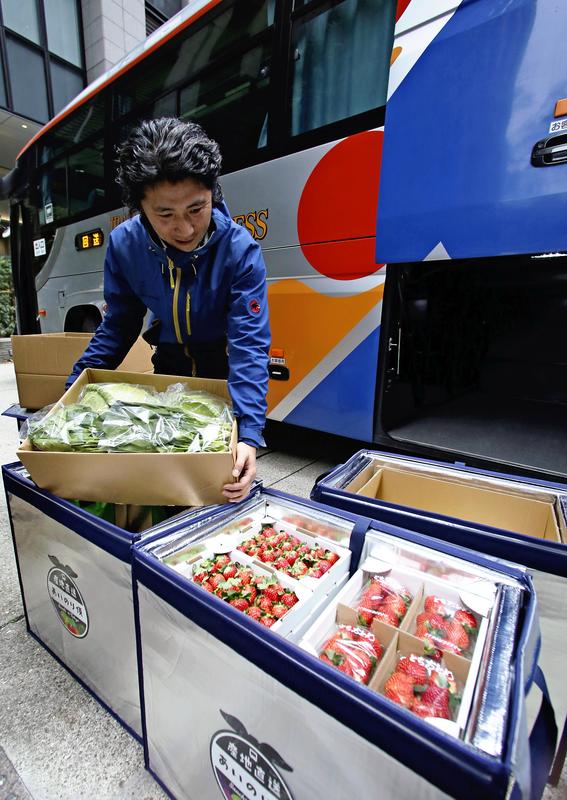
On Dec. 13, an express bus from Mashiko, Tochigi Prefecture, arrived in the office district of Otemachi, Tokyo. The driver removed boxes of fresh strawberries and vegetables from the vehicle's storage compartment. Through the service -- launched by Mitsubishi Estate Co. and other firms in the summer of 2018 -- passenger buses transport local specialty products to Tokyo.
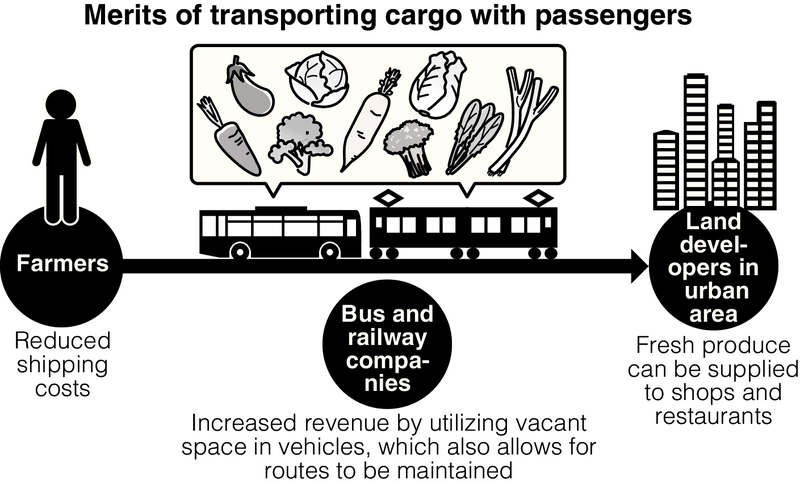
The introduction of this service has reduced shipping costs for those in agriculture while generating additional income for bus companies. Due to a deregulation scheme adopted in 2017, the service is expanding to bus and rail companies nationwide. Rural areas suffering from population loss strongly expect these services to generate revenue needed to maintain bus and railways routes.
However, some within the Land, Infrastructure, Transport and Tourism Ministry still harbor reservations.
"Transportation safety standards differ for passengers and cargo. If we don't give much thought to this, transport of both together can lead to accidents," said a source at the ministry.
Regulations are not the only distribution challenge, as last year's many natural disasters illustrated.
Torrential rains in western Japan in July 2018 interrupted transport networks primarily in the Chugoku region. Kansai airport was flooded and temporarily closed due to Typhoon No. 21 in September 2018. When strands of Japan's complex mesh of modern transportation routes are cut, shipments and equipment fail to arrive, severely disrupting families' daily lives and private-sector production.
Kinkai Yusen Kaisha Ltd., a shipping company based in Tokyo, will open a regular route connecting Tsuruga Port, Fukui Prefecture, on the Sea of Japan with Hakata Port, Fukuoka Prefecture, in April 2019. Kinkai Yusen, a member company of the Nippon Yusen Kaisha group, aims "to secure multiple regular transportation routes" so as to be prepared for possible disasters, according to an official of the company.
The first paragraph of "TA-Q-BIN Kaihatsu Yoko" (Important points in door-to-door delivery service development), a document written by Ogura in 1975, says, "Taking customers' point of view." In today's convenience-oriented society, anyone can send and receive parcels or luggage safely, reliably and quickly. However, the surge in shipment volume, along with labor shortages, confronts the logistics industry with new challenges.
Delivery networks can be considered the economy's circulatory system. It is important to maintain and develop new initiatives and achieve a system through which the flow of goods is never allowed to stop. This can be accomplished by learning from those who came before us and utilizing cutting-edge technology.
Read more from The Japan News at https://japannews.yomiuri.co.jp/