
The first time my parents left my brother and me alone overnight, it was New Year's Eve. Being the wild-eyed, raucous partiers that we were, we celebrated our freedom by watching one of those countdown shows on television, popping a batch of popcorn and drinking Dr Pepper.
And thus was a tradition born. For the next several years, we observed New Year's Eve, separately or together, with popcorn and Dr Pepper.
The point is that New Year's Eve traditions are easy to make. But around the world, they seem to share a couple of themes.
Many cultures look to New Year's Eve or New Year's Day as a time to hope for prosperity. That is why many cultures celebrate with a pot of beans or lentils, which, because there are so many of them in a serving, represent abundance.
Other cultures focus on the end-of-year, beginning-of-year theme of continuity, by specifically serving foods that are round.
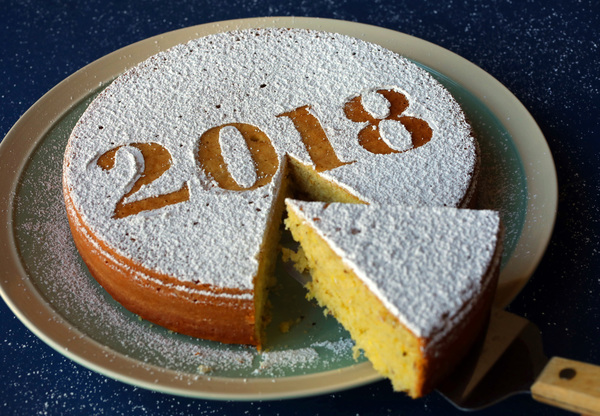
And some cultures combine these two ideas by placing a prize _ often a coin _ inside a round cake or bread. Whoever gets the piece with the prize or coin is said to be assured of wealth and good luck in the coming year.
That's the case with the Greek tradition of serving Vasilopita.
Vasilopita is named for St. Basil, whose feast day is Jan. 1 for the Eastern church and Jan. 2 for the Western. Practically every family in Greece has its own recipe for Vasilopita, but the one I baked from "Food from Many Greek Kitchens" is truly stunning.
This elegant cake is dense and not too sweet. It is flavored with the zest of orange and lemons, scented with vanilla and brandy, and graced with a hint of almonds. It can also be beautiful; it is traditionally decorated with sliced almonds in a pretty pattern or with powdered sugar sifted over a doily.
I chose to decorate mine in another traditional method for the New Year, cutting out the numbers of the year 2018 to use as a stencil, with powdered sugar flurried over the cake. When I removed the numbers, their crisp image was clear in the sugar, reminding all of the reason for the celebration.
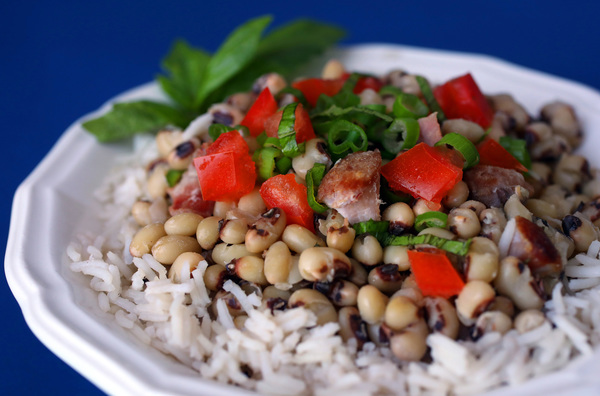
For my next New Year's inspiration, I looked to the American South, where I can attest that Hoppin' John is indeed a staple of the holiday. Hoppin' John is nothing less than black-eyed peas cooked with a ham hock, and yet it is also, somehow, so much more.
Perhaps it is the fact that this simple dish of ham-and-beans is made with 16 ingredients, proof of the extra care that is taken for the New Year's celebrations. Even so, it is just beans cooked with ham and mirepoix (onion, carrot and celery), spiced with a hot pepper and flavored with a bay leaf and thyme, served on basmati rice.
Typically, Hoppin' John is served on plain white rice, but the recipe I used gets great mileage out of the basmati substitution. Even better is this brilliant idea: It uses the flavored water that the beans were cooked in to also cook the rice. These simple tricks elevate an everyday dish to a comforting treat worthy of the new year.
In Italy, the holiday is also often celebrated with a plate of beans, only in this case it is sometimes lentils. The lentils are frequently cooked with sausage, but because that is too close in concept to Hoppin' John, I decided instead to go the vegetarian route with Polenta with Lentils in Tomato Sauce.
What could be more Italian than that?
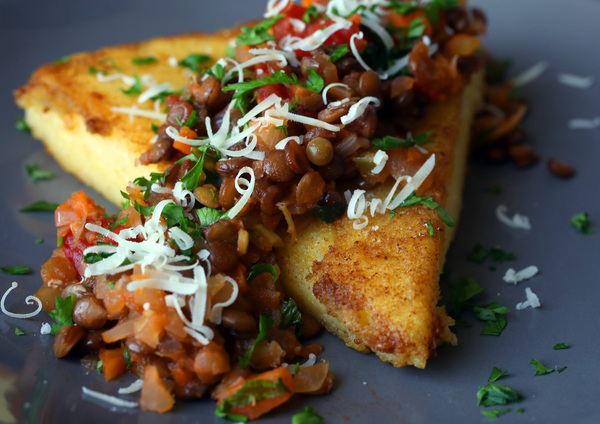
It's a straightforward dish, lentils plus garlic plus mirepoix plus tomatoes on polenta, but I made my own version of it fancier by pan-frying the polenta. All it takes is the forethought to make the polenta the night before. By morning, it can be cut into wedges and then fried until it is crisp and golden on the outside, and creamy on the inside. It's almost too good for lentils, but not quite.
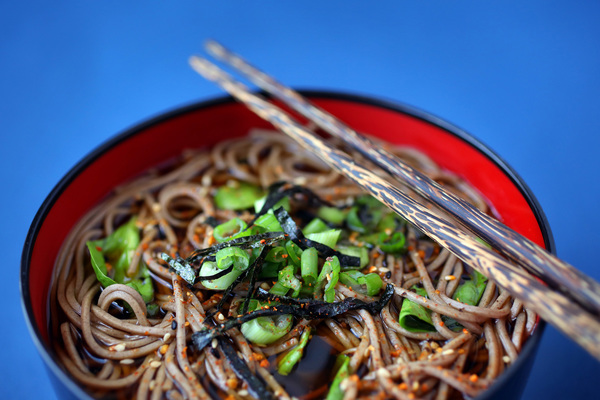
Finally, I turned to Japan for a tradition that is said to assure a long life. Every New Year's Eve, many Japanese eat Toshikoshi Soba, a noodle soup. The idea is that the noodles represent longevity, especially when they are slurped up without breaking them.
As with so many Japanese dishes, the base is dashi, a broth you can make yourself from bonito flakes, but I just used boiling water and a powder I bought at an international market. To this I added kaeshi, a blend of soy sauce, mirin and a little sugar that I did make myself. Combined, the two have a marvelous umami taste that is the perfect backdrop for soba noodles, which are made from buckwheat.
If you want, you could just serve the dish as is, but much of the fun of Toshikoshi Soba is deciding which ingredients to add into it. Chopped green onions are almost required, but I also added spinach leaves, a very popular seven-ingredient red pepper spice called shichimi togarashi and thin, dried seaweed called nori.
In Japan, it is often served with fishcakes called kamaboko, which I once saw described as a Japanese version of gefilte fish. And I know one Japanese native who adds a raw egg, allowing the heat of the broth to cook it. That's not necessarily typical, but she does it because she likes it.
Isn't that how traditions begin?