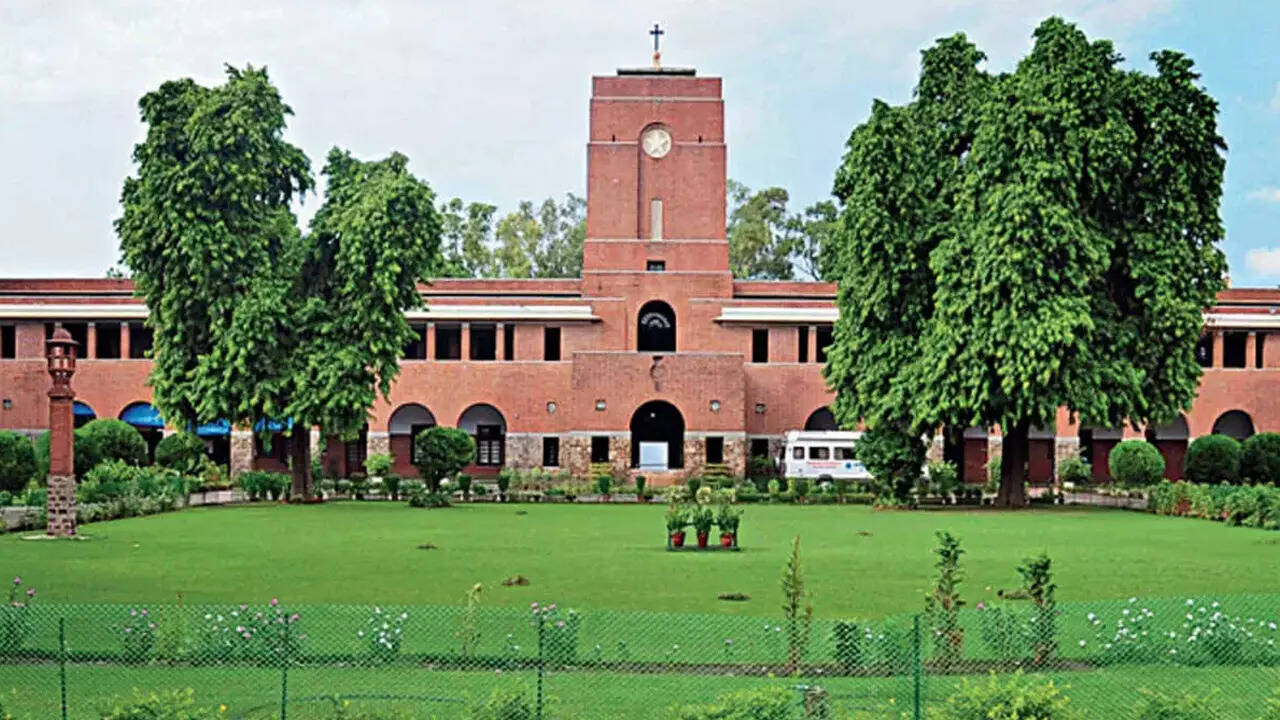
NEW DELHI: As Delhi University completes its 100th year of existence, the vision laid out by one of its pre-eminent vice-chancellors, Sir Maurice Gwyer, of the institution being a “field of ambition” has only gained more prominence.
In August 1939, Sir Maurice had said in a memorandum to the government of India: “It (DU) should be a field of ambition, in which all classes, parties and creeds may labour together in a labour of love, working harmony for a common cause… Will the university command the lively sympathy and assistance of the public and be enabled to secure its place as a great ‘all-India’ institution?”
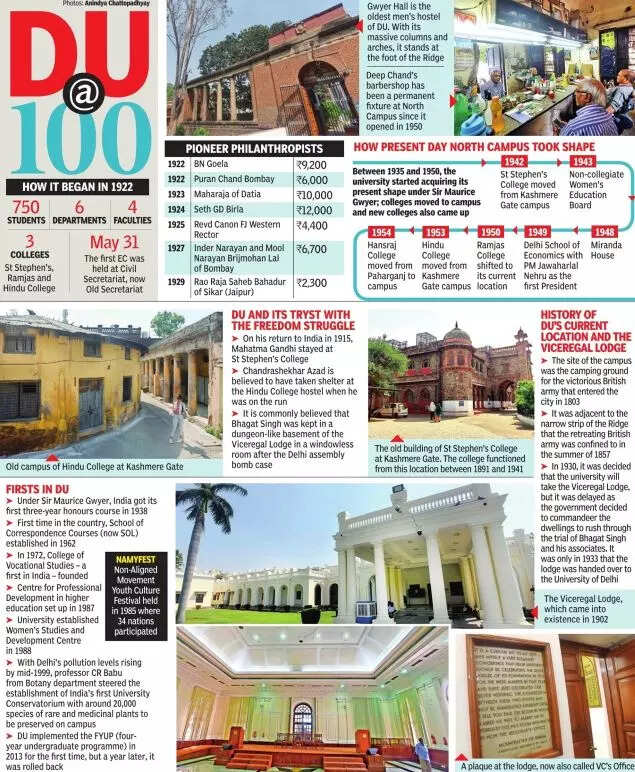
In his article, ‘The University of Delhi: A Field of Ambition’, former VC Upendra Baxi noted that Sir Maurice’s memorandum related to a resource crisis for the university that had “practically lived from hand to mouth from 1922 till 1937”. Despite such straitened beginnings, a century later, several former VCs and academicians are satisfied that DU has secured its place as a “great pan-India institution”.
Speaking to TOI, Baxi, who was VC from 1990-94, said, “DU has played a very good role in maintaining a high standard of education and research. The thread lies with the students who come from all parts of the country. The university is a mini-India, a microcosm of cultures.”
What began with three colleges and 750 students in 1922 is today an institution of higher learning with 91 colleges and 86 departments and over seven lakh students. Stating that it was Sir Maurice’s vision that inspired DU’s evolution, Sydney R. Rebeiro, DU’s first dean of alumni affairs, said, “It is a cardinal sin not to have given Gwyer his full, true and legitimate place in the history and tremendous evolution of Delhi. He was the one who brought the Oxford model of a three-year honours programme. With DU emerged the city of Delhi in many ways.”
Rebeiro also insisted that DU was not elitist. “Colleges like St Stephen’s, Hindu, Lady Shri Ram and Miranda House, among others, are elite and aristocratic in academia because they maintain high standards,” he said.
Over time, DU’s vice-chancellors have contributed greatly in enriching the processes of institutional expansion. As Baxi noted, “While the initiation of the idea of multi-campus development owes a great deal to Dr Sarup Singh, his successors have nurtured it to make DU a modern incarnation of the early institution, not just in terms of architecture of buildings but also in making the South Campus a site of many frontier disciplines in science.”
The university, established as an institution for imperial knowledge, soon became a reflection of political and social change in India, said Santosh Rai, professor in DU’s department of history. “When the principal of St. Stephen’s College became Gandhi’s host, it was apparent that DU would play a political role,” Rai said. “During the Quit India Movement, students of Indraprastha College for Women began participating in the freedom movement and a similar thing happened in Zakir Hussain College. The university gradually became a political space for the national movement. The real autonomy reflected not only in the statutes but also in actions and it was revolutionary.”
Highlighting how the university soon became the haven for the “best,” Rai added, “British administrators like Gwyer emphasised on recruiting the best. When the best faculty was installed, the best students also followed. After independence, DU became a nationalist university. Its biggest asset is the pluralistic character which caters to all social groups and gender. Apart from vice-chancellors Gwyer and CD Deshmukh, vice-chancellor KN Raj was instrumental in introducing most of the ordinances and statues that democratised the administration. Another visionary VC, professor Dinesh Singh, wanted to follow an interdisciplinary approach and introduced the four-year undergraduate programme in 2013.”
Emphasising that the university has kept pace with the times, Dinesh Singh, who was the VC from 2010 to 15, said, “The best quality of the university is that it attracts very talented students from all parts of the country and from all segments of society. DU generally gets the better crop of the country’s students most of the time. Over time, it has, thus, consistently remained one of the best universities. This is an important factor which keeps the university energetic and lively.”
Talking about the time he introduced the four-year undergraduate programme at DU, Dinesh Singh said, “During my tenure, my cherished dream of fully implementing the four-year undergraduate programme remained incomplete even though the four-year blueprint was fully in place. There are reasons that I do not wish to dwell upon that led to this. Fortunately, the four-year programme has returned now in near verbatim fashion and will likely do the nation a great deal of good.”
Rai said that the century has shown that DU is where it is on the strength of its curriculum, faculty’s knowledge and empowerment and the students’ capacity to adjust to rapid changes to the curriculum. “After a century of existence, the challenges before the university are: what is our vision for the future? Will we continue to cater to a plurality of students? And will the freedom that the faculty and students have been enjoying continue to remain or will we become another mere university?” asked Rai.
After a glorious 100 years, Delhi University’s aim is to now be among the 200 best universities in the world, asserted Yogesh Singh, incumbent vice-chancellor. “DU is a very old institution and it has served not only the people of India and the government of India, but also the entire humanity,” said Yogesh Singh. “It has done remarkably well in the last 100 years. It has participated actively in the growth and development of our country.”
The VC said now is the time to think of the university’s next 25 years to the time when DU would be 125 years old. “Where would we like DU to be? I think our first target is to be in the top 200 universities of the world,” said Yogesh Singh. “I know that will not be an easy achievement, but we have potential and the capacity to reach that milestone. What is more, we are already working in that direction.”
The VC added, “We also have to strengthen our infrastructure. While one segment of this process is the restoration and renovation work — which has already begun on a war-footing — the other is the creation of new infrastructure. The starting of new projects worth Rs 1,000 crore is on the anvil.”
Delhi University’s appetite to become a ‘field of ambition’, it appears, hasn’t diminished even after 100 years.