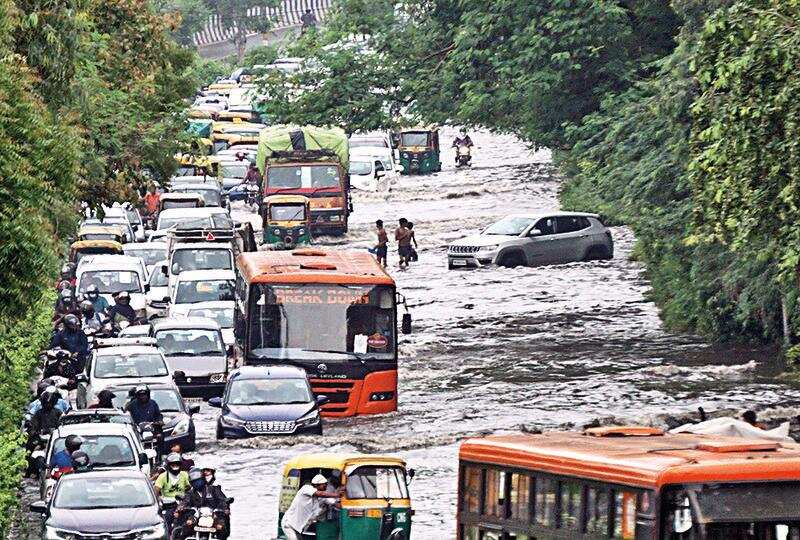
NEW DELHI: The Public Works Department (PWD) is planning to set up an underground tank with a capacity to hold 2.5 lakh litres rainwater in an attempt to solve the waterlogging problem at ITO near the World Health Organization office on Ring Road. This site is one of the 147 critical points for waterlogging in the city.
Despite four diesel pumps being deployed there, this stretch remains inundated for hours even after moderate rainfall. Officials said carrying of the excess rainwater runoff remains slow due to a sewage treatment plant (STP) on the outfall of the sewage line leading to the Yamuna.
According to the plan, the excess runoff would be collected in the underground tank that would be created on the green belt near the WHO office. This water would then be released in the river. The tendering process of the underground tank is likely to be carried out next month. PWD stated that the sump would be constructed before the 2022 monsoon.
In July 2020, heavy rain had led to overflowing of the drain near the WHO office and washed away 10 jhuggies. At that time, South Delhi Municipal Corporation and PWD had blamed the incident on a wall built on the drain. The Ring Road stretch near WHO figures in the list of seven top vulnerable locations, which are directly monitored at the PWD headquarters.
PWD, in a report, stated that waterlogging at this site was mainly due to overflow of the Delhi Jal Board sewer near the Indraprastha subway opposite the WHO office. As the area was also low lying, it further compounded the problem. As a short-term solution, regular monitoring was carried out by field units and the PWD control room and four tractor-mounted pumps with a capacity of 25hp and five temporary diesel pumps were deployed there.
Out of the 147 vulnerable points identified for waterlogging, the situation remains particularly troublesome at seven locations where PWD has introduced remedial measures like installing CCTV cameras and sensors and redesigning of drains. Another 50 critical points were added in the second phase where corrective measures would be taken.
The civic body would also run these points on software made by IIT-Delhi for the new drainage master plan. PWD has spent around Rs 75 lakh on measures like sensors, CCTV cameras, new motors and alternate drain in case of Minto Bridge and around Rs 70 lakh would be spent on Pul Prahladpur underpass. The first phase of the exercise at seven locations is expected to be completed by February 2022 and the second phase by December 2022.