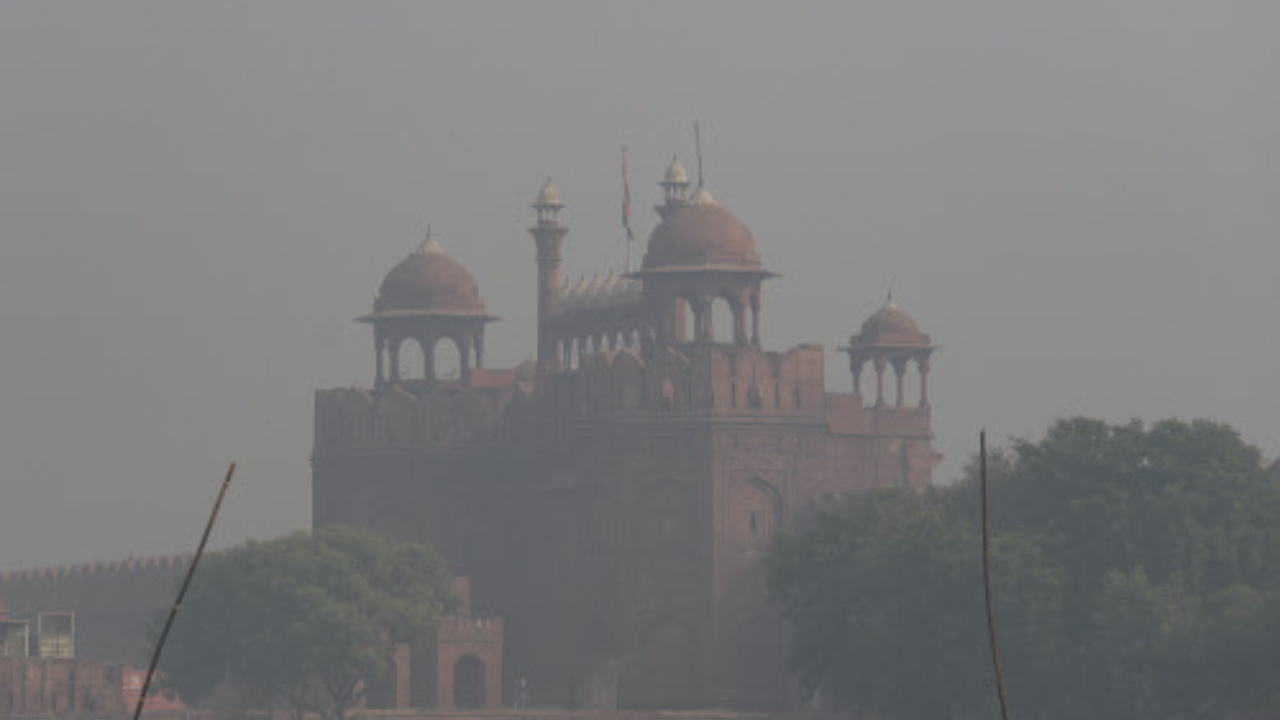
NEW DELHI: Delhi experienced alarmingly high levels of air pollution on Monday, reaching seven to eight times above safe standards.
In response, the city government announced the revival of its flagship "odd-even" scheme, a traffic management strategy, after a four-year hiatus, as they anticipated further air quality deterioration post-Diwali. Additionally, to safeguard the health of schoolchildren, the government decided to suspend in-person classes in all schools, with the exception of students in grades X and XII who are preparing for board exams. This suspension will remain in effect until November 10.
The city's 24-hour average Air Quality Index (AQI) recorded at 4 pm on Monday stood at 421, showing marginal improvement from the previous day's AQI of 454. However, a toxic haze continued to shroud the city for the seventh consecutive day.
Other cities in neighboring Haryana, Rajasthan, and Uttar Pradesh also reported hazardous air quality, with Ghaziabad (391), Gurgaon (373), Noida (384), Greater Noida (420), and Faridabad (412) experiencing similar conditions.
The concentration of PM2.5, fine particulate matter that can deeply penetrate the respiratory system and pose health risks, exceeded the government-prescribed safe limit of 60 micrograms per cubic meter by seven to eight times at various locations throughout Delhi-NCR. In fact, it was 30 to 40 times higher than the healthy limit of 15 micrograms per cubic meter set by the World Health Organization (WHO).
According to the Ministry of Earth Sciences' Air Quality Early Warning System for Delhi-NCR, the region is expected to endure severe air quality for another five to six days.
Exposure to Delhi's polluted air is equated to the health risks of smoking approximately 10 cigarettes a day, according to Rajesh Chawla, a senior consultant in pulmonology and critical care at Indraprastha Apollo Hospital. Prolonged exposure to such high pollution levels can lead to or exacerbate respiratory conditions like asthma, bronchitis, and chronic obstructive pulmonary disease (COPD), significantly increasing the risk of cardiovascular diseases.
In anticipation of worsening air quality post-Diwali, Delhi Environment Minister Gopal Rai announced the reinstatement of the odd-even scheme, which restricts cars from operating on alternate days based on their number plates. Additionally, a decision on allowing 50 percent of staff in government and private offices to work from home will be considered after Diwali.
Rai also stated that directives have been issued to implement stringent restrictions prescribed in the final stage of the Central government's air pollution control plan for Delhi-NCR, known as the Graded Response Action Plan (GRAP). Stage IV of GRAP, which includes a ban on construction work and the entry of polluting trucks into the capital, came into effect after the air quality dropped to "severe plus" levels (AQI above 450).
Unfavorable meteorological conditions, vehicular emissions, paddy straw burning, firecrackers, and other local pollution sources collectively contribute to hazardous air quality in Delhi-NCR during the winter months.
According to the Delhi Pollution Control Committee (DPCC), the capital experiences peak pollution from November 1 to November 15 when incidents of stubble burning in Punjab and Haryana increase. On Sunday, a total of 4,160 farm fires were reported in North India, the highest for the season. Punjab alone reported 3,230 stubble-burning incidents, a record high for a single day.
Under Stage IV of GRAP, only CNG, electric, and BS VI-compliant vehicles from other states are allowed to enter Delhi. Exemptions are granted only to those involved in essential services. Additionally, all medium and heavy goods vehicles not engaged in essential services are banned in the capital.
Over the past 10 days, Delhi-NCR has witnessed declining air quality due to a drop in temperatures, stagnant winds that trap pollution, and an increase in post-harvest paddy straw burning in Punjab and Haryana. Data from the Central Pollution Control Board (CPCB) shows that Delhi's AQI increased by over 200 points between October 27 and November 3, reaching the "severe plus" category on Friday. The 24-hour average AQI of 468 on Friday was the worst since November 12, 2021.
Despite the ongoing air crisis in the capital, a unique study initiated by the Delhi government to identify pollution sources and take mitigating actions was abruptly halted, allegedly on the orders of Delhi Pollution Control Committee Chairman Ashwani Kumar. Additionally, a large smog tower in Connaught Place, which was installed to mitigate air pollution, was unilaterally shut down by Kumar.
Delhi's air quality continues to rank among the worst in the world's capital cities. A report from the Energy Policy Institute at the University of Chicago (EPIC) in August revealed that air pollution in Delhi is reducing life expectancy by almost 12 years.
(With agency inputs)