Four new greenfield cities, being planned as “Namo Cities” across the National Capital Region (NCR), will receive central assistance of Rs 5,000 crore over the next five years, Union housing and urban affairs minister Manohar Lal said after a meeting of the NCR Planning Board (NCRPB) on Tuesday, a TOI report stated.
The proposed cities will come up in Delhi, Haryana, Uttar Pradesh and Rajasthan under the upcoming Regional Plan 2041. The government also decided that the existing NCR boundary, spread across 55,083 sq km, will remain unchanged, ending discussions over reducing the region’s size.
New urban hubs to be selected through challenge process
The new cities, also referred to as “Namo Nodes”, will be developed as part of the NCR’s future growth strategy. Each state will submit three proposals, and one proposal from each state will be selected through a challenge-based process.
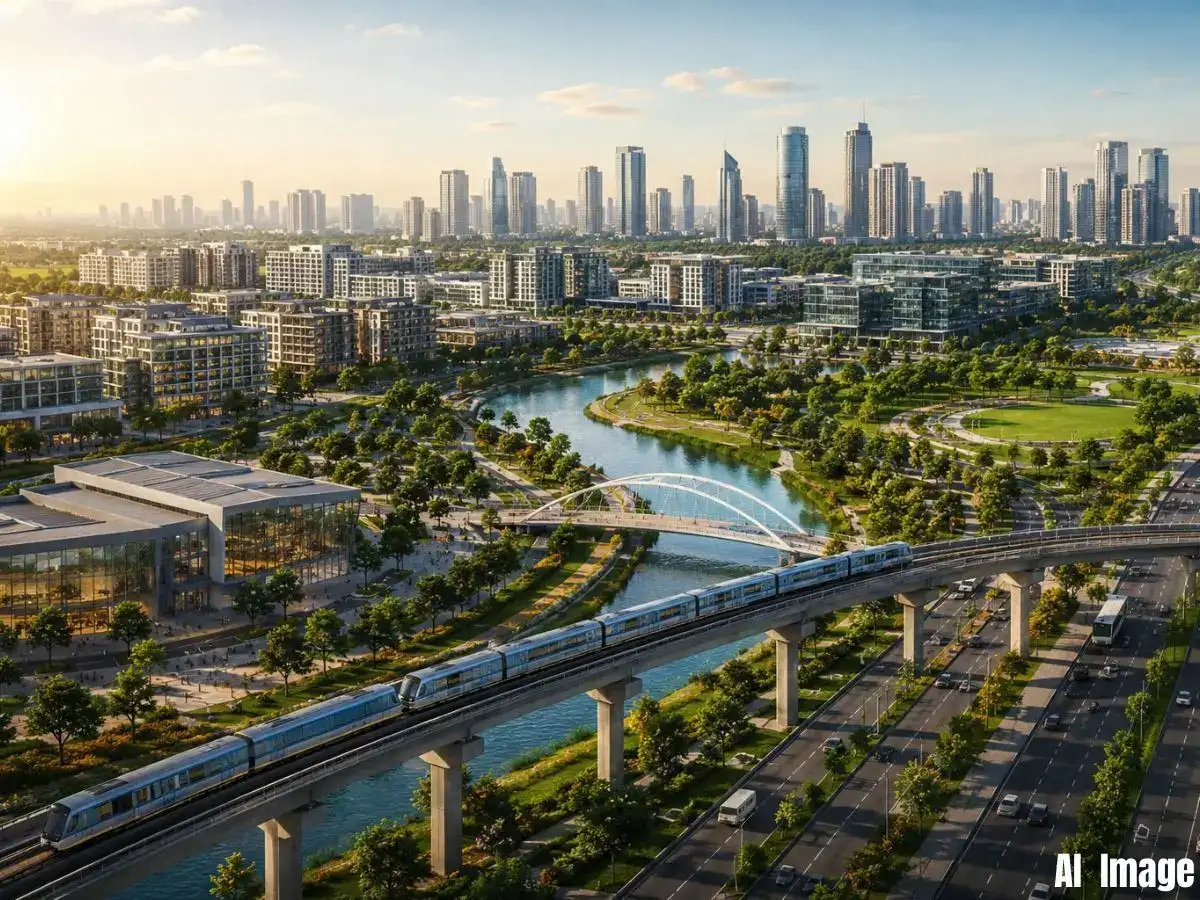
A city node is planned as a modern urban centre linked with surrounding areas through transport networks. It will include housing, commercial spaces, jobs, healthcare facilities, education infrastructure and other basic services.
Speaking after the meeting, Lal said, “There are large tracts of vacant land on its outskirts where a sub-city could be developed”.
Officials said the proposed cities are expected to receive high-speed road or rapid rail connectivity to improve movement across the NCR region.
No change in NCR boundary after state concerns
The NCR Planning Board meeting was attended by Delhi Chief Minister Rekha Gupta, Haryana Chief Minister Nayab Singh Saini, Uttar Pradesh urban development minister A K Sharma and Rajasthan urban development minister Jhabar Singh Kharra.
The board discussed the Regional Plan 2041, which will decide the future roadmap for urban expansion in the region.
Earlier, Haryana had suggested removing districts such as Karnal, Jind, Panipat, Mahendragarh and Bhiwani from NCR due to concerns related to environmental restrictions and the impact of measures like the Graded Response Action Plan (GRAP).
However, the Centre decided to keep the NCR area unchanged.
Lal said, “After deliberation, it was decided that the entire area will remain as it is. There will be no change. The demand for reducing area arose due to concerns over some environmental issues such as repeated imposition of restrictions, especially when there is congestion and when GRAP is applied.”
He added that future restrictions would be implemented in a more targeted manner so that distant districts do not face unnecessary difficulties.
NCR population expected to double in 15 years
The push for new cities comes as the NCR continues to witness rapid population growth. Officials estimate that the region’s population could rise to around 15 crore in the next 15 years, with nearly 67% of people expected to live in urban areas by 2041.
The government believes new planned cities can reduce pressure on existing urban centres and create more balanced development across the region.
UP, Rajasthan prepare proposals for new city locations
Uttar Pradesh has already suggested possible locations for its greenfield city proposal. State urban development minister A K Sharma said Noida, Dadri, Jewar and Bulandshahr are among the areas being considered.
Rajasthan minister Jhabar Singh Kharra said the state would submit its proposals soon.
The NCR will also be divided into four planning zones under the new approach — Delhi, Central NCR, highway corridor zone and transit-oriented development zone.
Officials described the Central NCR area, extending from Delhi’s borders up to five kilometres beyond the Eastern and Western Expressways, as the “golden ring of opportunity” for future urban growth.
Regional Plan 2041 approval expected soon
Lal said all aspects of the Regional Plan were discussed during the meeting and another meeting would be held after two months before its final declaration.
Haryana Chief Minister Nayab Singh Saini said the next NCR Planning Board meeting will be held in December in Gurgaon, where the Regional Plan is expected to be approved.
Delhi Chief Minister Rekha Gupta said all NCR states must work together to provide better services and ensure balanced development for residents across the region.