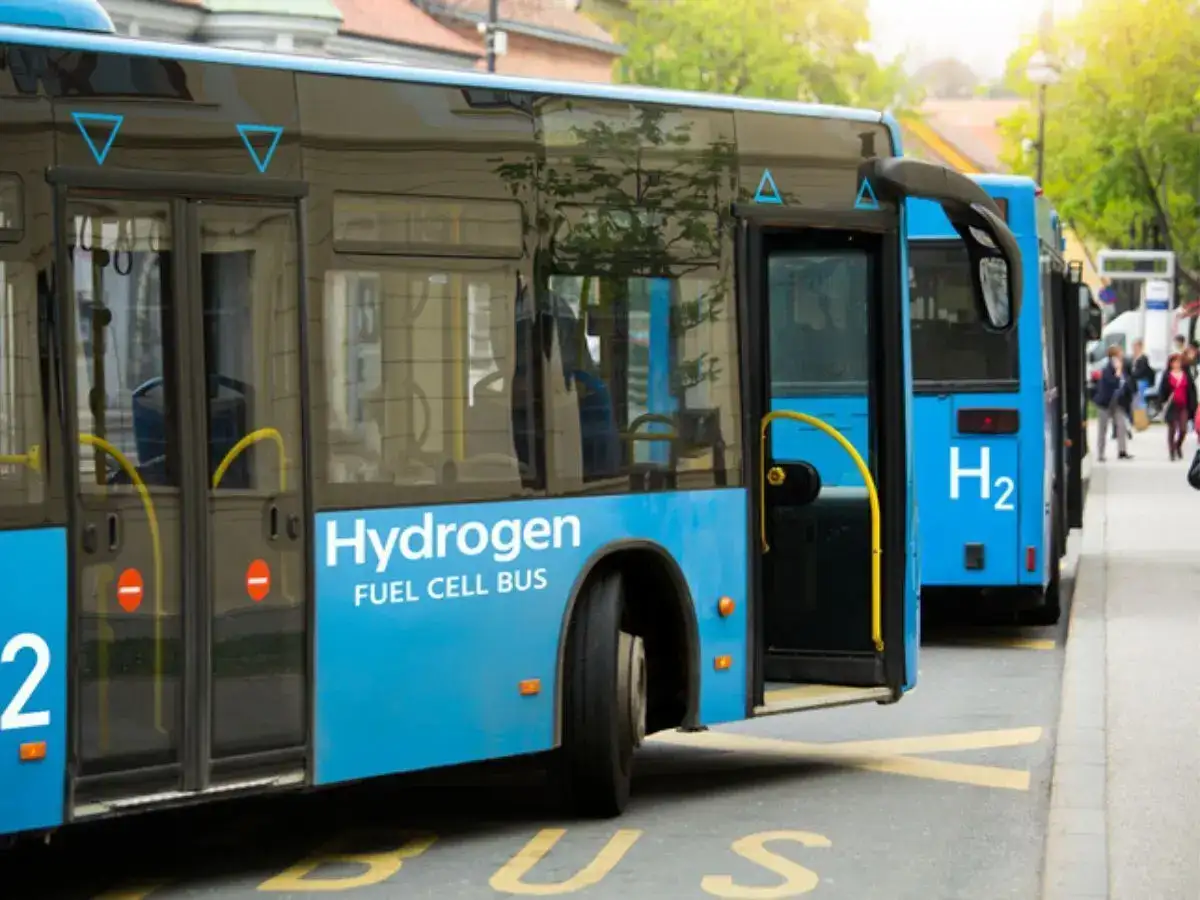
Delhi has started operating two hydrogen-powered shuttle buses in the Central Vista area, marking one of the capital’s first visible experiments with hydrogen-based public transport.
Each bus carries four hydrogen cylinders mounted on the roof with a total capacity of around 30 kg. On a single refill, the buses can travel nearly 250 km.
Right now, they cover about 180 km every day, including trips to Indian Oil Corporation Limited’s hydrogen station in Faridabad for refuelling.
But while the buses may look like a glimpse into the future, experts told TOI that hydrogen-powered vehicles still face serious challenges before they can become practical for large-scale city transport.
Why are hydrogen buses being called zero-emission vehicles?
According to Amit Bhatt, India managing director at the International Council on Clean Transportation, there are two kinds of hydrogen-powered vehicles.
He told TOI that hydrogen internal combustion engine (ICE) vehicles do not release carbon dioxide but still produce nitrogen oxide emissions, meaning they are not globally treated as fully zero-emission vehicles.
The second category is hydrogen fuel cell vehicles, where hydrogen is converted into electricity to power the vehicle.
The buses introduced in Delhi’s Central Vista area belong to this second category.
Umish Srivastva, executive director in-charge at Indian Oil’s R&D centre in Faridabad, told TOI that hydrogen fuel cell buses are almost twice as efficient as hydrogen ICE vehicles.
He said hydrogen ICE vehicles have an efficiency of 30-35%, while fuel cell buses can reach nearly 60%.
Why are hydrogen buses more expensive than CNG buses?
Cost remains one of the biggest problems.
Srivastva told TOI that operating a CNG bus costs around ₹60 per kilometre, including fuel and driver expenses.
In comparison, a hydrogen bus currently costs nearly ₹100 per kilometre to run.
He explained that the technology has not yet achieved economies of scale, which keeps prices high.
Experts also pointed out that hydrogen vehicles are not commercially available in India yet, making large-scale adoption difficult for now.
Why is hydrogen infrastructure a major challenge in India?
Bhatt told TOI that storage and dispensing systems for hydrogen remain a major obstacle.
Unlike EV charging systems, existing CNG infrastructure cannot simply be adapted for hydrogen use.
At present, the buses operating in Delhi still need to travel to Faridabad for refuelling.
Bhatt also said the growing demand for battery EVs raises questions about the long-term economic viability of hydrogen-powered transport.
Are hydrogen buses better than electric buses?
The answer depends on who you ask.
Srivastva told TOI that hydrogen fuel cell buses are considered fully zero-emission because they use green hydrogen generated from renewable sources like solar energy.
He argued that electric buses still depend on electricity from India’s power grid, which is heavily reliant on coal.
But mobility expert Shreya Gadepalli told TOI that hydrogen vehicles lose significant energy during production, storage, transport and conversion into electricity.
She explained that electricity is first used to produce hydrogen through electrolysis, after which the hydrogen is compressed, transported, stored and later converted back into electricity inside the vehicle.
According to her, the entire process results in major energy losses, making hydrogen less efficient than EVs.
Are hydrogen vehicles safe and commercially viable?
Safety and affordability are still concerns.
Gadepalli told TOI that hydrogen is highly flammable and requires careful handling.
She also said the overall production and transportation process remains very expensive, making hydrogen financially unviable at present.
Meanwhile, pilot projects involving hydrogen fuel cell vehicles are already underway in Leh and Ladakh, while Union minister Nitin Gadkari has also reportedly been using such vehicles on a trial basis.
Still, experts told TOI that hydrogen may ultimately prove more useful in sectors like shipping and industrial decarbonisation rather than regular city transport.
(With TOI inputs)