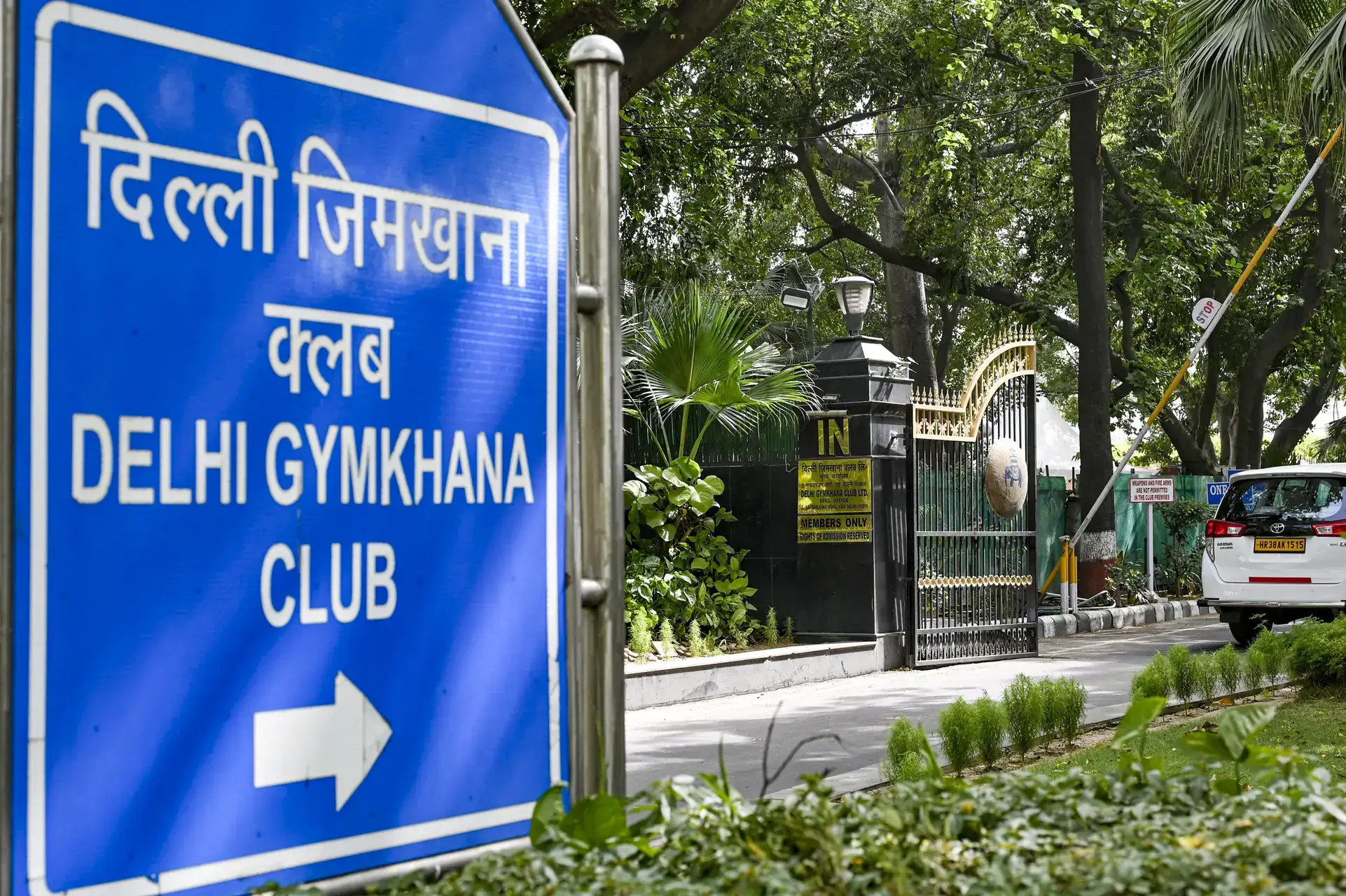
For more than a century, the Delhi Gymkhana Club has stood quietly behind its manicured lawns and colonial facades, functioning as one of Lutyens’ Delhi’s most elite addresses. Cabinet ministers, retired generals, judges, diplomats and corporate heavyweights have all passed through its gates. Getting membership itself can take years, sometimes decades.
Now, the club finds itself at the centre of a legal and political storm.
Centre has ordered the Club to vacate its sprawling 27.3-acre premises at 2, Safdarjung Road by June 5, triggering outrage among members, panic among employees and a legal battle in the Delhi High Court.
At the heart of the dispute is a simple question: Can the government reclaim one of Delhi’s most prestigious institutions in the name of “public purpose”?
Centre vs Delhi Gymkhana Club: The trigger
The controversy erupted after the Land and Development Office (L&DO), functioning under the Ministry of Housing and Urban Affairs, issued an order on May 22 directing the club to hand over possession of the property.
Centre argued that the land, located next to the prime minister’s residential zone on Lok Kalyan Marg, lies in a “highly sensitive and strategic area” and is urgently required for strengthening defence infrastructure, governance facilities and other public-interest projects.
The government invoked Clause 4 of the original lease deed signed with the then Imperial Delhi Gymkhana Club. The provision allows the government, as lessor, to reclaim the land if it is needed for a public purpose.
The order effectively terminated the club’s lease and stated that the entire land parcel, including buildings, lawns and sports facilities, would vest with the President of India through the L&DO.
The move is also being linked to a broader redevelopment exercise in the high-security zone surrounding the prime minister’s residence. According to some reports, adjoining areas are being reclaimed as part of a larger infrastructure and security overhaul.
A high-profile court battle
The matter quickly escalated to the Delhi High Court after members and the club’s elected body challenged the order.
Senior advocates Abhishek Manu Singhvi and Kapil Sibal appeared in court on behalf of the club and its stakeholders, arguing that the takeover could not happen abruptly and that thousands of members and hundreds of employees would be affected.
Meanwhile, Centre represented by Solicitor General Tushar Mehta, defended the action, saying the government was acting strictly within the terms of the lease deed. Mehta told the court there would be no “forcible takeover” before June 5 and that due legal procedure would be followed.
The government also indicated that compensation and even alternate accommodation could be considered separately.
Legally, Centre’s case rests on the fact that the land is not privately owned by the club but leased from the government. In Lutyens’ Delhi, many institutions function on leasehold land administered by the L&DO on behalf of the President of India.
Under the Public Premises (Eviction of Unauthorised Occupants) Act, once a lease is terminated, continued occupation can be treated as unauthorised. However, legal experts note that the government’s powers are not unlimited. Courts can examine whether the action is arbitrary, discriminatory or lacking genuine public purpose.
That is where the High Court’s scrutiny becomes crucial.
Also read: 'Our fight is for survival': Delhi Gymkhana Club management assures staff jobs are safe
Gymkhana's legacy: Beyond elites
At one level, the row appears to be a clash between the state and one of India’s most exclusive clubs. But the fallout may stretch far beyond Delhi’s power circles.
The Delhi Gymkhana Club has roughly 14,000 members and employs nearly 600 workers, many of whom have spent decades there. Since the order was issued, anxiety has spread among staffers worried about salaries, rehabilitation and job security.
Some employees reportedly gathered at a small shrine near the club premises praying for a resolution, while others spoke of sleepless nights and fears about supporting their families.
The club management has tried to reassure workers that operations will not stop immediately and that legal and administrative efforts are underway to protect jobs.
The dispute has also revived debate over the future of colonial-era institutions in India’s power corridors. Critics view Gymkhana as a relic of exclusivity and privilege occupying prime public land in the national capital. Supporters argue that the club is part of Delhi’s living heritage and represents a rare social and architectural institution with over 110 years of history.
Founded in 1913 as the Imperial Delhi Gymkhana Club, the institution evolved alongside the making of New Delhi itself. Designed by architect Robert Tor Russell, whose works also include Connaught Place and Teen Murti Bhawan, the club became synonymous with the understated culture of Lutyens’ Delhi.
That legacy is now colliding with a modern state increasingly willing to repurpose prime land for strategic and administrative priorities.
The Delhi High Court’s eventual ruling may therefore determine more than the future of a club. It could shape how far the government can go in reclaiming leased institutional land in the name of national interest, and whether heritage, continuity and community hold any legal weight against the expanding logic of state redevelopment.