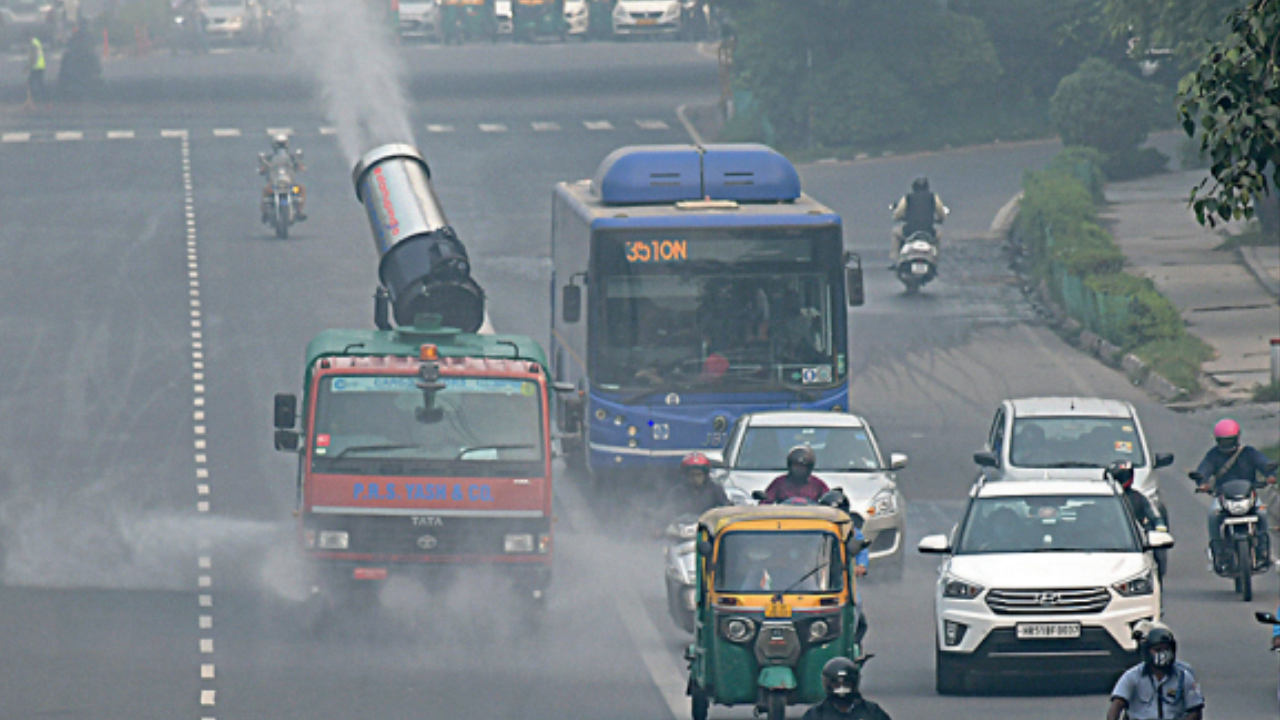
NEW DELHI: With the Commission on Air Quality Management, the central government's body on pollution in Delhi-NCR, deciding to base anti-pollution measures under the Graded Response Action Plan on predicted air quality rather than recorded air quality, scientists are updating the system to shorten the forecast time by one-third.
Scientists at the Indian Institute of Tropical Meteorology (IITM) in Pune are currently engaged in increasing the accuracy of its forecasts. "Earlier a three-day forecast took 12 hours. We are working to save four hours, which means feeding the data to the model, processing and posting on the website will now be done in less time. These four hours will help expedite GRAP implementation," said Dr Sachin Ghude of IITM.
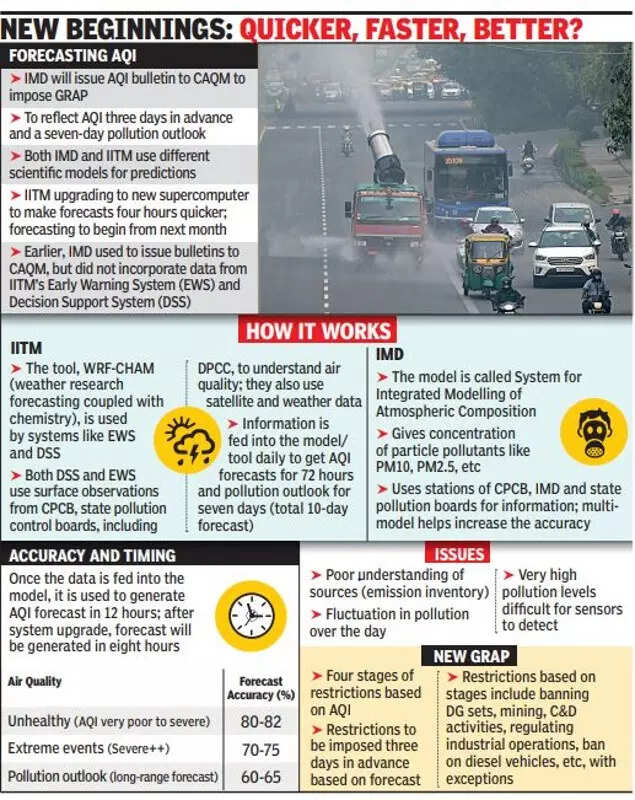
Scientists said that AQI forecasting will be based on the models used by IITM and the India Meteorological Department. The AQI bulletin to be forwarded to CAQM for the panel to initiate measures under GRAP will be compiled by IMD based on IITM feeds.
"The forecast will be the cumulative result of the separate models run by IITM and IMD. In this regard, the forecasting models of IITM are being upgraded to reduce time and enhance accuracy," said Ghude.
According to Ghude, IITM uses two systems at present - the early warning system for short-term forecasting and the decision support system to forecast AQI for three days and pollution outlook for an additional seven days. The latter also detects the pollutants and their chemical sign to indicate 10 likely sources from biomass burning to vehicle emission.
IMD uses a different model, but both the institutional models use information like particle and gaseous pollutants and weather conditions from the Central Pollution Control Board, state pollution boards, IMD and forecaster SAFAR as inputs for their results.
"IITM uses a one-of-its-kind model. We had been forecasting AQI for three years. The model can't predict all extreme events, but it has an overall accuracy of over 75%," said Ghude. Now to speed things up, IITM is shifting the forecasting model from the supercomputer named Aditya to the new Pratyush.
According to Dr VK Soni, senior scientist at IMD, earlier forecasts submitted to CAQM did not include information from IITM. "IMD uses a model called SILAM. Its results along with those from IITM's much advanced model will be employed to generate the pollution bulletin. With data from IITM's decision support system, we will know how a district is likely to be impacted by Delhi's air quality," said Soni, adding there will also be information on pollution trajectory to indicate where the pollution is heading.
Scientists, however, expect the mission inventories of NCR cities to be updated so that the forecasting models will have a "structure of pollution sources" to aid in forecasts. Speaking about the AQI forecasts, Ghude said, "At times, the pollution is extreme and this makes mapping pollution difficult. But globally, no one has developed an operational system working consistently for three years like IITM's. So, even if we didn't correctly assess 100% of the extreme cases, we managed around 70%, which is commendable."