(Corrects day of week in paragraph 5)
NEW DELHI (Reuters) -Beating the earth with his fists, a young man wails as the body of his father, who died after contracting COVID-19, is taken from an ambulance and lowered into a hastily-dug grave in India's capital New Delhi.
"You told me not to go outside but I didn't listen," he cries. "It's my fault," he shouts over and over. "I'm sorry."
The city's main Muslim graveyard for victims of COVID-19 is running out of space, according to authorities, as cases in Delhi and across the country run out of control following the relaxation of almost all curbs on movement last year.
India, a country of almost 1.4 billion people, has reported more than 200,000 new daily cases for the last two days, the highest in the world, with Delhi overtaking Mumbai as the country's worst-hit city.
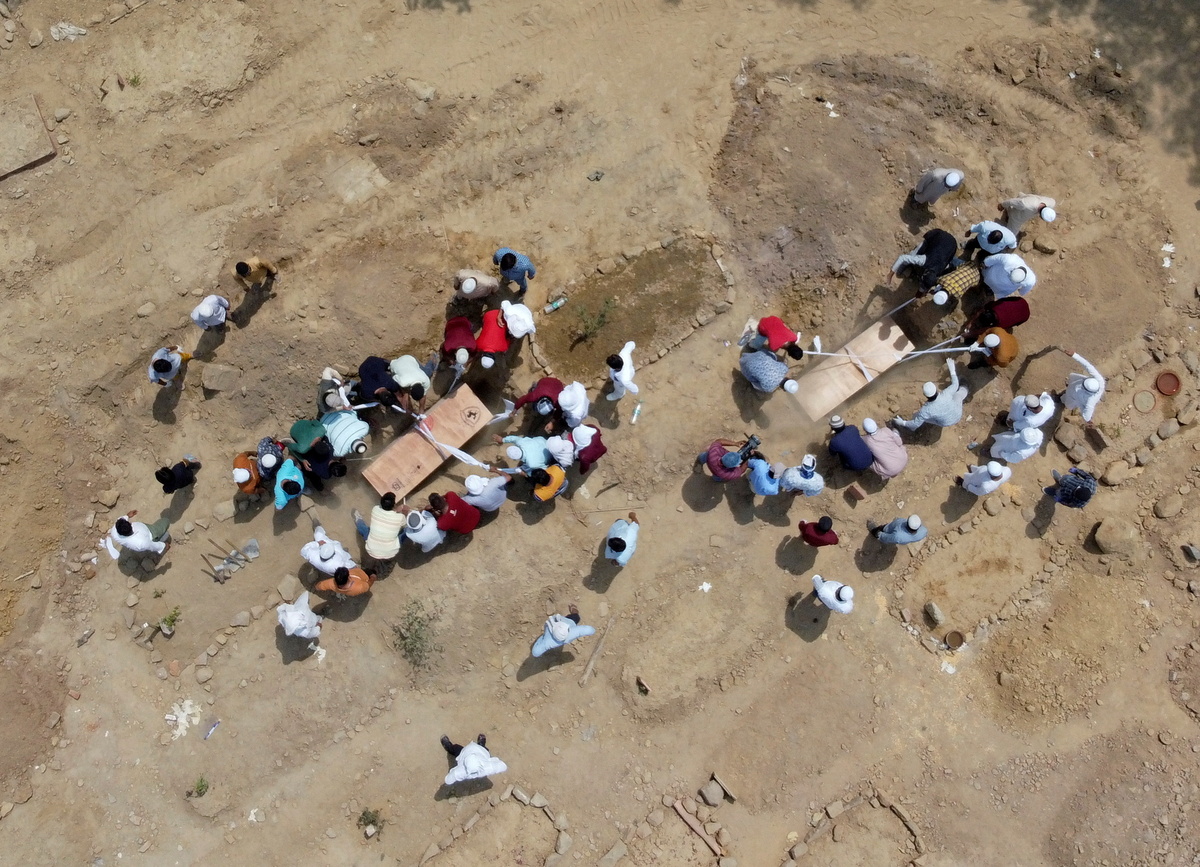
On Friday, a steady stream of ambulances arrived at the Jadid Qabristan cemetery on the outskirts of the ancient walled city, where a vast patch of wasteground was turned into a COVID-19 burial ground last year.
Stretching as far as the eye can see, the graves now run up to the boundary wall, with little space for more.
Head gravedigger Mohammad Shameem said he now has to turn bodies away, with space and staff at a premium.
"Yesterday there were 19 bodies, but we can only handle 15," he said.
Families, many wearing little or no protective equipment, lift relatives into rough plywood coffins or carry the dead wrapped in a simple white sheet.
The family of COVID-19-positive Pappu Ali, 43, visited several private hospitals in the capital searching for a bed for him. He died after finally being admitted to a government hospital.
"There were not enough doctors," his uncle, Mehboob, said, after a yellow excavator filled the grave. "We couldn't even find water."
(Editing by Janet Lawrence)