NEW DELHI: Delhi chief minister Arvind Kejriwal on Monday announced the Delhi winter action plan against air pollution, listing 10 points where the government will be focusing on this winter. The chief minister said while the use of bio-decomposer spray developed by the Indian Agricultural Research Institute (IARI) to prevent stubble burning would continue this year, the government will work to ease traffic flows on 64 highly congested roads where jams are a problem.
In addition, the chief minister said the government will deploy 250 teams to prevent garbage-burning and 75 units to monitor dust pollution, form teams to work on Delhi’s existing and new pollution hotspots and induct 50 engineers in collaboration with the University of Chicago to upgrade Delhi’s existing green war room to provide more robust data.
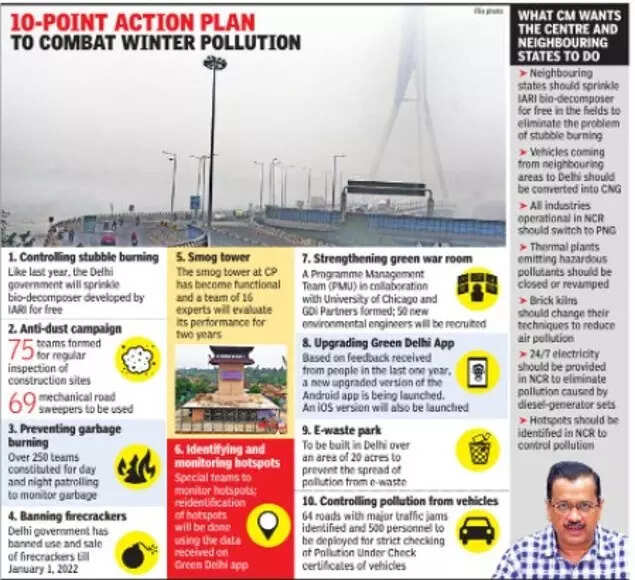
Appealing to Delhi and NCR states to follow in Delhi’s footsteps to take stringent action against sources of pollution, Kejriwal said vehicles plying in NCR and entering Delhi needed to be converted into CNG, thermal power plants in NCR needed to be either converted to clean technology or shut down, hotspots in NCR needed to be identified and, in addition to stopping stubble burning, states needed to provide 24x7 electricity to reduce the use of diesel gensets.
The CM said an upcoming e-waste park spread over 20 acres, the continued analysis of data generated by the anti-smog tower at Connaught Place and the ban on firecrackers were also part of the action plan, which aims to cover different sources of pollution through the winter.
“To prevent stubble burning, the bio-decomposer solution will be sprayed throughout Delhi for free by us and if the governments of Punjab, Haryana and UP also use this solution properly, then pollution through stubble-burning can be eliminated.
We are running an anti-dust campaign and we aim to strengthen it further by deploying 75 teams which will be visiting different construction sites to check dust norms,” said Kejriwal at a press conference on Monday.
“We keep monitoring the number of pollution hotspots through a war room and these pots will be assigned special teams to keep the level of dust and pollution in check. The green war room is also being strengthened with a programme management room created in collaboration with the University of Chicago and GDI Partners. We have recruited 50 new environment engineers for the same,” Kejriwal added.
In addition to action on congested roads, Kejriwal said 500 teams will be checking pollution under control (PUC) certificates, with 10-year-old diesel vehicles and 15-year-old petrol vehicles to be scrapped.
A senior government official said the action plan will be functioning in addition to the graded response action plan (GRAP), which kicks into effect each winter as an emergency measure to control pollution and includes extreme measures such as stopping entry of trucks into Delhi, shutting down construction sites and even enforcing the odd-even scheme. Some components of the plan will come into force immediately, while others will take some time, such as formation of teams.
Kejriwal said while public campaigns will be launched in the coming days that are centred around air pollution, he laid down a seven-point agenda for the Centre and Delhi’s neighbouring states, asking for stubble burning to be checked and polluting thermal power plants to be converted or shut down.
The CM said he had been tweeting about Delhi’s AQI figures since September 15 to show that on its own, Delhi’s air wasn’t polluted, but pollution from external sources, especially stubble burning, was leading to deterioration in air quality each winter.
“For the past few days, I have been tweeting about the AQI figures of Delhi to show how pollution remains under control in Delhi, barring winter. I have an appeal to the Centre and neighbouring states – that we must stop the burning of stubble. If Delhi can help by providing its farmers with free decomposers and eliminate the need to burn the stubble, then other states can come forward and use the same,” Kejriwal said.
“Secondly, vehicles coming from NCR to Delhi should be converted to CNG and, like in Delhi, all industries operating in NCR should switch to PNG instead of using highly polluting fuels. Brick Kilns in neighbouring states also need to change their techniques to reduce air pollution and pollution from DG sets can be eliminated if 24x7 electricity is in supply,” the CM said, asking for hotspots in NCR to be identified simultaneously. “These are our appeals with the motive of coming together and joining hands to make our air purer and cleaner, and our people, healthier.”