The government missed the end-of-February deadline for submitting to the United Nations a plan with revised targets for greenhouse gas emission cuts based on the Paris Agreement, an international framework for combatting climate change. Moves to bolster measures to fight global warming are spreading in Europe and elsewhere, and discussions aimed at improving Japan's emissions target are continuing inside the government. However, achieving Japan's goal will not be easy because of reasons including delays in restarting the nation's nuclear power reactors.
Nations that ratified the Paris accord were supposed to review their current reduction targets and submit an updated plan by the end of February. The government had been leaning toward maintaining the nation's current target of cutting its emissions by 26% by fiscal 2030 from the fiscal 2013 level.
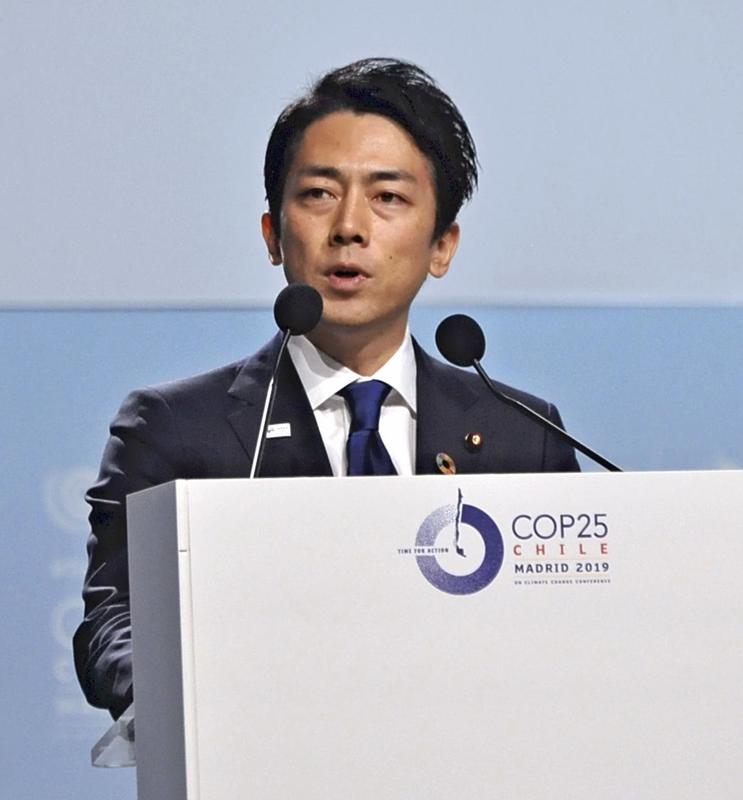
But this situation changed due to the U.N. climate change conference, known as COP25, held in Spain in December 2019. Europe and island nations that will bear the brunt of the effects of global warming strongly pushed for higher emission cut targets. Grassroots-level movements demanding greater action were also spreading.
Nongovernmental organizations and other groups in Japan also issued a statement calling for Japan to increase its reduction target. At least 240 local governments, companies and other entities threw their support behind this drive. Amid these stepped-up calls for greater action in Japan and overseas, Environment Minister Shinjiro Koizumi is considering including these progressive ideas into the government's plan. "What's important is not the deadline, but that we don't pour cold water on the current trend," Koizumi said.
These developments came in the wake of frequent disasters thought to be connected to global warming, such as a heat wave in Europe last summer, and an awareness that under each nation's current countermeasures, it will be impossible to achieve the Paris Agreement's target of keeping the average increase in global temperature to below 2 C from a benchmark set before the Industrial Revolution.
However, greenhouse gas emissions are closely linked to a nation's energy policy. Raising the target for emission cuts will not be simple. In 2015, the Economy, Trade and Industry Ministry announced energy mix ratio targets for fiscal 2030 of 20% to 22% for nuclear power and 22% to 24% for renewable energy sources including solar power generation. The current emission cut target was set based on these figures.
Japan's use of renewable energy is trending upward, but they still do not cover the shortfall arising from the delays in restarting nuclear reactors since the Great East Japan Earthquake in March 2011. The nation still relies heavily on thermal power generation, which produces significant volumes of greenhouse gases. Total emissions in fiscal 2018 declined by only 12% from fiscal 2013. Some government officials strongly believe that because the nation is already struggling to achieve its existing target, increasing the figure further would be difficult.
While reviewing the nation's goal, the focus will be on how stronger steps could be taken at a time when raising the target looks difficult. There are signs of cracks appearing in the Paris Agreement, exemplified by the United States officially pulling out of the deal later this year in November. Of the about 190 nations and territories that ratified the agreement, only four countries including Norway submitted new emission plans by the February deadline.
"The updated target Japan submits will indicate its level of commitment," said Seita Emori, deputy director of the Center for Global Environmental Research, a core organization of the National Institute for Environmental Studies. "Japan must show how it will fulfill its responsibility internationally in measures to combat global warming."
Read more from The Japan News at https://japannews.yomiuri.co.jp/