Our previous Spacewatch on 3 November anticipated the imminent launch of the shuttle Discovery on its final mission to the International Space Station. But a chain of technical issues, initially a leak in a fuel line and then cracks in the insulation and underlying structure of the external tank, have forced the launch to be postponed until 30 November, just as the ISS returns to our predawn sky.
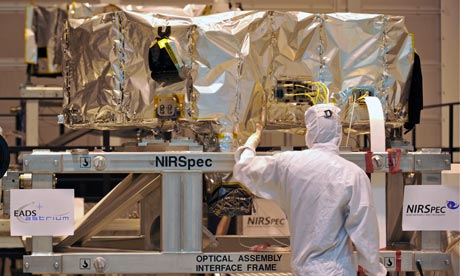
Meanwhile, Nasa's James Webb Space Telescope (JWST) has been subject to ever longer delays and cost increases which have ensured that it is the most expensive unmanned space project ever. Called initially the Next Generation Space Telescope, and billed as the successor to the Hubble Space Telescope, its target launch date has slipped from 2009 to 2014 as its cost has exploded from $1bn to $5.1bn.
Now an independent review has concluded that it could be possible to launch the JWST by September 2015 at a total lifetime cost of $6.5bn, but only if Nasa can scrape together some additional cash in the short term. The telescope, the largest ever to be sent into space, is a joint project with the European Space Agency and its Canadian counterpart.
Due to be launched on an ESA-built Ariane 5 rocket from French Guiana, it will be positioned some 1,500,000km above the night-time side of the Earth and will study the farthest objects in the Universe, using a suite of four cameras and spectrometers operating at infrared wavelengths.