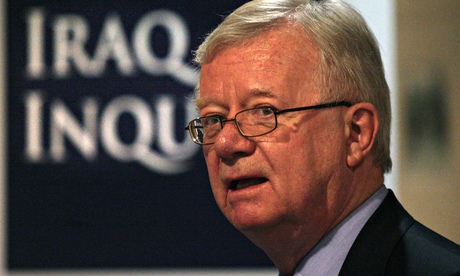
Labour will on Monday promise to embrace the results of the Chilcot inquiry into British involvement in the Iraq war and say that the repeated delays to the report’s publication have paralysed British foreign policymaking, including the ability to restore public trust.
In his major pre-election speech on foreign policy, the shadow foreign secretary, Douglas Alexander, will argue that the unforeseen delays to the report have acted as a barrier to building a consensus on future UK foreign policy.
Alexander will describe the Iraq war as having “greater and deeper consequences than the invasion of Suez”. He will also say the loss of trust due to Iraq means it will be harder for the UK to get involved in any similar actions in the future: “The bar of public legitimacy for future interventions has been permanently raised, whichever government puts them before parliament.”
Various reasons have been given for the delay in the publication of the report, including hotly denied claims that former Labour cabinet ministers have been contesting its conclusions, but Alexander will say: “The continued delay has contributed to, rather than addressed, the growing sense of introversion that many people feel about Britain’s place in the world.”
In his speech to Chatham House in London, Alexander will add: “The Chilcot report needs to be a bridge to a new chapter in British foreign policy, but its delayed publication is now a barrier to rebuilding the trust of the British public.”
“Learning the lessons from the Chilcot inquiry will mean that the next Labour government will turn the page on the last decade of foreign policy, not turn our backs on the world”.
Indeed it is likely Labour will see the Chilcot report as the central building block of a post-election foreign policy review that will confront the politics of pessimism about Britain’s place in the world.
“All of us who want Britain to have a progressive internationalist foreign policy have an interest in seeing the report published.
“We must learn the lessons of Iraq, but not be paralysed by it. That is why there is an urgent need for the inquiry to conclude its work.”
He will add that no one ever contemplated that the inquiry’s work would still be unfinished after nearly six years and two general elections.
Ed Miliband was not in the Commons at the time of the Iraq war, but has said he would have opposed it if he had been.
Alexander will go further in his criticism of the war than just the fundamental error of the absence of weapons of mass destruction, arguing that long-term repercussions were not considered.
“What has also subsequently emerged is that removing Saddam and empowering the [Shia] majority, without ensuring adequate safeguards for the Sunni Arab minority, exacerbated sectarian frictions within the country. Iraq became seen as a country supporting Iranian ambitions, rather than balancing them, thereby further destabilising an already volatile regional power-balance.”
“More than a decade on, Iraq still holds difficult lessons for British foreign policy, but they are lessons that need to be learned. It would be futile to deny history, and it would be folly to repeat it.”
Alexander will also use the speech to underline his party’s determination to engage with Europe – remarks that will please even some of those businessmen sharply critical of Labour’s tax and industrial policies.
He will say: “At a time when great power struggles are once again emerging, and when economic warfare has once again become a central tool of foreign policy, it is clear that our membership makes us stronger and helps promote our interests and values in this changing international context.”
Speaking as “a prospective foreign secretary”, Alexander will say that the UK is viewed as a problem within the EU and that a Labour government will have to mend fences. “Too often we are now seen by our European allies not as a leader and contributor, but as a potential problem and adversary.
“Indeed the willingness of the Conservatives to open the question of the UK’s continued EU membership – indeed a foreign secretary, Philip Hammond, who seems to support departure – undermines the basic principle of solidarity and is one of the many reasons we have taken a different view to this government.
“Britain needs a post-Cameron Europe policy, so in government Labour will set itself the task of reviewing, repairing, and resetting our country’s approach to Europe.”