
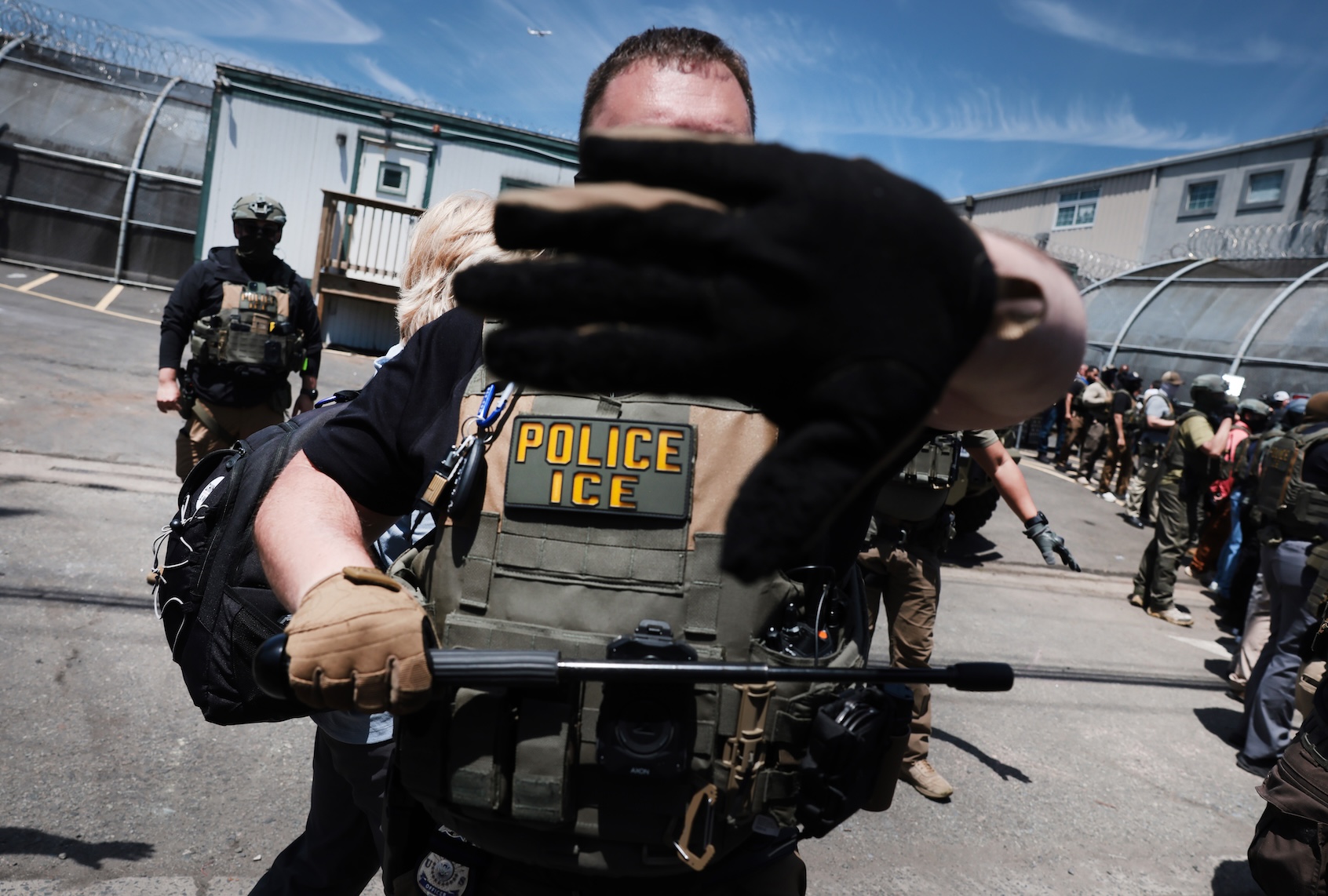
While the hunger and labor strike at the Delaney Hall immigration detention facility in New Jersey ended weeks ago, conditions within the facility have not improved, and may be even worse than before the strike there. Now, policies are seemingly directed at obscuring conditions in the for-profit facility operated by The GEO Group.
In May of 2025, Delaney Hall, which operated as a holding facility for those picked up by Immigration and Customs Enforcement from 2011 to 2017, was recommissioned to support President Donald Trump’s mass deportation agenda. On May 22, detainees at Delaney Hall launched a hunger and labor strike at the facility, capturing national attention to what they described as inhumane conditions in the facility. In particular, detainees described unsanitary, moldy or spoiled food and mistreatment by guards. The strike led to significant protests outside the Newark, New Jersey, detention center, and high-profile clashes between protesters and the guards there as well as a frenzy of attention from the national press.
On June 22, advocates for detainees there said that the strike had ended, though not because conditions had improved, but rather because the facility and the Department of Homeland Security had adopted a tactic of frequently transferring detainees between facilities, which effectively broke the ability of detainees to organize themselves within the facility.
Volunteers at an aid tent maintained by local religious groups and organizers say that conditions at the facility have not improved, and may even be getting worse for some, based on conversations with released detainees and their families.
Haydee Colon Hernandez, a pastor at Saint John’s Lutheran Church in Summit, New Jersey, relayed one story in which guards seemingly retaliated against a man in a wheelchair following a conversation between the detainee and Sen. Andy Kim, D-N.J., in which she says guards told the man, “Do you think that just by talking to the senator you’re going to be released?”
“If you want to tell a guy that is in a wheelchair, ‘Stand up when I’m talking to you,’ that’s really abuse. He said, ‘I wasn’t able to get up. I’m in a wheelchair,’” Hernandez said.
Other complaints include persistently low-quality food, isolation within the facility, and frequent transfers between Delaney Hall and other facilities, which serve to prevent organizing in the detention center. One volunteer also described a new system adopted, in which new detainees, often there for shorter periods of time, are kept away from longer-term detainees. Those who are held for shorter periods of time also describe better conditions upon release than other detainees who are held for longer periods. Other volunteers said that the families of detainees have been intermittently encouraged not to discuss conditions in the facility after visits to their family members.
In response to a request for comment from Salon, an ICE spokesman denied any allegations of “subprime conditions or overcrowding” at Delaney Hall.
“All detainees are provided with proper meals, water, medical treatment, and have opportunities to communicate with their family members and lawyers. We offer everything a traditional ICE detention facility offers, including access to free legal services and a law library, a variety of reading materials detainees can borrow in our library, recreational space and religious accommodations. All detainees receive full due process,” the spokesperson said.
The frequent transfers between facilities is one of the most important developments since the strike, according to Sally Pillay, the director of the Mami Chelo Foundation, and one of the lead organizers at the aid tent, which provides assistance to both families visiting the facility and those released.
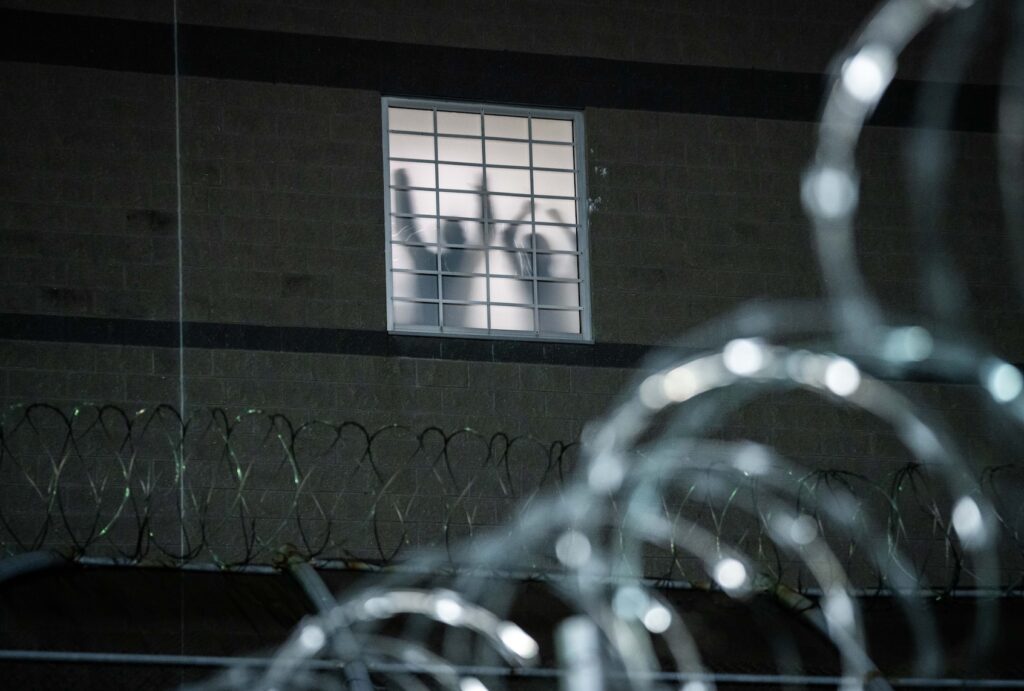
(Photo by Adam Gray/Getty Images) Detainees stand by a window inside the federal immigration center at Delaney Hall in Newark, where ICE is housing detained immigrants on May 26, 2026 in Newark, New Jersey.
“ICE has really escalated in kidnapping people out in the community,” Pillay said. “So every day, hundreds and hundreds of people are being brought into the facility, and every day, hundreds and hundreds of people are being moved out.”
Pillay theorized that the frequent transfers, alongside preventing organizing within the facility, also make it harder for detainees to file habeas corpus petitions, which is a legal mechanism that allows detainees to challenge their detention in court.
Pillay, who has spoken with hundreds of detainees and their families, said that detainees are typically woken up around 1 a.m. for transfers, and that the transfer bus will leave anywhere between 4 a.m. and 10 a.m.
Gabriela Soto, the wife of Martin Soto, a leader of the hunger strike, recalled her experiences with ICE attempting to move her husband from Delaney Hall, which was ultimately successful.
“I saw my husband being thrown into a van from the ramp inside, going into the visiting chapel, two ICE agents grabbed my husband by his ankles and his wrists and threw him in the van. I just hate to see — or to understand why they will do these things,” Soto said in an interview with Salon.
Martin Soto was in Delaney Hall from February until late May, and according to Soto, he was transferred to the Elizabeth Detention Center in New Jersey around 2 a.m. on May 25.
Other volunteers said that it has been harder to gauge what is happening at the facility from the outside due to the disassembly of the so-called “First Amendment” area, which blocked off traffic in the lane of Doremus Ave. closest to Delaney Hall. Before the disassembly, they said they could often hear commotion and sometimes screams from inside the facility, potentially owing to alleged instances where guards pepper-sprayed and beat detainees with batons.

(Photo by Adam Gray/Getty Images) An ICE agent sprays chemical irritants at protesters and media outside the federal immigration center at Delaney Hall, where ICE is housing detained immigrants on May 27, 2026 in Newark, New Jersey. The ongoing protests, which became tense over the holiday weekend, come amid reports of a hunger strike by detainees.
Delaney Hall is not the only detention facility plagued by allegations of abuse. A recent report from Human Rights Watch and the American Civil Liberties Union found that detainees at the Camp East Montana detention center were forced to endure filthy conditions, fed inedible meals and denied medical care. Detainees also described frequent beatings. DHS denies those allegations.
DHS, in response to a request for comment, also claimed that they provide comprehensive medical care to everyone in ICE custody and that ICE maintains a “zero-tolerance policy for all forms of assault involving individuals in ICE custody.”
“ICE takes every allegation of misconduct seriously and is committed to holding perpetrators fully accountable. Protecting the rights and safety of those in our care is a top priority. This includes safeguarding against abuse by staff, contractors, volunteers, or other detained individuals,” the DHS spokesperson said.
Kathy O’ Leary, a mainstay at the aid tent who works with Pax Cristi, spoke with Salon both during and after the strike and noted that visitation has been much more restricted since the strike began in May, and as tensions escalated throughout June.
For example, visitors were once allowed to wait in an indoor air-conditioned room and are now expected to wait for visitation in an outdoor seating area inside of a chain link fence near the gate of the facility. Inside the facility, there are other issues with heat. For example, during a dangerous heat wave in early July, air conditioning in one section of the facility also went down.
O’Leary cited persistent issues with transparency at the privately owned for-profit detention center as well. If a legislator is visiting for an inspection, they are now required to present privacy waivers for each detainee they want to speak with, which must be signed by the detainee. However, visitors aren’t allowed to bring the papers with them when they visit family in detention, meaning that the only chance detainees have to sign the papers is during a weekly visit to a nearby law library. O’Leary said that the aid tent keeps these papers on hand, but even the volunteers and organizers there needed assistance from legislative aides to ensure they were filled out correctly, and that language barriers can prove a challenge for detainees and their families.
“They’re a little confusing. We have them here in the tent. They’re a little confusing for even for us to figure out. We’ve had to ask the legislative aides for help,” O’Leary said.
Separate from the aid tent, protests at the facility persist, with a grassroots group of activists maintaining a mutual aid table of their own near the detention center. One protester who goes by Basher, and has become a fixture of the protest efforts, said that even though the cameras have left, protests at the facility continue, with between 20 and 30 protesters showing up most nights. In recent days, however, owing to recent killings by ICE in Basher’s view, ICE and guards have been more reluctant to clash with protesters.
In recent weeks, immigration enforcement officers have shot and killed two people: Lorenzo Salgado Araujo in Texas and Johan Sebastian Guerrero in Maine. In Florida, another yet-to-be-identified man was killed after being struck by a semi-truck in Florida while fleeing ICE.