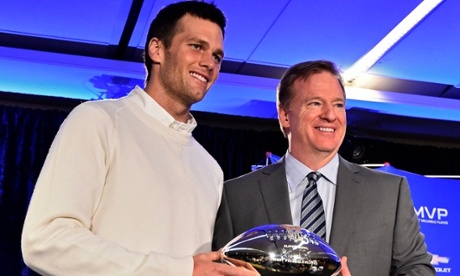
Deflategate rumbles on. Tom Brady denied under oath to NFL commissioner Roger Goodell that he tampered with footballs before the Patriots’ AFC title game with Indianapolis, according to a 457-page transcript of his 23 June appeal released on Tuesday.
The transcript, filed in Manhattan federal court by the NFL players’ union as part of the challenge to Brady’s suspension, reveals that Brady denied discussing air-pressure levels with the ball boys, or even thinking about how inflated the footballs were when he selected them. The quarterback insists he has done nothing wrong.
According to the transcript, Brady said: “I never, in the history of my career … I never thought about the inflation level of a ball.”
Separately, NFL investigator Ted Wells denied that he warned Brady he would be punished if he didn’t turn over his cellphone, and an extra layer was added to the scandal when the Baltimore Ravens felt moved on Wednesday to insist they did not tip off the Colts about the Patriots’ game balls.
The Ravens released a statement acknowledging that a team official contacted the Colts about the Patriots’ kicking balls, but coach Jim Harbaugh said: “I’ve been consistent from the beginning when asked about whether the Ravens tipped off the Colts about deflated footballs. I’ll say it again – we didn’t. We knew nothing about deflated footballs.”
Brady was suspended for four games, and the Patriots were docked $1m and two draft picks, after an investigation, led by Wells, found the Patriots supplied improperly inflated footballs for the game against the Colts in January, which New England won 45-7.
The Pats quarterback felt the suspension, which rules him out of a quarter of the regular season, was unfair, and appealed the punishment. Goodell decided to hear the appeal himself and upheld the penalty. Unhappy with the decision, Brady and the NFL players union took the matter to court.
With the union and the NFL at an impasse, US district judge Richard Berman ordered the sides to work out a settlement. An exasperated Berman urged the two parties to begin settlement talks “forthwith actively,” and stop their public sniping.
“While this litigation is ongoing, it is appropriate (and helpful) for all counsel and all parties to this case to tone down their rhetoric,” he wrote. “The earth is already sufficiently scorched.”
Tuesday’s transcript also shed light on Brady’s decision to destroy his cell phone rather than turn it over to Wells and his team.
Brady said he often has an assistant destroy old phones to ensure that personal information, such as family photos, remains confidential.
“I have always told the guy who swaps them out for me, make sure you get rid of the phone. And what I mean is destroy the phone so that no one can ever, you know, reset it or do something where I feel like the information is available to anybody.”
Wells said he asked repeatedly for Brady’s cellphone, but denied that he gave the quarterback an ultimatum.
“I did not tell Mr Brady at any time that he would be subject to punishment for not giving … not turning over the documents. I did not say anything like that,” the transcript read.
Wells said, though, that he did not believe Brady had nothing to do with the ball deflation because Brady refused to provide all of the documents that were requested.
“In my almost 40 years of practice, I think that was one of the most ill-advised decisions I have ever seen, because it hurt how I viewed his credibility,” Wells testified. “It hurt my assessment of his credibility for him to begin his interview by telling me he declined to give me the documents.”
Brady’s attorneys did provide copies of his emails to investigators.
The NFLPA called four witnesses at the appeal hearing: Brady, Wells, NFL executive vice president Troy Vincent and Ted Snyder, dean of the Yale School of Management.
The two sides are expected to appear in court on 12 August.