Local governments across Japan have different definitions of what constitutes "a death from the novel coronavirus," according to a Yomiuri Shimbun survey conducted nationwide.
Many local governments count the deaths of all people infected with the virus as a death "from the infection," but some exclude cases in which the deaths are deemed to have come from other causes. In Saitama Prefecture, for example, more than 10 people were excluded from the prefecture's coronavirus death toll, while in Fukuoka Prefecture, the calculation of the death toll was found to differ between the prefectural and a municipal government.
Experts say it is impossible to make comparisons and analyze the deaths if definitions are inconsistent, and urge the central government to present unified standards.
-- Impossible to scrutinize all
From late May to early June, The Yomiuri Shimbun interviewed 113 local governments -- 47 prefectural and 66 city governments that have their own data on the number of infected people -- about their counting methods and other matters.
So far, 62 prefectural and city governments have announced the deaths of people infected with the virus in their jurisdictions. Of this number, 44 said they counted deceased patients infected with the virus as "a death from infection," regardless of the specific cause of death.
As to why, the Tokyo metropolitan government said, "Many elderly people have a pre-existing condition, and it is difficult for a government to determine whether the virus was the direct cause of their death." The Chiba prefectural government responded, "It's not always possible to scrutinize the cause of everyone's death."
In Aomori Prefecture, one person who was infected with the virus has died. The prefectural government official said: "The doctor concluded that the patient died of old age. Although the infection was not the direct cause of the patient's death, the prefecture is reporting the deaths of people who tested positive as 'deaths from the infection.'"
-- 'Distinction necessary'
In contrast, 13 governments said they considered excluding infected patients from the virus' death toll "as long as doctors determine that the people died from a cause other than the novel coronavirus." Some deceased patients who tested positive were not included in the lists of Saitama and Fukuoka prefectures, as well as Yokohama.
The Saitama prefectural government had excluded 13 people who were infected with the virus from the list of deaths caused by the novel coronavirus as of Friday, saying, "The causes of their deaths were different from the virus."
The local government believes the 13 people died of such causes as cancer. "It's reasonable to medically differentiate people who died of the virus from those who did not, because the figure is related to the lethality rate of the virus," a prefectural government official said.
The Yokohama city government did not count one infected person as a death from the virus, as a doctor diagnosed a different cause of death.
-- Gap between prefecture, city
In Fukuoka Prefecture, the definition of death from the virus differs between the prefecture and a city.
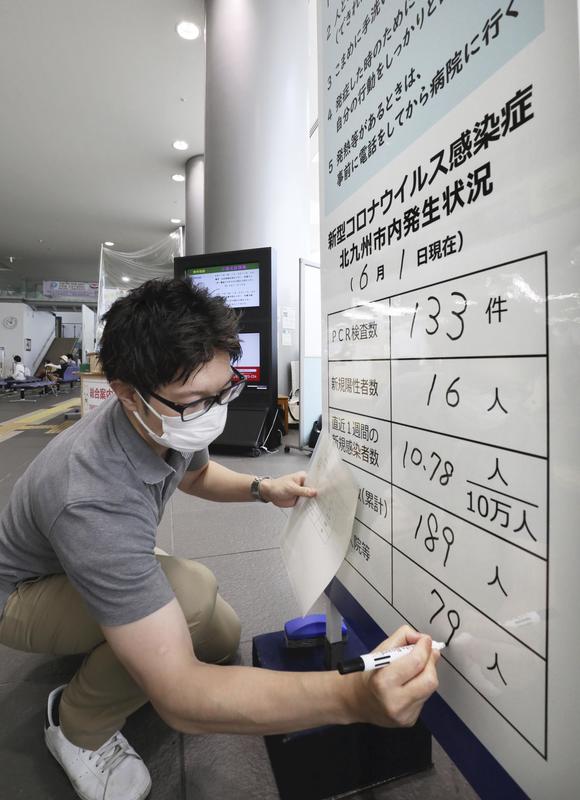
In Kitakyushu, the deaths of infected people are all counted as a death from the infection. In response, Fukuoka prefectural government officials with medical licenses and other staff interviewed the primary doctors of the deceased and determined whether their death was caused by the virus.
As a result, four patients who were deemed by Kitakyushu to have died of the coronavirus were excluded by the prefecture from a list of the dead.
The remaining five of the 62 local governments responded that they had not set a definition yet, but have included the deaths of infected people among those who died of the virus because they cannot consider any cause of death other than the coronavirus at present.
According to the Health, Labor and Welfare Ministry's International Affairs Division, the World Health Organization has not provided any definition to determine the cause of death as the novel coronavirus. The ministry also does not. However, several local governments are calling for the central government to come up with a unified definition.
-- 'Preliminary report'
The health ministry announced that 922 people infected with the novel coronavirus had died as of Friday in its report titled "Coronavirus disease 2019 (COVID-19) situation within and outside the country." This figure was said to have been reached by combining the deaths that all prefectures have posted on their websites, and it has been conveyed to the WHO.
In addition to tallying the death toll from the novel coronavirus, the ministry annually publishes vital statistics summarizing all the deaths in the country. Since the statistics are based on physicians' death certificates, the number of deaths from the novel coronavirus is expected to be fewer than currently announced figures.
This means the central government will announce two different numbers regarding deaths from the virus.
An official in charge at the ministry's Tuberculosis and Infectious Diseases Control Division said, "We rely on local governments to decide regarding the number of deaths to be published, and are aware that the definitions vary depending on local governments.
"We ask [the public to recognize] the current death toll as a preliminary figure and a guide. The number of deaths from the virus counted on a uniform basis will be shown in vital statistics."
-- Experts: Unify definition
Osaka City University Prof. Ayumi Shintani, who specializes in medical statistics, said: "The number of deaths is a matter of worldwide concern, and it's not convincing to tell other countries that our figures 'vary from municipality to municipality.' The central government should unify and clearly define deaths [from the novel coronavirus] in order to compare how the situation differs between counties as well as between prefectures."
Norio Omagari, director of the Disease Control and Prevention Center at the Tokyo-based National Center for Global Health and Medicine, said: "The number of deaths is one of the indicators for medical workers to determine whether treatment is being provided properly. I urge the definition be unified in preparation for the possible second wave of the outbreak.
"Swift action is necessary. So it might be better to use a method that does not involve human judgment, such as '[a death from the coronavirus has to be] a case in which the patient dies within four weeks of testing positive.'"
Read more from The Japan News at https://japannews.yomiuri.co.jp/