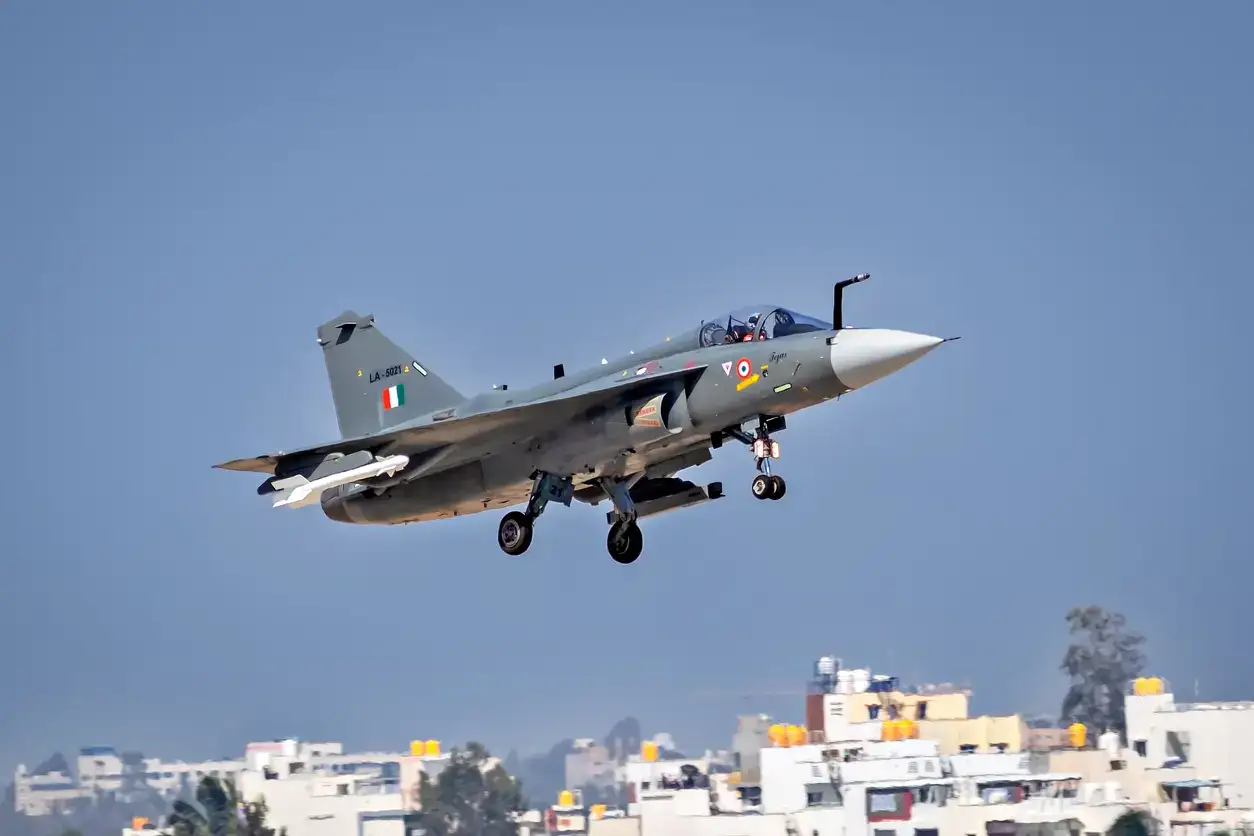
The Defence Ministry expects around 18 to 24 Light Combat Aircraft (LCA) Mark1A to be ready by the end of this year, according to sources cited by ANI.
Defence ministry sources told ANI that the production and readiness schedule for the LCA Mark1A is expected to reach approximately 18 to 24 aircraft by the end of the current year after suffering significant delays due to GE F414 engine delays from the US firm.
Defence Ministry sources told ANI, Defence Minister Rajnath Singh reviewed the LCA programme and assessed its progress. According to the sources, six LCA Mk1A aircraft equipped with engines are currently ready, while 18 to 24 aircraft are expected to be ready by the end of the year, provided Hindustan Aeronautics Limited (HAL) addresses the remaining Air Staff Qualitative Requirements (ASQRs).
The sources said several milestones have already been achieved under the indigenous programme, although some requirements are yet to be completed to the satisfaction of the Indian Air Force. They expressed hope that the remaining shortcomings would be addressed later this year.
The sources further stated that delays in the programme could attract penalties and that HAL has been directed to fulfil its commitments and adhere to the prescribed timelines.
HAL to deliver 180 Tejas Mk1A jets to IAF under two contracts
The Indian Air Force (IAF) has placed orders for 180 Light Combat Aircraft (LCA) Mk1A fighters in two tranches, with Hindustan Aeronautics Limited (HAL) currently maintaining a production capacity of 24 aircraft annually.
HAL received its first contract from the IAF in February 2021 for 83 LCA Mk1A aircraft, comprising 73 fighter variants and 10 trainers. A second order for 97 additional aircraft was placed in September 2025 at a cost of more than Rs 62,370 crore.
At the current production rate, HAL is expected to take more than seven years to complete deliveries, with the entire fleet projected to be inducted by around 2033.
Why the LCA Mk1A is important for the IAF
The LCA Mk1A is an upgraded version of the Tejas fighter aircraft and forms a key part of the IAF's efforts to replace its retired MiG-21 fleet and address declining squadron strength.
A 4.5-generation, single-engine, multi-role fighter, the aircraft is designed to undertake air defence, ground attack and maritime strike missions.
Key upgrades over the Tejas Mk1
The Mk1A introduces several enhancements compared with the earlier Tejas Mk1 variant. These include an Active Electronically Scanned Array (AESA) radar, an indigenous electronic warfare suite, air-to-air refuelling capability and improved maintenance systems.
The aircraft's indigenous content exceeds 64%, with 67 additional Indian-origin components incorporated into the platform.
The AESA radar improves target detection and tracking while enabling simultaneous air-to-air and air-to-ground engagements. The electronic warfare suite enhances survivability through threat detection and jamming capabilities.
The fighter also features improved maintainability through Line Replaceable Units and advanced diagnostic systems aimed at reducing turnaround times.
Weapons and operational capabilities
The IAF currently operates 40 Tejas Mk1 aircraft in Initial Operational Clearance (IOC) and Final Operational Clearance (FOC) configurations.
The Mk1A can carry a broad range of weapons, including beyond-visual-range missiles, close-combat missiles, precision-guided bombs, laser-guided munitions and anti-ship missiles. It is also equipped with a 23 mm internal cannon and multiple hardpoints for carrying weapons and external fuel tanks.
With 180 Mk1A aircraft on order, the Tejas programme is expected to remain a key component of India's fighter fleet until more advanced platforms such as the Tejas Mk2 and the Advanced Medium Combat Aircraft (AMCA) enter service.
Great Nicobar Islands development project
In a separate update, the ministry has also outlined plans under the Great Nicobar Islands development project, which includes an investment of Rs 13,000 crore for the construction of an airport and runway intended for dual use by the Indian Navy and civilian operations. The project is projected to be completed within five years, with funding to be shared by the Defence Ministry and the Ministry of Civil Aviation.
Under the Great Nicobar Islands development initiative, India plans to invest Rs 13,000 crore in building an airport and runway designed for both military and civilian use. Officials have stated that the project is expected to be completed over a five-year period, with financial responsibility shared between the Defence Ministry and the Ministry of Civil Aviation.