The national swim team held its training camp in December at an indoor pool in Tomi, Nagano Prefecture, a location 1,730 meters above sea level. Daiya Seto, Ippei Watanabe and Yui Ohashi were included in the group, which is expected to reach heights by winning multiple medals at the Tokyo Olympics.
Even these top swimmers called the high-elevation training "tough" though, because of an oxygen level that is 80% of normal density.
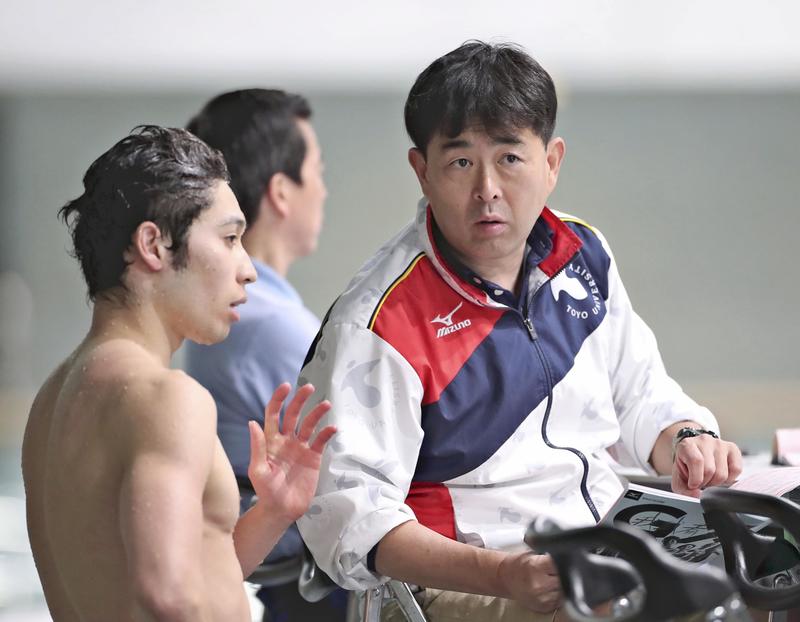
The person keeping a sharp eye on the athletes when they swim is head coach Norimasa Hirai.
About 20 years ago, he shunned criticism and introduced high-altitude training. It is now widely known as a method that improves cardiopulmonary functions and strengthens the body to fight against fatigue.
Many of his pupils have put up excellent results, but Hirai is not satisfied. "Swimming at high altitudes doesn't necessarily mean you'll improve," he said. "I'm always trying to think about how to incorporate it into our other training methods to produce good results."
Hirai was a member of the Waseda University swim club, but didn't find much success in his athletic career.
At the prompting of those around him, he reluctantly transitioned to team manager. Swimmers he helped coach appeared in the 1984 Los Angeles Olympics. He felt a closeness to the Games that he had not been familiar with until that time.
Despite his parents' opposition, he joined the prestigious Tokyo Swimming Center as a coach in 1986. Hirai, at a welcoming party for new employees, said, "I came here to help develop Olympic athletes."
About 10 years after joining the company, he discovered Kosuke Kitajima, a junior high school swimmer. Kitajima had muscles with elasticity and was extremely hard to beat on race day.
Whenever Hirai offered him advice, the swimmer took in the words with a glare.
During a meeting to select the athletes who would be invited to train for the Olympic team, Hirai recommended Kitajima be on the list.
Questions were raised about Kitajima being too physically stiff, but Hirai countered with strong arguments. Hirai was convinced, thinking: "The knee and ankle joints needed for breaststroke are flexible. He can compete at the world-class level if he improves on these advantages."
When Hirai was worried about how to get Kitajima to achieve a major record, he recalled books written by Kenji Kimihara, a marathon silver medalist at the Mexico Olympics, and other titles he had read as a student.
The books described the training he had done at a high altitude.
In swimming circles at the time, high-altitude training was regarded as effective for long-distance swimmers who need endurance, but not for those competing at short distances.
As he read material from other sports, Hirai began thinking a change in the length of stay and training intensity at high altitudes would be effective for short-distance swimmers like Kitajima.
"If you aim for the top of the world stage, you can't be afraid to change common thinking that someone has created."
In the spring of 1999, Hirai and Kitajima -- then a high school student -- flew to the United States for the highlands of Arizona.
Kitajima, who returned to Japan about a month later, subsequently broke his own record. He finished fourth at the Sydney Olympics the following year. He won gold medals in two events, the 100- and 200-meter breaststrokes, in Athens and then again in Beijing.
Kitajima said: "Hirai walked one or two steps ahead of me toward the same dream. At that time, I was preoccupied with getting through practice. But my belief was, 'This will make you stronger.'"
Hirai helped develop numerous medal winners, including Reiko Nakamura, Aya Terakawa and Kosuke Hagino.
"I have always been looking for swimmers of different types. I don't subscribe to the notion that all the strong swimmers are just like Kitajima."
Hirai adjusts practices and his methods of interaction with the athletes, urging them positively to get their work in.
He is active in introducing new practice methods such as recently bringing in bicycle-type training equipment.
"No paths will just open up for you if you follow conventional wisdom. The Tokyo Olympic medals will come at the end of a challenge."
The decorated coach is pushing forward toward the big stage.
Read more from The Japan News at https://japannews.yomiuri.co.jp/