
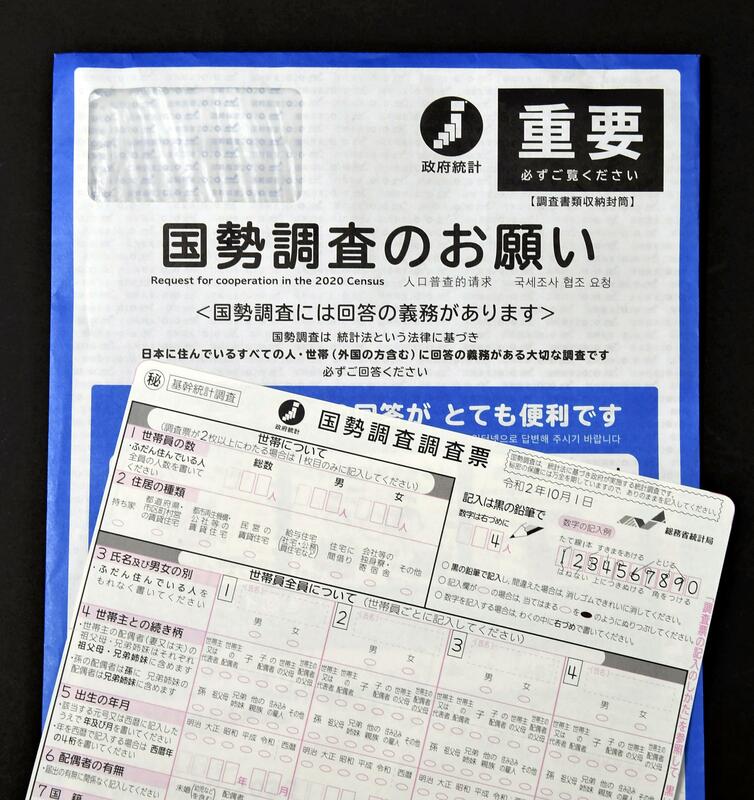
The total population of Japan as of Oct. 1, 2020 was 126,146,099, according to the definite figures of the 2020 national census released by the Internal Affairs and Communications Ministry. The number marked a decrease of about 950,000, or 0.7%, from the previous census in 2015.
Also revealed was that as the number of Japanese drops because of a declining birthrate, the decline has been mitigated somewhat by a significant increase in the number of foreigners.
This article will examine the results of the census conducted in the middle of the novel coronavirus pandemic and problems to be addressed.
The national census is conducted once every five years and covers every household in Japan. It serves as a key statistic used by the government to redistrict constituencies in the House of Representatives and to calculate tax grants allocated to local governments.
From the start of the census in 1920, the population had marked an increase every time until peaking at 128,057,352 in 2010, after which it entered a downward trend.
In the latest census, Japanese nationals numbered 123,398,962, a decrease of about 1.78 million (1.4%). In contrast, the population of foreign nationals increased by about 830,000 (43.6%) to 2,747,137.
The percentage of foreigners in the overall population was 2.2%, the highest since the end of World War II. By prefecture, Tokyo topped with 4%, followed by Aichi Prefecture (3.4%), Gunma Prefecture (3.1%), and Mie Prefecture (2.9%). By nationality, Chinese accounted for the most with 667,475. Notably, the number of Vietnamese nearly quadrupled from the previous census to 320,805.
Behind the trend are the increase in admissions of technical trainees from overseas to help ease labor shortages in the agriculture, fishery, and manufacturing industries, and the escalation of accepting foreign students in response to the globalization of society.
Aside from the technical trainees, who are expected to transfer skills back to their home countries, more foreigners arrived following the introduction of a new residence status of "specified skilled worker" in 2019 that permits employment in various fields.
Although admissions into the country have been halted due to the pandemic, the percentage of the foreign population can be expected to increase over the mid to long term.
-- Dire issue of low birth rate
The percentage of the population aged 65 and older rose from 26.6% in the previous census to 28.6%. Akita Prefecture has the highest percentage at 37.5%, followed by Kochi Prefecture (35.5%), indicating they are mostly concentrated in rural areas. The percentage of those aged 75 and older similarly increased from 12.8% to 14.7%.
"It's not just about the increasing percentage of elderly people, but that the age group that has a higher need for medical and nursing care is quickly growing," said Hisakazu Kato, a professor of population economics at Meiji University. "The latest census brings to light the seriousness of an aging population."
The census also revealed the direness of a declining birth rate. The percentage of the population under 15 was 11.9%, a decrease of 0.7 percentage points from the previous census. That is the lowest level in the world.
The main cause is the trend of people getting married later, or not marrying at all. The percentage of unmarried males and females aged 15 and older is 29.5%, an increase of one percentage point from the previous census. Among prefectures, the unmarried percentage is highest in Tokyo at 37.7%, while the neighboring prefectures of Kanagawa, Chiba, and Saitama also rank high.
The Health, Labor and Welfare Ministry's vital statistics on population show that the total fertility rate, which is the estimated average number of children a woman gives birth to in her lifetime, was down to 1.34 in 2020, a decrease by 0.11 points from 2015.
The drop in the birth rate is due partly to the influx of young women from rural Japan to the Tokyo metropolitan area, where the birth rate is low, and there seems no way of stopping this negative chain reaction.
Then, how to deal with this problem?
A focus of attention is the percentage of unmarried women aged 25 to 34. It soared to 51.8% from 49.1% in the previous census. The trend to marry later or not at all has gained momentum over the last five years, making it an urgent task to create an environment that allows them to get married and give birth as they want.
-- Lower accuracy
The distribution of forms for the latest census started on Sept. 14, 2020. In the past, they were mainly distributed and collected personally by census takers, but this time, to help prevent possible spread of infections, a non-contact style was adopted as much as possible.
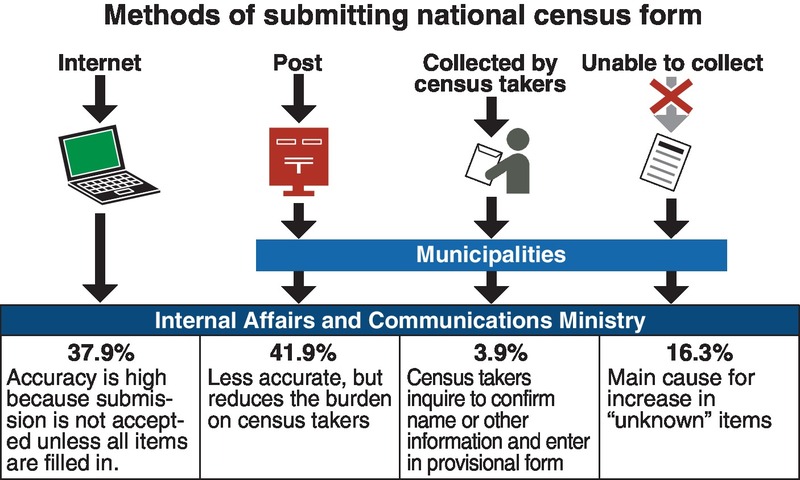
Each household received the form in the mail, and was asked to submit their responses in principle either by the internet or post.
The percentage of submissions by post was the highest with 41.9%, while the internet accounted for 37.9%, less than the target of 40%. Collection by census takers stood at 3.9%.
The percentage of forms that could not be collected, because residents were away or for other reasons, was 16.3%, an increase of 3.2 percentage points from the previous census.
"Under the adverse circumstances of using the non-contact style in principle, the percentage of submissions by post increased greatly from 34.1% of the previous survey, which is a certain achievement," says the census department of the Internal Affairs and Communications Ministry.
Still, given the increase in the number of uncollected forms, the department acknowledged, "We cannot deny the accuracy of the census was lowered."
-- Even in rural areas
Municipalities usually fill in unanswered items in the collected forms through personal visits by census takers or by referring to the Basic Resident Registration. However, as this can done for only so many items, and many are marked "unknown" with no data.
The number of uncollected forms began to increase rapidly from 2005, after the Protection of Personal Information Law took effect. The increase in auto-lock apartment buildings also has had an effect.
In the latest census, there were about 2.2 million people for whom it was unknown whether they were Japanese or a foreigner, double the 1.06 million in the 2015 census.
The number of people whose marital status is unknown rose from about 2.71 million to about 4.62 million. Up to now, such unknowns were mainly in large cities, but the latest survey revealed that they have increased in rural areas as well. For example, the number has nearly tripled in Yamagata, Nara, and Miyazaki prefectures.
The national census department says that the increase may have stemmed from the principle use of the non-contact style in municipalities that conventionally relied mainly on collection by census takers.
For the next census in 2025, the department aims to decrease the "unknowns" by using census takers and being more proactive with internet submissions, all based on the assumption that the coronavirus will be contained by then.
Read more from The Japan News at https://japannews.yomiuri.co.jp/












