 Business documents should persuade, make a clear case, and hold up under scrutiny. Yet as AI-written prose spreads through proposals, decks, and internal reports, teams hit a quieter snag: the words read fine but ring hollow. Using an AI Checker at the drafting stage helps organizations identify mechanical phrasing, restore human judgment, and protect credibility before decisions are made based on the text.
Why Business Writing Suffers Most From AI Overuse
Fluency Is Not the Same as Trust
In business settings, clarity by itself doesn’t cut it. Stakeholders read between the lines, listening for ownership, accountability, and intent. AI-generated copy often avoids strong commitments and defaults to neutral framing. While this reduces immediate risk, it also weakens persuasion and accountability.
Decision-Makers Sense Distance Quickly
Executives and clients may not consciously identify AI-generated language, but they often react to it. Phrases feel generic, conclusions feel hedged, and recommendations lack conviction. Over time, this erodes confidence in both the document and the team behind it.
Internal Documents Carry External Consequences
Internal reports steer strategy, budgets, and performance reviews. When these documents lean too hard on AI summaries, small mismatches snowball into choices that hit headcount, spend, or timelines. Detection becomes a seatbelt, not a coat of paint.
How AI Detection Changes Business Writing Outcomes
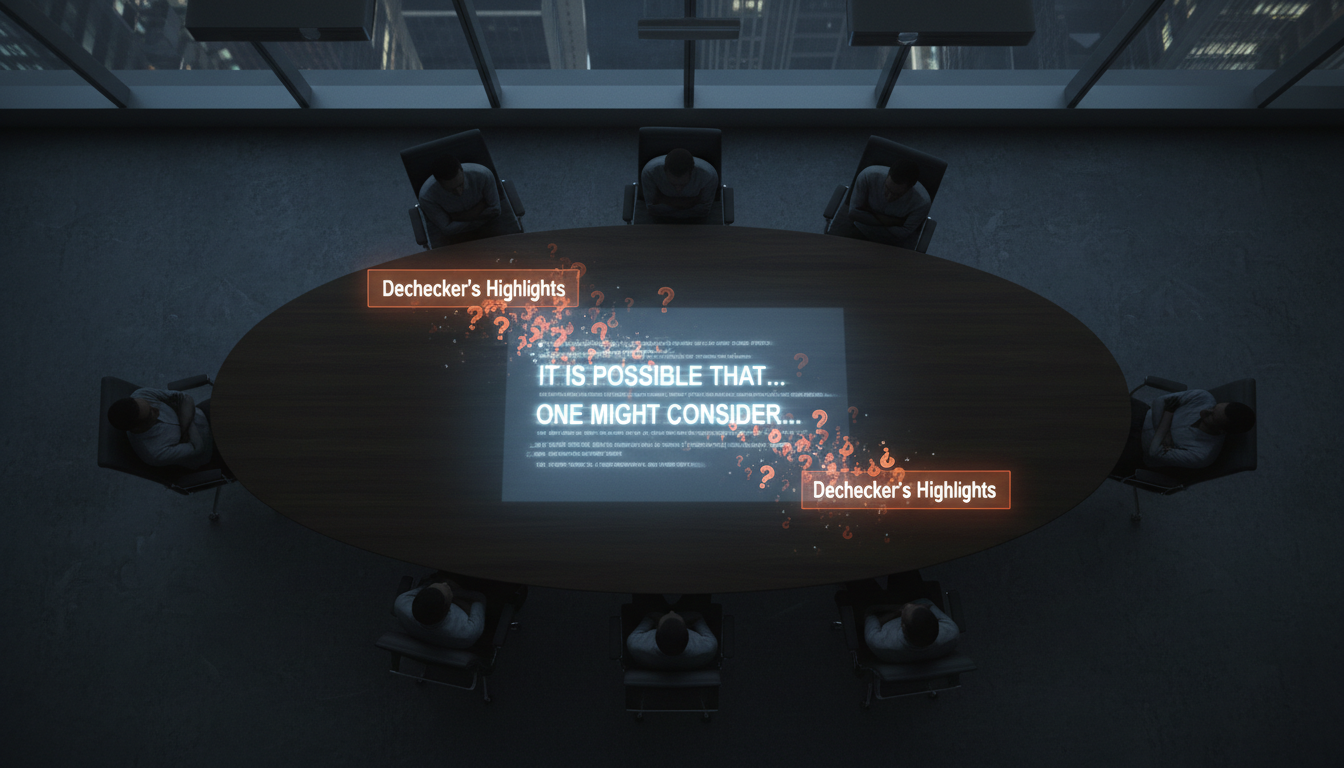
In business contexts, the value of AI detection lies less in identifying whether AI was used and more in revealing how that usage affects meaning, tone, and trust. An effective AI Checker brings visibility to mechanical language before it ever reaches stakeholders. These are the shiny paragraphs that feel hollow—stuffed with broad claims, careful but non‑committal phrasing, and wrap‑ups that recap instead of choose. When these sections surface early, teams can swap automation for substance—bringing in hard numbers, real trade‑offs, and lived judgment that decision‑makers actually trust.
Detection also reshapes how revision happens under pressure. Business writing rarely allows the luxury of starting over. Proposals, reports, and presentations are revised incrementally, often hours before approval. By pinpointing only the sections that weaken credibility, AI detection enables focused edits instead of exhaustive rewrites. Editors and managers can spend their limited time strengthening the most sensitive parts of a document, preserving speed while improving confidence in what is being delivered.
Over time, AI detection contributes to something more structural: a shared understanding of what “human enough” looks like in business communication. In large organizations, writing standards vary widely across teams and roles. Detection results provide a neutral reference point that helps align expectations, reducing subjective debate about tone or authenticity. Rather than banning AI or relying on vague guidelines, teams gain a practical framework for balancing efficiency with responsibility. In this way, AI detection quietly improves not just individual documents, but the overall quality and credibility of business communication at scale.
Dechecker in Real Business Scenarios
Client Proposals and Pitch Decks
Proposals often combine market analysis, strategic framing, and financial projections. AI-generated text tends to smooth over uncertainty, which can make proposals feel safe but uninspiring. Detection highlights where stronger positioning or clearer ownership is needed to win trust.
Executive Summaries and Board Reports
Summaries shape interpretation. AI-generated executive summaries may accurately restate content while missing nuance or urgency. Detection allows leaders to ensure that summaries reflect real priorities rather than neutral synthesis.
Internal Performance and Strategy Reports
When teams rely on AI to draft internal reports, the language can unintentionally mask problems or dilute accountability. Detection helps surface these areas, prompting more honest and actionable communication.
Integrating Dechecker Into Business Workflows
From Draft Review to Final Approval
Dechecker’s AI Checker fits naturally into existing approval processes. Teams can run checks before final sign-off, ensuring that documents represent genuine analysis rather than automated phrasing.
Cross-Functional Collaboration
Business documents often involve multiple contributors. Detection helps harmonize tone and depth across sections written by different teams, reducing inconsistencies that undermine credibility.
Speed Without Added Complexity
Business users rarely tolerate tools that feel technical or disruptive. Dechecker’s fast, straightforward analysis encourages adoption across roles, from consultants to internal analysts.
AI Detection Beyond Written Reports
When Business Insights Start as Conversations
Meetings, interviews, and workshops often generate the most valuable insights. These are frequently transcribed using an audio to text converter before being shaped into reports. When AI later assists with summarization or restructuring, detection helps ensure that the original intent is preserved rather than replaced with generic phrasing.
Preserving Accountability in Automated Workflows
AI excels at smoothing transitions and filling gaps. Detection introduces a moment of accountability, prompting teams to confirm that recommendations truly reflect their judgment.
Preparing for Audit and Compliance Review
In regulated industries, documentation may be reviewed long after creation. Detection reduces risk by ensuring that reports demonstrate clear human oversight and reasoning.
Choosing an AI Checker for Business Use
Interpretability Over Technical Metrics
Business users need clarity, not statistical abstraction. Dechecker focuses on actionable signals, making it easier to decide whether to rewrite, clarify, or expand flagged sections.
Low Friction for High Adoption
Tools that slow workflows are quickly abandoned. Dechecker’s immediate feedback makes detection a habit rather than an exception.
Supporting Long-Term Communication Standards
As AI becomes embedded in business writing, governance matters more than prohibition. Detection supports internal guidelines that balance efficiency with credibility, ensuring consistency across documents and teams.
Conclusion: Credibility Is a Business Asset
In business communication, words shape decisions, relationships, and outcomes. AI-generated text can accelerate drafting, but unchecked automation introduces subtle risks that compound over time. Dechecker offers organizations a way to see where language stops reflecting human judgment and starts sounding mechanical. By using an AI Checker as part of routine review, teams protect not just writing quality, but trust itself.