
The December Fed meeting concluded on December 10, with the central bank issuing its third straight quarter-point rate cut.
The central bank also released its Summary of Economic Projections, or dot plot, which remained more or less the same from September, but gave more optimistic outlooks for the economy and inflation.
"Powell got out his three wood and hit it right done the middle," says Ryan Detrick, chief market strategist at Carson Group. "The market got the cut it wanted and although a January cut isn't the base case, by no means did they put cold water on that potential move. Then the cherry on top was a stronger forecasted economy next year, never something we'd consider a bad thing."
The Kiplinger team is reported live on the December Fed meeting, bringing you the news and our expert analysis of what it could mean for the economy. Scroll for all the updates.
Best Stocks to Buy for Fed Rate Cuts | Falling Interest Rates: What They Mean for Homeowners, Savers and Investors | What's Next for the Fed — as an Institution?
Fed meeting schedule for 2026
The next Fed meeting, which runs from December 9 to December 10, marks the final gathering of 2025. Looking ahead to 2026, the Federal Open Market Committee will hold its first meeting of the new year on January 27 to 28.
"The committee meets eight times a year, or about once every six weeks," writes Kiplinger contributor Dan Burrows in his feature, "When Is the Next Fed Meeting?".
The Federal Open Market Committee "is required to meet at least four times a year and may convene additional meetings if necessary," Burrows adds, noting that "the convention of meeting eight times per year dates back to the market stresses of 1981."
Fed meetings last two days and wrap up with the release of a policy decision at 2 pm Eastern Standard Time. This is typically followed by the Fed chair's press conference at 2:30 pm.
Here is the full Fed meeting schedule for 2026:
- January 27 to 28
- March 17 to 18
- April 28 to 29
- June 16 to 17
- July 28 to 29
- September 15 to 16
- October 27 to 28
- December 8 to 9
- Karee Venema
Who gets to vote at the December Fed meeting?
The Federal Open Market Committee (FOMC) has 12 total members, eight permanent and four who rotate each year.
The eight permanent voting committee members include the Fed chair and vice chair, the five Fed governors and the president of the New York Fed.
Four regional Fed presidents are rotated in each calendar year.
The 2025 FOMC voting committee consists of:
- Fed Chair Jerome Powell
- Vice Chair Philip Jefferson
- Fed Governor Michael Barr
- Fed Governor Michelle Bowman
- Fed Governor Lisa Cook
- Fed Governor Stephen Miran
- Fed Governor Christopher Waller
- New York Fed President John Williams
- Boston Fed President Susan Collins
- Chicago Fed President Austan Goolsbee
- St. Louis Fed President Alberto Musalem
- Kansas City Fed President Jeffrey Schmid
In 2026, the presidents from Cleveland, Philadelphia, Dallas and Minneapolis will rotate in as FOMC voting members, according to the Federal Reserve. Additionally, Jerome Powell's term as Fed chair is up in May.
- Karee Venema
How can you invest for lower interest rates?
With the Federal Reserve expected to cut rates at its final meeting of 2025, many investors may be wondering how they can prepare their portfolios.
One way is to seek out high-quality growth stocks, which tend to see outsize benefits from lower interest rates.
This happens for two reasons, says Kiplinger contributor Charles Lewis Sizemore, CFA. For one, lower rates make capital cheaper and "young, fast-growing companies often rely on external funding."
Additionally, lower interest rates boost the current value of future profits, which increases valuations for firms with long-term earnings potential.
Read more: How to Invest for Fall Rate Cuts by the Fed
Markets are optimistic about a rate cut
Equity index futures pointed to a higher open for Fed Week Monday morning, following through on solid gains for the first week of December. The S&P 500 closed higher for a fourth straight session and its ninth out of 10 on Friday.
"The stock market may have bounced back strongly from its November pullback," E*TRADE Managing Director Chris Larkin observes, "but a new up leg to its rally is still a work in progress."
According to Larkin, what the FOMC does and Federal Reserve Chair Jerome Powell say on Wednesday "will likely determine whether the S&P 500’s October record highs turn out to be genuine resistance level or just the latest notch on the bull market’s belt."
FedWatch shows a near-90% probability the FOMC will cut the target range for the federal funds rate by another 25 basis points, following similar moves in September and October. As Larkin notes, recent incoming economic data highlight both "ongoing labor-market softness and sticky inflation.
So lower interest rates at this meeting "might not be a slam dunk" despite market optimism. "As is often the case, though," Larkin concludes, "Chair Powell’s press conference could play a big role in shaping the market’s short-term response."
– David Dittman
The Fed's windshield is foggy
The three main U.S. equity indexes turned negative less than an hour into Monday's trading session as investors continue to process incoming data from the economic calendar.
The S&P 500 was down about 0.2% a little more than 50 minutes after the opening bell but remained within 0.5% of its October 28 record closing high of 6,890.89. The Dow Jones Industrial Average was off 0.3%, and the Nasdaq Composite was down 0.1%.
We should probably expect a little intraday up-and-down this week, which will still amount to not much compared to movement in expectations around what the Fed will do this week.
FedWatch has been all over the place amid unprecedented data-blindness due to a record-long government shutdown. Today, it shows a near 90% probability of a 25-basis-point rate cut.
As recently as November 19 markets were about 70% certain the FOMC would hold the target range for the federal funds rate at 3.75% to 4.00% after cutting at its September and October meetings.
“To my knowledge, it’s totally unprecedented,” Peterson Institute of International Economics Senior Fellow David Wilcox told Quartz.
Wilcox said the present situation is "off the charts" and compared the Fed to a person driving with a foggy windshield.
– David Dittman
For whom the Fed bids
As Bloomberg's Joe Weisenthal notes, nobody cares about the independence of the U.S. central bank amid lingering questions about what's next for the Fed as an institution during President Donald Trump's second run in the White House.
The White House has already openly discussed whether it would fire Fed Chair Jerome Powell as it lobbied for lower interest rates through most of 2025. And there's a pending Supreme Court case that will resolve Gov. Lisa Cook's future on the Fed's board.
"There's a ton of talk on Wall Street and in the media that Fed independence is at risk of going away," Weisenthal observes. "That is definitely a valid concern."
He cites Trump's public criticism of the FOMC and the fact that the president named the chair of his own Council of Economic Advisors to fill a recent vacancy on the board.
And Trump will soon name a successor to Powell: "One likely candidate is Kevin Hassett, and there is a fear that Hassett will be there to do Trump's bidding, rather than assiduously pursue the Fed's dual mandate."
At the same time: "There's not much evidence that this is a real concern in the market right now." Weisenthal quotes Standard Chartered macro strategist Steve Englander at length but the bottom line is right here:
"Questions have been raised about Kevin Hassett’s credibility with markets and within the FOMC," Englander writes, "but the questions are not showing up so far in inflation breakevens, which are close to post-2024 election lows."
As Englander explains, "If Hassett as Federal Reserve Board Chair is expected to compromise inflation outcomes, this is where we would expect to see these concerns most clearly."
– David Dittman
The first half of the first day of Fed Week
There's a split among the "bullish" sectors – communication services, financial stocks, industrials and technology stocks – in the first half of Monday's trading session. The first two are in the red, the other two are in the green.
And all three main U.S. equity indexes have stabilized with modest losses of 0.2% to 0.3%.
Action in the bond market is similarly stable, with the yield on the 2-year U.S. Treasury note up to 3.602% from 3.564% on Friday. The 10-year U.S. Treasury yield is up to 4.178% from 4.139%, the 30-year from 4.822% from 4.792%.
FedWatch shows the probability of a 25-basis-point rate cut has dipped from 89.9% to 87.6%.
What's moving markets while we're watching the Fed? Probably Netflix (NFLX), which faces a hostile challenge from Paramount Skydance (PSKY) as it tries to complete its next eyeball-catching expansion with the acquisition of Warner Bros. Discover (WBD).
NFLX, a leader among communication services stocks, is down more than 4% as of midday Monday. The stock recently split 10 for 1.
Tech stocks were up but off their highs after International Business Machines (IBM) announced an $11 billion deal to acquire data-infrastructure firm Confluent (CFLT), as markets continue to ask whether we're in an AI bubble.
– David Dittman
The Supreme Court and the Federal Reserve
The Supreme Court is hearing oral arguments today in a case many observers consider a preview of the upcoming matter of whether President Donald Trump can fire Fed Governor Lisa Cook.
The White House is asking the high court to overturn a precedent established in a 1935 case, Humphrey's Executor v. United States, that limits presidential authority to remove the heads of independent agencies.
As Reuters reports, during today's questioning Associate Justice Brett Kavanaugh asked Solicitor General D. John Sauer, arguing on behalf of President Trump, about implications for the U.S. central bank.
"How would you distinguish the Federal Reserve from agencies such as the Federal Trade Commission?" Justice Kavanaugh asked. The Supreme Court will hear arguments on Trump's attempt to fire Cook on January 21.
In May, the Court issued an opinion suggesting at least six justices would rule against the president. It did not explicitly overrule Humphrey's Executor, but it did allow him to fire two members of other federal agencies' boards.
And the Court offered a two-sentence summary on the question it will begin to answer next month.
"Finally," the six-member majority wrote in an unsigned opinion, "respondents Gwynne Wilcox and Cathy Harris contend that arguments in this case necessarily implicate the constitutionality of for-cause removal protections for members of the Federal Reserve's Board of Governors or other members of the Federal Open Market Committee.
"We disagree. The Federal Reserve is a uniquely structured, quasi-private entity that follows in the distinct historical tradition of the First and Second Banks of the United States."
– David Dittman
Does Gen Z even care about the Fed?
In its most romantic guise it's the foundation of a whole new financial system where things like the next Fed meeting simply don't matter. In more prosaic terms what cryptocurrency is and how bitcoin works boil down to digital money.
At the same time, young people recognize what's happening here: crypto is growing and maturing. More evidence comes from an October 2025 YouGov survey surfaced by Marketwatch.com today.
According to YouGov (pdf), 26% of young men own cryptocurrency, and 28% own any crypto-based asset such as individual tokens and/or coins, crypto-based ETFs, or both. Meanwhile, 21% say they have a 401(k), Roth IRA or similar retirement fund. And 24% say they hold individual stocks.
This is consistent with similar findings from YouGov reported by Fortune in February: "Gen Z investors are four times more likely to own crypto than retirement accounts."
To be clear, these are the crypto trends we're watching in 2026.
– David Dittman
Certainty, uncertainty and the Fed
The three main U.S. equity indexes continued to head lower Monday afternoon amid rising volatility (as measured by the market's "fear index") and a lot of known unknowns.
"The uncertainty of the nature of the Fed cut expected this Wednesday has put the market in a wait-and-see mode," Louis Navellier of Navellier & Associates observes.
That 87.4% (and falling, if ever so slightly) probability is "clouded by the expectations that the cut will be highly contentious internally and whether the rhetoric will be hawkish enough to bring serious doubts about any further cuts until Chairman Powell is replaced in May."
Navellier notes as well that absence "of complete economic data due to the catch-up from the extended government shutdown also makes reaching conclusions difficult."
He says too that a developing "trend in interest rates is becoming more challenging," highlighting the move in the 2-year U.S. and the 10-year U.S. government yields to their highest levels in more than a month and since March, respectively.
"The VIX had dropped to 15.3 premarket, the lowest in three months," Navellier adds, "and has jumped back to 16.8 in an apparent caution over the upcoming Fed cut."
While the trend remains cautiously positive, he concludes, uncertainty will continue until after Wednesday's FOMC decision and commentary from the outgoing Fed chair.
– David Dittman
About the Fed's data deficit
Much is being made of the economic data deficit the longest government shutdown in the history of the United States has created for the Federal Reserve.
A lot of the ups and downs for expectations about what our central bankers will do with the federal funds rate have been fueled by the absence of information about jobs and inflation.
Now imagine a world where data about the holdings of the biggest investors, traders and speculators on the planet across the full spectrum of financial assets – including buy and sell transactions – is available in real time.
Among the crypto trends we're watching in 2026 is "integration and convergence": where "TradFi" and "DeFi" combine to make things more efficient for everyone.
OK, look, yes, we're not contemplating real-time Consumer Price Index (CPI) data (the dream is, of course, PCE…).
But at least some market participants were limited by the delay in commitment of traders reports from the Commodity Futures Trading Commission.
And the fast-growing and rapidly maturing crypto industry shows us how to solve problems like that, for the long term.
– David Dittman
Does the Fed need to think about deflation?
"This week will be all about the Federal Open Market Committee (FOMC) statement on Wednesday," Louis Navellier of Navellier & Associates says. Still, there are notable names on the earnings calendar, including Oracle (ORCL, +1.4%) and Broadcom (AVGO, +2.8%).
Navellier doesn't expect the FOMC to signal more cuts to interest rates in its post-meeting statement "no matter what their dot plot signals" because voting members remain "very uncomfortable with the delay in economic data from the federal government shutdown."
At the same time, the Fed must cut the target range for the federal funds rate two more times – in addition to a 25-basis-point move this week – "and move to a 'neutral' rate."
According to Navellier, "The inflation risk has fizzled, and due to falling home prices, excess rental properties, and falling crude oil prices, if anything, there is a potential deflation risk that the Fed must consider."
As of Monday's closing bell, FedWatch shows an 89.4% probability of a quarter-point rate cut at the conclusion of this week's FOMC meeting.
And we'll be there all the way through to the other side of Fed Chair Jerome Powell's press conference.
– David Dittman
Stocks start Fed Week on a negative note
Stocks trended lower throughout Monday's session as caution set in ahead of the December Fed meeting. The central bank is widely expected to announce its third straight quarter-point rate cut Wednesday afternoon. However, uncertainty remains about what's in store for interest rates and the economy in 2026.
"This week's FOMC decision could set the tone for the remainder of 2025 and beyond, shaping expectations for monetary policy, risk appetite, and market leadership," says Mark Hackett, chief market strategist at Nationwide.
Another rate cut "would reinforce the narrative of easing financial conditions," while "any deviation from the expected path, or hawkish commentary, could recalibrate positioning and volatility as investors reassess the Fed's resolve," Hackett adds.
At today's close, the blue-chip Dow Jones Industrial Average fell 0.5% to 47,739, the broader S&P 500 slipped 0.4% to 6,846, and the tech-heavy Nasdaq Composite shed 0.1% to 23,545.
Read more: Stocks Slip to Start Fed Week: Stock Market Today
Four rate cuts in the next 12 months?
Scott Helfstein, head of investment strategy at Global X, says it's not out of the realm of possibility for the Federal Reserve to cut rates up to four times over the next 12 months.
"Simply put, real rates, or Fed funds minus inflation, is too high," explains Helfstein. "That will ultimately drive the Fed in the coming meetings. Powell noted that inflation ex-tariffs was much closer to target than the headline number and risks to the employment mandate are rising."
As such, the Fed is expected to cut rates this week and Chair Powell will likely warn that future rate cuts are no guarantee. "This really should not be surprising nor trigger a market move, but it might," says the strategist. "They are going to be data dependent, and as of now, data favors lower rates."
The bottom line, he points out, is that the Fed appears to be on a slow, sustained path toward lower rates. This and strong earnings will likely keep the wind in the stock market's sail.
Looking ahead to 2026, Helfstein believes tech stocks will continue to perform well, but a broader rotation will benefit infrastructure and industrial stocks, as well as utilities.
- Karee Venema
Stock futures signal a lower start on Tuesday
Stock futures are trading cautiously lower ahead of Tuesday's open. At last check, futures on the Dow Jones Industrial Average and S&P 500 are down 0.1%, while the Nasdaq-100 is off 0.2%.
As for single stocks, Nvidia (NVDA) is up 0.3% in electronic trading after President Trump said the tech giant could sell its H200 AI chips to China in exchange for the U.S. receiving a 25% cut of the sales.
And alternative asset management firm Ares Management (ARES) is nearly 8% higher on news it will replace snack maker Kellanova (K), which Mars is acquiring, in the S&P 500, effective ahead of the December 11 open.
- Karee Venema
What is the greater risk to the economy: inflation or the labor market?
The Federal Reserve has spent the past several months trying to balance sticky inflation with signs of a major slowdown in the labor market, says Brent Schutte, chief investment officer at Northwestern Mutual Wealth Management Company.
This isn't anything new, he adds. Remember, the Fed has a dual mandate, as established by a 1977 amendment to the Federal Reserve Act, of maximum employment and stable prices.
But more recently, it's been an even tougher challenge.
Why? For one, says Schutte, there's less information available. Even "before the government shutdown, conflicting indicators of persistent inflation posed by tariffs versus a softening labor market and robust economic growth had already muddied the long-term economic outlook," he notes.
Additionally, economic divides have widened in recent years due to higher interest rates. Schutte says growth in areas that are sensitive to interest rates, including manufacturing and housing, has slowed, while higher-income investors have benefited.
This "K-shaped" economy makes "the Fed's job harder, as a policy that boosts one group may inadvertently drag down the other," Schutte explains. So, while the central bank is expected to cut rates by a quarter-percentage point this week, he believes there will likely be dissent among committee members.
- Karee Venema
Related: Kiplinger Jobs Outlook: A Good September Report Hides Ongoing Weakness
Who appointed Jerome Powell as Fed chair?
Jerome Powell assumed the role of Fed chair on February 5, 2018, after being nominated by then-President Donald Trump, who was serving his first term in the White House.
Powell's initial four-year stint as head of the Federal Reserve ended in 2022, but he was reappointed for a second four-year term on May 23, 2022, after being nominated by then-President Joe Biden.
Powell initially joined the Fed's Board of Governors in 2012 after he was nominated by then-President Barack Obama.
While Powell's second term as Fed chair will expire in May 2026, he can remain on the Fed's board until January 2028.
- Karee Venema
Job openings were unchanged in October
The Fed got its last labor market update ahead of tomorrow's policy announcement with this morning's release of the Job Openings and Labor Turnover Survey (JOLTS).
According to the Bureau of Labor Statistics, there were 7.67 million job openings in October, a tick higher than the 7.658 million job openings in September.
Total separations, which include quits, layoffs and discharges, slipped to 5.05 million from 5.264 million, as did hires (to 5.149 million from 5.367 million).
"The labor market is holding on, though it remains fairly unfriendly to job seekers," says Elizabeth Renter, senior economist at NerdWallet. "When employers aren't hiring, it makes it difficult for those without work, but also those who could otherwise move on from their current jobs to better opportunities."
The stagnation in both hiring and quits isn't great for the economy, she says, "but it's not bad enough to cause alarm. A more dramatic pullback in hiring could push the unemployment rate up, as could significant layoffs, but we're not seeing either of those in the data, yet."
- Karee Venema
Time to review your portfolio as the Fed lowers rates
No matter how you feel about the Federal Reserve's rate-cutting campaign, it's important to prepare your portfolio for lower interest rates, says Anne Kates Smith, executive editor of Kiplinger Personal Finance magazine.
"The good news for investors is that lower interest rates are largely positive for stocks — even in the second year of a rate-cutting cycle," she writes. Real estate, financials, tech and health care are among the sectors that tend to perform well in the second year of rate cuts, while mid- and small-cap stocks offer attractive options as well.
- Karee Venema
Read more: How to Position Your Portfolio for Lower Interest Rates
Will the Fed cut rates in December?
The Federal Reserve is widely expected to cut interest rates at its December 9-10 meeting as inflation holds steady and downside risks to the labor market remain.
As of December 9, CME Group FedWatch showed futures traders are pricing in an 89.6% probability the FOMC will lower the federal funds rate by 25 basis points (0.25%) to a range of 3.50% to 3.75%. This would mark its lowest level since September 2022.
- Karee Venema
Should you open a CD ahead of the Fed announcement?
Demand for certificates of deposit (CDs) has been on the rise in recent years, thanks to elevated interest rates, which weighed on stock market returns and had investors seeking out less-risky options.
With the Fed expected to cut rates again tomorrow, now could be an ideal time to lock in attractive yields on CDs.
The difference in yields on short-term and long-term CDs is minimal at the moment, so if you do decide to open a certificate of deposit, your choice between the two could rest with how long you're able to lock up your cash.
Remember that when putting your money into certificates of deposit, you're unable to access it until the CD matures. If you do withdraw funds ahead of time, you'll be charged a fee.
Read more: Should You Get a Long-Term or Short-Term CD Before the Next Fed Meeting?
The policy path for 2026 remains uncertain, says Raymond James CIO
The Fed will wrap up its final meeting of 2025 tomorrow afternoon and Wall Street is widely expecting the central bank to cut rates for a third straight time.
But just "beneath this near certainty lies an unusual public split within the Federal Open Market Committee," says Larry Adam, chief investment officer at Raymond James. "Recent dissents highlight the challenge of balancing a cooling job market against stubborn inflation – casting fresh uncertainty over the policy path for 2026."
And the end of Jerome Powell's term as Fed chair in May adds intrigue to the rate-cut debate. National Economic Council director Kevin Hassett, who is the frontrunner to replace Powell, said during a Wall Street Journal CEO Council event on Tuesday that "there's plenty of room" to cut rates moving forward "if the data suggests we could do it."
For now, Wall Street will have to rely on the FOMC's Summary of Economic Projections, or "dot plot", to see where committee members expect the federal funds rate to be at the end of 2026.
In September, the dot plot revealed median expectations for just one quarter-point rate cut in 2026, following three in 2025. "We don't anticipate major changes to that median view, but the growing gap between market pricing and the Fed's expected rate path is a risk worth watching," says Adam.
- Karee Venema
How well do you know the Fed?
Fed meetings have become key events on Wall Street after inflation hit a pandemic-induced 40-year peak in 2022 – which forced the central bank into an aggressive rate-hiking campaign that lifted the federal funds rate to its highest level in more than two decades.
But how well do you know the Fed?
With the next Fed announcement on deck, we decided to test your basic knowledge of the Federal Reserve and how its actions impact you and your money.
Quiz: How Well Do You Know the Fed?
A reality check on fixed income and Fed rate cuts
"What does the Federal Reserve's rate-reduction initiative mean in the short run for your fixed-income holdings?," asks Jeffrey Kosnett, editor of Kiplinger Investing for Income.
If past is precedent, some short-term upheaval. After the Fed cut rates by one full percentage point in late 2024, "the year ended with bond markets and fund returns in retreat," says Kosnett. And with sticky inflation and a weak dollar, "there is no sign of fading economic momentum to the degree that traditionally provokes big flows into Treasury bonds and forces those yields down."
Still, investors should hang tight, Kosnett advises, and seek out potential opportunities in places such as non-traditional bond funds and municipal bonds.
- Karee Venema
Read more: What Fed Rate Cuts Mean For Fixed-Income Investors
Another near certainty on Wednesday: Powell's purple tie
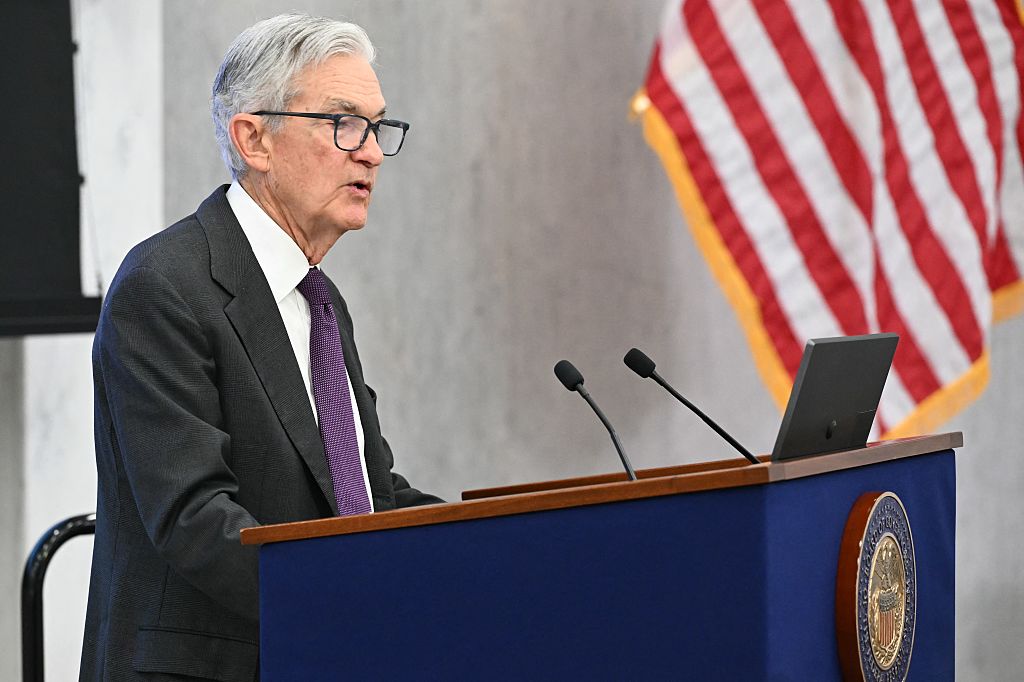
The odds of a December rate cut are high. It's also a near-certainty that Fed Chair Powell will be wearing a purple tie during Wednesday's press conference.
That's because Powell always wears a purple tie … and there's a reason for it.
During an early April Q&A session with journalists at the Society for Advancing Business Editing and Writing conference, Powell was asked about the significance of his purple ties.
"At the beginning, the only significance was that I like purple ties," Powell replied. At his next press conference, he said he went to reach for a red or blue tie and thought, "Maybe not … so I wind up wearing purple."
He said now it's become "a thing," and it supports the fact that the Fed "is strictly non-political" and "bipartisan," and purple is a good color for that.
"Plus, I like purple ties," Powell concluded.
- Karee Venema
Small caps outperformed on Tuesday
Stocks were choppy Tuesday, with market participants in wait-and-see mode ahead of tomorrow's policy announcement from the Federal Reserve. With the central bank widely expected to cut interest rates again, rate-sensitive small caps outperformed and the Russell 2000 hit a new intraday high.
The small-cap benchmark fell short of a new record close, though, gaining 0.2% to 2,526. The tech-heavy Nasdaq Composite (+0.1% at 23,576) also finished in positive territory, while the broader S&P 500 (-0.09% at 6,840) and the blue-chip Dow Jones Industrial Average (-0.4% at 47,560) ended in the red.
Read more: JPMorgan's Drop Drags on the Dow: Stock Market Today
What time will the Fed statement be released and what changes are expected?
The Federal Open Market Committee will release its updated policy statement at 2 pm Eastern Standard Time today, December 10.
"Available indicators suggest that economic activity has been expanding at a moderate pace, the committee wrote in its October statement. "Job gains have slowed this year, and the unemployment rate has edged up but remained low through August; more recent indicators are consistent with these developments. Inflation has moved up since earlier in the year and remains somewhat elevated."
As such, the FOMC voted to lower the federal funds rate by a quarter-percentage point to a range of 3.75% to 4.00%.
This time around, Goldman Sachs economists say the statement "will likely borrow the 'extent and timing of additional adjustments' language used in December 2024 under quite similar circumstances to convey that the bar for any further cuts will be somewhat higher."
They also expect more dissents than at the October Fed meeting, where Fed Governor Stephen Miran supported a half-percentage point cut and Kansas City Fed President Jeffrey Schmid supported a pause.
The economists say one other committee member could join Schmid in voting to keep rates unchanged at this meeting and believe that up to five central bankers could issue soft dissents on the Fed's monetary policy choices for this year.
What's a soft dissent? The Fed's December meetings allow all committee members to " tell you what they thought was appropriate policy for the year that just ended," explains Nick Timiraos of The Wall Street Journal. "In other words, do they agree with what just happened? Most years, this is a formality — everyone writes down whatever rate the committee settled on. But when it isn't, you get something fascinating: soft dissents. Officials who didn't vote against the decision (or weren't even voting members) quietly register that they would have done something different. "
"Dissents might actually be somewhat helpful to Powell in getting across that the bar for another rate cut will be higher," Goldman Sachs economists write.
- Karee Venema
Stock futures signal a quiet open on Fed Day
Stock futures are little changed Wednesday as Wall Street awaits this afternoon's policy announcement from the Federal Reserve. At last check, futures on the Dow Jones Industrial Average and S&P 500 were up slightly, while the Nasdaq-100 was signaling a lower open.
There is some notable price action among individual stocks, though. Braze (BRZE) is 16% higher in pre-market trading after the consumer engagement platform reported a fiscal third-quarter revenue beat. And Cracker Barrel Old Country Store (CBRL) is down nearly 4% after the restaurant chain's fiscal first-quarter top-line miss.
- Karee Venema
Trump to conduct final interviews with potential Powell replacements
President Donald Trump said he will begin the final interviews with the top candidates to replace Jerome Powell as Fed chair.
While Kevin Hassett, director of the National Economic Council, is widely believed to be the frontrunner, media reports suggest Trump and his team will meet today with Kevin Warsh, who served as a Fed governor from 2006 through 2011.
On Tuesday, Trump told POLITICO that he would only choose someone to replace Powell who is committed to cutting interest rates.
- Karee Venema
When does Jerome Powell's term as Fed chair end?
President Trump has not been subtle in his dislike of Fed Chair Powell. But the question of whether or not Trump can fire Powell has quieted down in recent months, given that the Fed chair's term is up on May 15, 2026.
Christian Hoffmann, head of fixed income at Thornburg Investment Management, says there likely won't be any surprises at the December meeting, but notes that "the biggest thing happening in the background is the question of who will lead the Fed."
He expects Fed Chair Powell to become "a lame duck fairly quickly," with whoever is chosen to replace him to become somewhat of a "shadow Fed chair ... offering opinions or taking potshots from the sidelines."
For what it's worth, Powell's term as a member of the Board of Governors of the Federal Reserve ends on January 31, 2028.
- Karee Venema
Where can I watch Fed Chair Powell's press conference?
Fed Chair Jerome Powell's press conference will begin at 2:30 pm Eastern Standard Time this afternoon.
The presser can be viewed on the Federal Reserve's website or on the Fed's YouTube channel.
Labor costs rise at a slower-than-expected pace in Q3
The Federal Reserve was dealt a small inflation win this morning.
Ahead of the open, the Bureau of Labor Statistics said the Employment Cost Index (ECI), which measures labor costs, rose 0.8% from Q2 to Q3. The shutdown-delayed data came in below economists' estimate for a 0.9% increase.
Year over year, the ECI was up 3.5%.
The report shows that "the labor market is not a source of excess inflationary pressure at present," says Wells Fargo Senior Economist Sarah House. But the data "offered additional evidence that the gradual softening in the labor market is translating to slower compensation growth."
- Karee Venema
The December rate cut will be a hawkish one, says SWBC CIO
Chris Brigati, chief investment officer at SWBC, believes today's rate cut will be a hawkish one.
"The Fed is divided on how to proceed with rate cuts in 2026 given the delicate balance between job market weakness and still elevated inflation," says Brigati. "There is also uncertainty about the new Fed chair, and that may also add to the central bank's reluctance to make any major rate moves in the months leading up to Chair Powell's term ending."
As such, the central bank is unlikely to signal any additional rate cuts for early 2026. And Brigati thinks the Fed will keep interest rates unchanged in the first half of 2026, even amid pressure from doves, including Powell's eventual successor.
"We remain concerned about a potential inflation resurgence," explains the CIO. "Price data has stayed stubbornly high, consumer spending — particularly among higher-income households — shows little sign of slowing, and a more accommodative Fed stance to counter labor market weakness could reignite demand and add inflationary pressure."
Investors need to "stay alert," Brigati advises, and continue to rebalance portfolios following this year's strong showing from tech stocks. He says investors shouldn't abandon these high-growth stocks; rather, they need to develop a strategy "to cushion against volatility and position for opportunity."
- Karee Venema
Where have all the Fed speakers been?
The Fed-speak has been nonexistent over the past week or so. That's by design. Since Saturday, November 29, and until Thursday, December 11, participants in the FOMC meeting have been bound by a Federal Reserve policy that limits the extent they can talk about the economy and interest rates.
These two-week "blackout periods" begin the second Saturday that falls 10 days before the next FOMC meeting and end the Thursday that follows the meeting. The Fed's blackout period was an unofficial practice that began in the 1980s. It was formalized in 2011 and reaffirmed in January 2025.
Fed-watchers see the policy as a measure against corruption and the potential for information leaks to distort markets. It also provides cover for open discussion during the Fed's most intense periods of policy-making.
Here is a schedule for all blackout periods through January 2027.
- David Dittman
Stocks are mixed ahead of FOMC announcement
With about 45 minutes to go until the latest policy announcement from the FOMC, the main indexes are mixed. The blue-chip Dow Jones Industrial Average is up 0.5% on strength from financial stocks American Express (AXP) and JPMorgan Chase (JPM).
The broader S&P 500 is 0.1% higher, while the Nasdaq Composite is down 0.2%.
Over in the bond market, the 2-year Treasury yield is off 2.7 basis points to 3.586%, while the 10-year Treasury yield is down 2.6 basis points at 4.16%. A basis point = 0.01%.
- Karee Venema
What savers should do after the latest Fed rate cut
As the Federal Reserve wraps up its final meeting of the year, it's a good time for savers to take stock of where their money sits and what adjustments might make sense heading into the new year.
"After the Fed issued rate cuts this year, APYs on savings accounts dropped. Adding to uncertainty for savers is the fact that there will be a new Fed chair next year when Jerome Powell's term ends in May. However, it isn't all doom and gloom. Some savings accounts still offer substantial gains, helping you reach your short-term savings goals," says Sean Jackson, personal finance writer at Kiplinger.
And Sean is right. A rate cut doesn't change APYs overnight. Many of the top online banks were still offering yields in the low-to-mid-4% range throughout 2025.
By late 2025, savings rates remained elevated compared to pre-hiking-cycle norms, though they had eased off their absolute peaks, signaling a gradual, not dramatic, cooling. For savers, that means there's still time to capitalize on relatively high returns before yields drift lower.
To brace for the uncertainty 2026 brings, read Smart Money Moves Savers Should Make in 2026.
- Carla Ayers
The Fed decision is in
As expected, the Federal Reserve lowered interest rates by a quarter-percentage point at its December meeting, bringing the federal funds rate to a range of 3.5% to 3.75%.
Three Fed officials dissented from the latest rate cut
There were three FOMC committee members who voted against today's rate cut. Fed Governor Stephen Miran supported lowering the federal funds rate by a half-percentage point, while Kansas City Fed President Jeffrey Schmid and Chicago Fed President Austan Goolsbee supported a pause.
These dissents are "feeding the narrative that the Fed could be on hold after this, if there is so much internal disagreement now," says Jim Patterson, managing editor of the Kiplinger Letter.
- Karee Venema
What changed in the December FOMC statement
Changes to the FOMC's latest policy statement include the following:
Job gains have slowed this year, and the unemployment rate has edged up through September. More recent indicators are consistent with these developments. (Previously read: Job gains have slowed this year, and the unemployment rate has edged up but remained low through August; more recent indicators are consistent with these developments.)
In considering the extent and timing of additional adjustments to the target range for the federal funds rate, the Committee will carefully assess incoming data, the evolving outlook, and the balance of risks. (Previously read: In considering additional adjustments to the target range for the federal funds rate, the Committee will carefully assess incoming data, the evolving outlook, and the balance of risks.)
The Committee judges that reserve balances have declined to ample levels and will initiate purchases of shorter-term Treasury securities as needed to maintain an ample supply of reserves on an ongoing basis. (Previously read: The Committee decided to conclude the reduction of its aggregate securities holdings on December 1.)
- Karee Venema
What did the FOMC's Summary of Economic Projections show?
Federal Open Market Committee members left their projections for interest rates unchanged compared to September. According to the dot plot, the Fed is forecasting just one rate cut in 2026 and another in 2027.
The group expects real gross domestic product (GDP) to be slightly higher this year and next than it forecast in September, at 1.7% in 2025 and 2.3% in 2026. Meanwhile, inflation expectations drifted lower, too, with committee members now expecting PCE inflation to finish 2025 at 2.9% vs its previous estimate of 3.0% and end 2026 at 2.4%, down from 2.6% in September.
Expectations for the unemployment rate were unchanged at 4.5% for 2025 and 4.4% for 2026.
You can see the FOMC's full Summary of Economic Projections here.
- Karee Venema
Powell says the Fed will resume Treasury securities purchases
"In light of continued tightening in money market interest rates relative to our administered rates and other indicators of reserve market conditions, the committee judged that reserve balances have declined to ample levels," says Powell.
As such, the committee decided to initiate purchases of shorter-term Treasury securities, namely bills. The FOMC will begin with $40 billion in purchases in the first month and "may remain elevated for a few months."
- Karee Venema
SEP suggests only moderate rate cuts from here
In his opening statement, Fed Chair Jerome Powell reported that the Fed expects inflation to end the year at 2.9%, based on its preferred gage, and then ease to 2.4% at the end of 2026. He also said that the Fed now expects U.S. GDP growth of 2.3% next year, which is a bit stronger than the central bank had previously projected for 2026.
Powell noted that the labor market has weakened recently, with hiring likely down due to reduced immigration. He also shared his colleagues' average projection for where the Fed's benchmark interest rate is going, with a median estimate of 3.4% at the end of 2026 and 3.1% at the end of 2027.
Those are just estimates, not firm plans, but they suggest only modest additional interest rate cuts from the Fed's current range of 3.5%-3.75%.
- Jim Patterson
Powell agrees that the Fed is basically "on hold" for now
Asked in a follow-up question whether the Fed's modest projections of further rate cuts means that the central bank is "on hold" now, Powell basically said yes.
He indicated that the Fed's benchmark rate is now likely somewhere close to the "neutral" level that neither stimulates the economy nor restrains it to lower inflation.
No one knows precisely where that theoretical neutral point is, but the fact that Powell believes that the Fed has gotten fairly close to it certainly indicates that he won't be in a hurry to extend the string of cuts the Fed has made in recent months.
- Jim Patterson
Market participants aren't too shaken by Powell's rate-cut outlook
There have been several times in recent memory when Chair Powell's cautious take on future rate cuts has sparked a stock market selloff, but we're not seeing that so far today.
At last check, the Dow Jones Industrial Average is up 0.8% and the S&P 500 is 0.4% higher. The Nasdaq Composite is hovering around the flatline.
- Karee Venema
While there were more dissents than usual, Powell says all members agree that inflation is too high
Asked about the elevated level of dissenting members of the Federal Open Market Committee who did not support today's quarter-point rate cut, Powell emphasized that everyone on the FOMC agrees that inflation is still too high, and that there are also risks to economic growth right now.
Addressing those two problems puts the Fed in a bind in deciding whether to cut rates to combat inflation, or lower them to boost the economy and hiring.
It sounds from Powell's remarks on the Fed's deliberations this month that today's quarter-point cut was an attempt to balance those competing concerns.
"You can't do two things at once," he noted. All of that certainly fits with the signals that the Fed will be waiting for a bit now before cutting rates again in the new year.
- Jim Patterson
The bond market sees the federal funds rate as closer to neutral, says GammaRoad Capital Partners CIO
The bond market isn't making a major move in reaction to today's Fed decision. At last check, the 2-year Treasury yield was down 5 basis points at 3.563% and the 10-year Treasury yield was 2 basis points lower at 4.166%.
"Treasury futures' muted initial reaction to today's rate cut at both the short and the long end suggests that the bond market now views policy as much closer to the proper neutral rate," says Jordan Rizzuto, CIO at GammaRoad Capital Partners. "This is further evidenced by the tightening of the spread between the two-year yield and the policy rate. Since the Fed's previous rate cut, we have seen long yields steadily rising, and we expect that any dovish guidance in the press conference will renew this recent upward pressure on long rates, as further cuts could be interpreted by bond traders as excessive."
- Karee Venema
The labor market remains a concern for Fed officials
"The labor market has continued to cool gradually ... maybe just a touch more gradually than we thought" in October, Powell said, in explaining why the Fed opted to cut rates again today, when he had suggested at the previous meeting that it might stand pat in December due to a lack of economic data during the government shutdown.
"It doesn't feel like a hot economy" where strong job creation could lead to renewed inflation pressures, he said.
He is not sounding any alarms about the job market, but it does appear that there is a note of concern about hiring among Fed officials.
- Jim Patterson
Chair Powell believes the inflationary impact from tariffs could peak in Q1
Powell expects the inflationary impact of new tariffs to peak in the first quarter of 2026, barring new tariff announcements.
"It takes some months ... quite a while for an individual tariff to take effect," the Fed chair said.
If the FOMC is right about that, then inflation from goods should ease later in the new year, and help lower the overall inflation rate. He noted earlier in his remarks that services costs have been cooling, but rises in goods linked to Washington's new tariff regime have kept the headline inflation number uncomfortably high.
Of course, there is no guarantee that the White House won't roll out additional duties on imported goods and scramble that rosy scenario.
- Jim Patterson
Powell says the Fed is committed to 2% inflation
"We're committed to 2% inflation and we'll deliver 2% inflation," Powell promised, when asked why the Fed is cutting interest rates when inflation is still above its 2% target. "If you get away from tariffs, inflation is in the low 2s," he estimated, and he noted that the Fed can't influence U.S. trade policy.
If the price bump from tariffs turns out to be a one-time issue, as the Fed expects, then Powell said he is confident that overall inflation will get back close to 2%, from its current level near 3%.
- Jim Patterson
Why is Powell worried about job growth?
Asked about concerns on job growth, Powell explains "it's very difficult to estimate job growth in real time," and recently there's been "an overcount," as indicated by revisions on job reports.
Based on recent numbers and revisions, he says, we could be in a place of negative job creation, and in a world where job creation is negative, the chair says, "we have to watch that very carefully."
- Alexandra Svokos
Powell on AI
On the topic of AI and whether it is leading to job losses, Powell allowed that that might be happening, but probably at a minor level right now, despite some prominent layoff announcements from big companies that cited greater reliance on AI.
Across the economy, job losses appear to be small, with relatively few people filing new claims for unemployment benefits. Powell noted that historically, new technologies often prompt fears of automation replacing human workers, but they normally end up making the human workforce more productive in the long run.
Still, he noted that the Fed is on guard against further deterioration in the labor market as part of its dual mandate to keep prices stable and maintain full employment.
- Jim Patterson
Powell on his replacement
Asked about what he hopes his legacy as Fed chair will be as his tenure draws to a close, Powell had a simple message, that he wants the economy to be in a good place when he makes way for whoever his successor turns out to be. That means low unemployment and inflation "under control."
Those happen to be the Fed's two institutional mandates all of the time, but considering the creeping concerns about whether the job market is weakening and whether inflation will behave next year, you can't blame Powell for patting himself on the back if he manages to reach those two objectives by the time he hands off leadership of the Fed next spring.
- Jim Patterson
Job creation, price stability - and wealth inequality
Powell discussed the concept that higher-net-worth and income folks are driving consumption, noting that "it's clearly a thing," especially as asset values, including housing and securities, are high, and the people who own those assets are typically those at the "higher end of income and wealth." (The question and his answer allude to a K-shaped economy.)
Is that sustainable, that the top-third of Americans are driving "way more" than a third of consumption? He muses, somewhat ominously, that's "a good question."
And that's why, he clarifies, he and the FOMC are so focused on building price stability and a strong labor market, as those factors help lower-income and net-worth people. A strong labor market, particularly over a long period, he said, is important for wage growth for people in the lower quartile.
- Alexandra Svokos
The Fed can't save the housing market
While many Americans look to the Fed for lower interest rates they hope will bring more affordable housing, there's little water in that well. For one thing, mortgage rates tend to follow the 10-year Treasury more closely than the Fed.
For another, though, there are factors beyond rates at play in the housing market that are driving up costs. Primarily, there's the problem of supply. Housing supply is low for two reasons: First, because America simply hasn't built enough in recent years. Second, because people aren't moving ... because their mortgage rates are so low from the post-pandemic period, they don't want to sell their house just to buy a house with a high price and high mortgage rate.
So, yes, it's something of a vicious circle the Fed will get blamed for. But until more housing is built, it's hard to see a way out of rising home prices, even if mortgage rates go down.
- Alexandra Svokos
What investors need to do after today's Fed meeting
Today's Fed meeting revealed "quite disparate points of view" among FOMC members that highlight "unanswered questions we're all asking about where the economy is headed next year," says Brent Schutte, chief investment officer at Northwestern Mutual Wealth Management Company.
The economy is in a delicate state right now, which could lead to weakness or higher inflation 2026, he adds. "This narrow balance is driving internal divisions within the Fed and more dissents."
And investors need to prepare their portfolios for these uncertainties, Schutte advises. "We’re encouraging investors to return to the fundamentals of investing, which means a focus on diversification and relative valuations – with an eye toward intermediate to longer-term relative returns."
For folks looking for a jumping-off point on how to position their portfolios, these core stocks are solid, long-term investments that can provide stable returns and steady growth. And these exchange-traded funds make our list of the best ETFs to buy for 2026 because they possess structural characteristics that make them attractive buy-and-hold options.
- Karee Venema
Markets get a boost from the Fed
All three main U.S. equity indexes closed higher on Fed Day following what many market participants may regard as an ideal scenario for the economy and the stock market described by the Federal Reserve.
The blue-chip Dow Jones Industrial Average closed higher by 1.1% at 48,057. The S&P 500 added 0.7% to 6,886, and the Nasdaq Composite was up 0.3% to 23,654.
The Fed's updated Summary of Economic Projections (pdf) reflects both concerns about the jobs market and persistent inflation as well as rosier growth expectations.
The median forecast shows 2.3% GDP growth in 2026, up from 1.8% in September, core inflation of 2.5%, down from 2.6%, and unemployment steady at 4.4%. Altogether, it adds up to only one rate cut in 2026.
The yield on the 2-year U.S. Treasury note ticked lower to 3.546% from 3.613% on Tuesday. The 10-year yield was down to 4.155% from 4.186%, and the 30-year was at 4.794% vs 4.809%.
The average year-end 2026 price target for the S&P 500 is up from around 6,500 in early September to 7,269 as of December 9, notes LPL Financial Chief Technical Strategist Adam Turnquist.
Turnquist cites the AI boom, stimulus from President Donald Trump's One Big Beautiful Bill and easing monetary policy as "key catalysts" for even more upside.
"A bottom-up analysis," he elaborates, "which aggregates analyst price targets for individual S&P 500 components, suggests the index could reach 7,900 by the end of next year."
– David Dittman
What's next for the Fed? FHN Financial's senior economist explains
Today's decision to cut rates was not unanimous, says Sophia Kearney-Lederman, senior economist at FHN Financial. And the dot plot showed that there were four soft dissents, "meaning four additional non-voters did not support the cut at the December meeting and would have preferred to leave rates unchanged."
Kearney-Lederman says talk will now turn to what's next for the Fed. "As Chair Powell said in the press conference, 'All across the Committee, people see the picture pretty similarly, but see the risks quite differently.'"
While the median projection for interest rates at the end of 2026 was unchanged from September, the range of forecasts widened, she notes, adding that the closer the federal funds rate gets to neutral, the slower the pace of rate cuts will be.
The economist believes "the focus will now shift to the great deal of data to be released between now and the next FOMC meeting" in late January, though "as Chair Powell pointed out in the press conference ... there are likely to be some distortions to the data. This means Wall Street and the Fed will remain in wait-and-see mode.
- Karee Venema