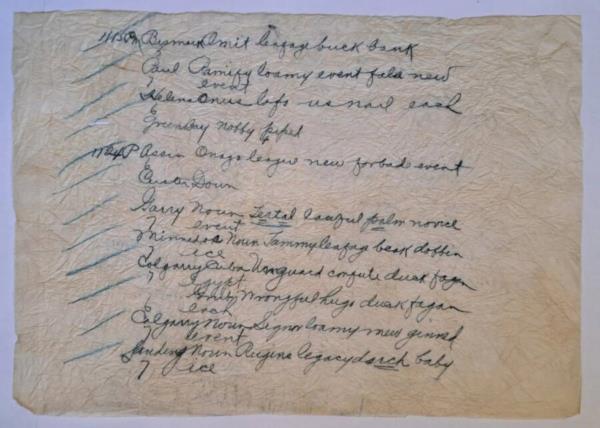
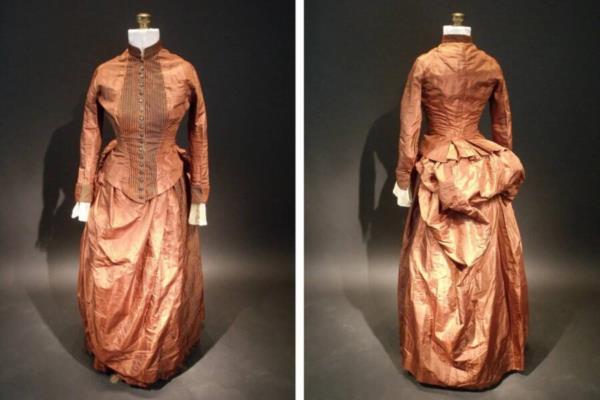
Deep within the folds of a 19th-century silk bustle dress, a hidden secret lay dormant for over a century. When Sara Rivers Cofield stumbled upon this enigmatic attire in Maine ten years ago, little did she know that it would lead her on an extraordinary journey. Curiosity piqued, she peered closer, only to discover a coded note tucked away in a secretive pocket. And so began a decade-long quest to unravel the mysteries woven within.
The note, initially resembling gibberish, had confounded many minds. Was it a clandestine message exchanged by spies? A clandestine correspondence between star-crossed lovers? Or perhaps evidence of a covert gambling operation? The truth, as it turns out, was far more extraordinary. Enter Wayne Chan, a data analyst at the University of Manitoba, whose keen eye and analytical prowess cracked the code.
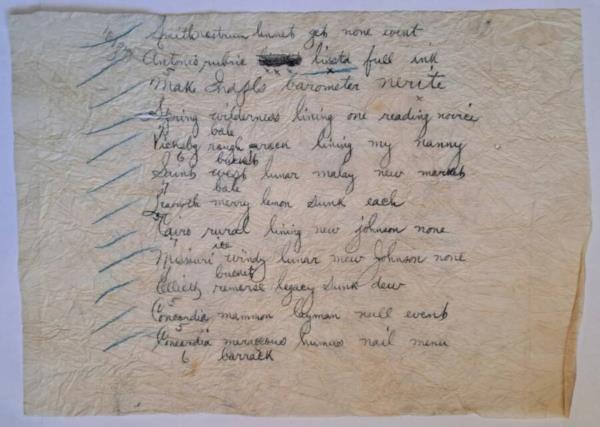
Chan described the note as an intricate telegraphic code, one of the most complex he had ever encountered. Scribbled in smudged ink, it began with phrases like 'Bismark Omit leafage buck bank' and 'Calgary, Cuba, unguarded, confute, duck, fagan.' Puzzling indeed, but Chan, armed with his expertise, realized that these words were meant to represent weather observations from 1888 in the United States and Canada.
In a stroke of serendipity, Chan stumbled upon an old telegraph history book that contained similar codes used by the U.S. Army Signal Corps and the U.S. Weather Bureau to transmit weather data across North America. The pieces of the puzzle were slowly falling into place. Seeking further insight, he reached out to a librarian at the National Oceanic and Atmospheric Administration (NOAA), who provided a weather code book from 1892.
With the code book in hand, Chan meticulously deciphered the enigmatic dress note, revealing its hidden message. 'Bismark Omit leafage buck bank,' for instance, turned out to be a weather report for the Bismarck station in the Dakota Territory. It chronicled details like temperature, barometric pressure, dew point, weather conditions, and wind speed—painting a vivid picture of a moment frozen in time.
Chan's breakthrough shed light on the extraordinary role these coded messages played in disseminating weather information. For the first time in history, people in remote locations could rapidly share weather data, enabling the comprehensive analysis of weather patterns nationwide. Chan marveled at these significant advancements, realizing that such messages, though plentiful at the time, were rarely archived, making their discovery all the more remarkable.
Yet, as one mystery was solved, others lingered. Who was the original owner of the dress? Why were they carrying this cryptic note? The name 'Bennett' offered a glimmer of hope, but Chan's search for a woman named Bennett working for the Army Signal Service in the 1880s proved futile. Maitland Bennett, a male clerk at the time, seemed an incongruous fit for the dress. The veil of uncertainty still enveloped the apparel and its enigmatic message, leaving room for endless speculation.
Amidst the intrigue and unanswered questions, one thing remains certain: the allure of a mystery captivates us all. Sara Rivers Cofield's discovery of the coded note in a Victorian-era dress reminds us of the untold stories hidden within the folds of history. Whether it be deciphering ancient codes, decoding inscrutable sculptures, or unraveling unsolved ciphers, the relentless pursuit of hidden knowledge lures us into fascinating realms.
In a world where everything seems accessible, when even the deepest secrets can be unearthed with a few taps on a keyboard, we are reminded that some enigmas remain untamed. The dress and its coded weather observations take us on a journey, reminding us of the power of curiosity, the thrill of discovery, and the enduring allure of the unknown. After all, in a world fueled by algorithms and predictable outcomes, the unsolved mysteries leave room for the wonders of imagination and unfettered creativity.