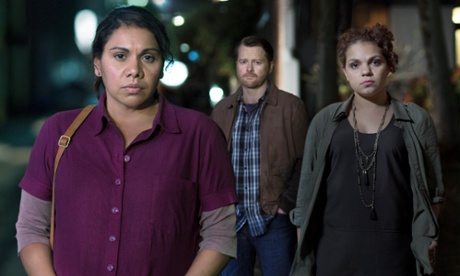
Over two seasons, ABC television series Redfern Now has depicted Indigenous Australian lives in the titular inner-city Sydney suburb. It has earned a reputation as a high-end drama that never shies away from confronting issues like domestic violence and deaths in custody, and in 2014 picked up the Aacta and Logie awards for best television drama.
Yet for starring actor Deborah Mailman, the most appreciated feedback has been around its universal appeal. “People don’t see these as stories that only happen in an Aboriginal community because so many people out in the wider community can relate to it. They just see [the show] as a great drama.”
On Thursday, Redfern Now returned as a feature-length telemovie called Promise Me and focuses on two of the main characters, Robyn (Rarriwuy Hicks) and Lorraine (Mailman). After a night out with friends, Robyn is attacked and sexually assaulted. She tells her policeman father Aaron (Wayne Blair) but refuses to report it, and that decision has unfortunate repercussions, particularly for family friend Lorraine.
Mailman, one of Australia’s most successful actors, has previously worked with Redfern Now director Rachel Perkins (in Radiance, Bran Nue Dae and Mabo), and Blair, who was her director in the feature film The Sapphires. “You see how everyone has developed their skill for the better,” she says about reuniting on the set of Redfern Now. “Here was another chance to do something as good as we did last time.”
The series is part of a recent and encouraging upswell of Indigenous Australian television and film productions. “Within the last five years there have been a lot of great examples that have shown the way forward in how we can tell our stories [and in] what genres.”
The Sapphires, for example, was a landmark moment for Indigenous Australians working in film and television. It received a 10-minute standing ovation at its 2011 premiere at the Cannes film festival, picked up a slew of awards and more than $14m at the Australian box office. But it was also significant for other reasons. “It’s one of the few films that allowed Indigenous stories to be entertaining,” says Mailman. “Prior to that, they were often seen as stories weighted in sorrow or despair, or that came from a very strong political place.”
And though the film touched on such gut-wrenching episodes in national history as the stolen generation, at the centre was a story of four girls pursuing a big musical dream. “[Writer] Tony Briggs really wanted it to be a story that anyone could sit down and watch with a smile on their face.”
ABC sketch show Black Comedy, featuring Mailman in the ensemble cast, also aims to put a smile on audience faces. She describes the show as “dangerous”, pushing into uncomfortable territory but never failing to be, first and foremost, very funny. “It was a joy to work on,” she says. “I related so well to all the sketches, and I just laughed reading them, so to do them was great. It’s a stroke of genius by the ABC and by the writers.”
The emergence of a new generation of Indigenous actors, including Redfern Now co-stars Hicks, Sharri Sebbens and Meyne Wyatt, seems to point at a changing television landscape.
“There were very slim pickings way back in the day, but now the list is extensive,” Mailman says about the new generation. “That’s such an exciting place to be and it’s about creating more opportunities for everyone to keep growing in their work.”
For Indigenous performers like Hunter Page Lochard, who recently spoke to Guardian Australia about starring in Belvoir’s racially-diverse production of Elektra/Orestes, it would be fair to say actors like Mailman helped to lead the way. Mailman played Cordelia in Barrie Kosky’s 1998 production of King Lear, and Company B’s Antigone a decade later, and says colour-blind casting allows Indigenous artists to broaden their experience. “But it requires imagination ... imagination around who can play that character.”
And while there’s no shortage of talent or stories to tell, commitment by the nation’s cultural institutions is necessary. “It does take a big leap of faith. It takes people with money, and with a big stage to have those opportunities to be seen outside of just a small audience,” she says. “That’s what so great about Redfern Now and the ABC’s support of it. I think that’s where the change is going to happen.”
While she has often refused the accolade, Mailman has been a trailblazer for Indigenous artists over her almost 20-year career. And in looking back, she can finally appreciate what has been achieved. “I tend to be a bit shy about it, but I’m incredibly proud of what I have done over the years and the opportunities that have been given to me.
“And now there are all these emerging actors that hopefully can see what the possibilities are, and where their futures can be as well.”
• Redfern Now: Promise Me screens on ABC on 9 April at 8.30pm


.jpg?w=600)