CLEVELAND _ President Donald Trump and Joe Biden will clash Tuesday night in their first face-to-face debate as the president urgently tries to close a persistent polling gap and move past damaging new revelations about his years of tax avoidance.
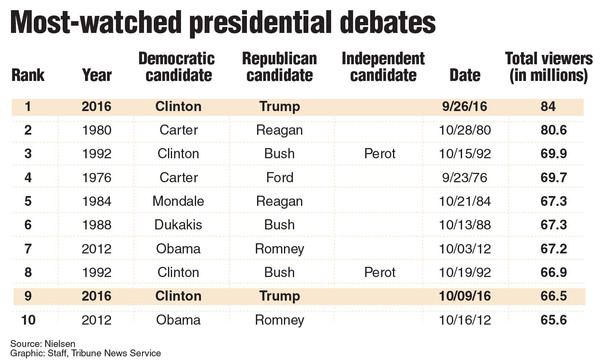
The debate at Case Western Reserve University in Cleveland could be one of the most-watched political events in American history, with roughly a third of the nation's voters watching the 90-minute broadcast that starts at 9 p.m. EDT.
Many have already received their ballots for an election that will determine who leads the nation amid a deadly pandemic and a deep recession, and which is playing out amid a monumental political fight over the future of the Supreme Court.

Trump's persistent false claims that mail voting will lead to widespread fraud, just as tens of millions of Americans plan to vote by mail due to the COVID-19 crisis, and his reluctance to commit to a peaceful transfer of power if he loses, will also thrust the topic of election integrity to the forefront Tuesday night.
Overshadowing the flurry of policy and political issues expected in the face-off moderated by Chris Wallace of Fox News is the mental agility of both septuagenarian candidates.
Trump, 74, has spent the last several weeks manufacturing conspiracy theories about Biden's health, suggesting without evidence that the 77-year-old former vice president is taking performance-enhancing drugs before public events to mask frailty and dementia.

The Trump campaign kept at it right into debate day, accusing Biden of trying to cheat by refusing inspection of the "electronic earpieces" that the candidates will wear on stage and Trump's requests to take a drug test, charges the Biden campaign declared false and absurd.
Biden staff responded by accusing the Trump campaign of demanding, as a condition of the debate, that Wallace not once mention the number of COVID-19 deaths in the United States _ now more than 205,000, more than any other nation.
It wasn't clear if the accusation was true. Biden's deputy campaign manager, Kate Bedingfield, told reporters that given Trump's unproven allegations, "you can consider that confirmed from the Biden campaign. See how easy it was to try to throw up the distraction?"

While the Biden campaign shrugged off the falsehoods spouted by Trump as a desperate distraction, the allegations against the former vice president are resonating with some voters, according to Democratic strategists who have been conducting focus groups.
Yet the low expectations Trump has set for Biden could ultimately hurt the president. A steady performance by Biden would likely convince voters that the former vice president doesn't fit the caricature drawn by Trump.
Trump, for his part, needs to reassure voters that he himself is not unbalanced.

His erratic behavior on Twitter and at White House news conferences, and his habit of amplifying conspiracy theories and misrepresentations, is costing him crucial votes among moderates, particularly in the battleground state suburbs, polls show.
The erosion of those voters from the Trump coalition is driving the steady, but not insurmountable, lead in the polls that Biden enjoys heading into the debate.
Trump is behind in most of the key battleground states, and Trump is also struggling in several key Sunbelt states that he won by a comfortable margin in 2016.

It remains to be seen whether the debate will significantly shift the contours of a race that has remained relatively stable for months. Rarely do such head-to-heads dramatically alter voter opinion.
Trump's surprise victory in 2016 was likely unrelated to his performance on the debate stage against Hillary Clinton. Polling indicated that she won all three debates.
This time, the president will face a moderator who has already proved tough on Trump on the topic where he is most vulnerable: White House management of the pandemic.

Biden, according to his staff, will try to focus on the rising number of COVID-19 deaths and the economic despair that could have been avoided with a more competent response to the virus, as he has through much of the campaign.
The coronavirus will be one of six topics Wallace will focus on during this first of the three presidential debates.
Another will be the rush by Trump and Senate Republicans to immediately fill the Supreme Court seat left vacant by the death of Justice Ruth Bader Ginsburg on Sept. 18.

The Trump campaign is confident that the president's nomination of staunch conservative Amy Coney Barrett and his insistence that she be swiftly confirmed will redirect voters away from the pandemic and help rebuild the coalition Trump needs for victory.
But the majority of voters, according to polls, do not support the rush to confirmation, and would prefer that the seat be left vacant until after the election and the end of Trump's first term.
The Biden campaign is stressing Republican backpedaling on earlier promises not to rush through a nominee this close to a presidential election, citing the GOP-led Senate's refusal to consider President Barack Obama's nominee for a Supreme Court seat 10 months before the 2016 election.

Biden's team also is warning of the consequences of a Barrett confirmation. She would lock in a 6-3 conservative majority hostile to the Affordable Care Act, abortion rights and expanded access to voting.
Trump heads into the debate with voter perceptions of his handling of the economy among his strengths. But revelations in The New York Times that Trump paid no federal income tax in 10 of the last 15 years threaten to put the president on the defensive when the conversation shifts in that direction.
During his first year in office, the billionaire paid just $750 in federal income tax, much less than the average middle-class American. Trump has refused to reveal his tax returns to voters, although he promised during the last campaign that he would do so.

On Tuesday afternoon, to punctuate the point, Biden and running mate Kamala Harris released their own federal tax returns.
The national reckoning on racial injustice will also be a major focus of the debate.
Trump and Biden contrast sharply on their response to the police killings of Black Americans that have touched off mass protests around the country.

Trump points to the protests to stoke fear among rural and suburban white voters, saying the disregard for "law and order" in cities run by Democrats foreshadows the chaos and violence that would spread should Biden win the White House.
The argument has resonated in some rural and economically struggling industrial communities, but it isn't taking hold in the suburbs, where voters are skeptical of Trump's divisive approach to race and law enforcement.
Biden, who styles himself as a healer who can lead a national conversation on race, is aiming to build on voter outrage over the unjustified killings and sympathies with the protest movement.

The former vice president often points to Trump's refusal to condemn the white nationalists who chanted anti-Semitic and racist slogans and killed a counterprotester on the streets of Charlottesville, Virginia., in August 2017 as motivating his third run for the White House.
Confronting racial inequality is a main theme of the Biden campaign, which worked to galvanize voters of color with Biden's choice of Harris, whose parents were immigrants from Jamaica and India, as his running mate.