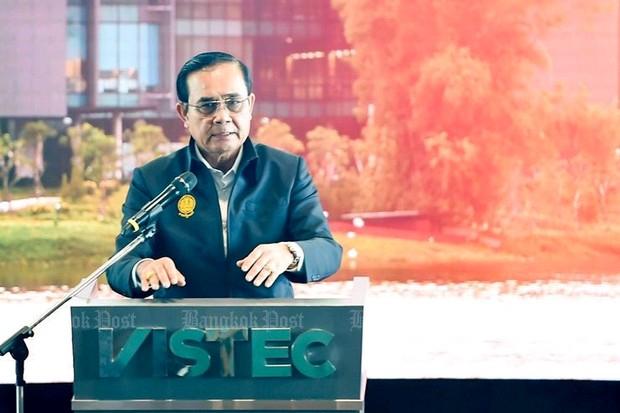
When it comes to sharing his thoughts or defending his government policies in public, Prime Minister and junta leader Gen Prayut Chan-o-cha has for almost five years opted for ways that allow him to dictate and control the conversations.
He has used state resources to air his visions and promote his government's actions on a nationally televised programme every Friday evening.
When talking behind a podium during press briefings or at other public events, the few challenges coming from the floor have mostly come from members of the media.

The responses have usually been in a swift, short-tempered and aggressive manner.
With the country about to transfer from his authoritarian rule to a democratic regime after the March 24 general election, Gen Prayut has agreed to be part of this process. He is a prime ministerial candidate for the Palang Pracharath Party (PPRP).
However, despite calls for him to do so, he has refused to take part in televised prime ministerial debates against candidates from other parties.
He claims the debates will lack substance and focus more on political attacks then policy discussions.
These claims show an unfair attitude and narrow view towards them. With neutral moderators, these debates involving other prime ministerial candidates will let voters learn more about their policy platforms, their ability and character.
By ducking the debates in front of the masses, Gen Prayut has squandered a chance for voters to see how he would react and interact with other candidates and what type of leadership skills he would use in a democratic system.
At the same time, he has let his rivals, many of whom expected to corner him on key issues, make some political capital out of it.
Gen Prayut said he is not scared about being challenged publicly. And it is probably true that there is no reason for him or other candidates to be worried about TV debates, which may not have a make-or-break influence on the outcome of the poll.
Political scientists in the US and the UK, for example, have pointed out that voting decisions in past races do not change much following election debates.
That means few voters change their minds as to who to vote for in relation to the outcome of a debate.
Gen Prayut may be worried about breaching the election law. Deputy Prime Minister Wissanu Krea-ngam, earlier expressed concern that the premier, as a public office holder, may have to be neutral if participating in debates.
But there is no need for Gen Prayut to fret about that. Taking part in a debate is far more legal and justifiable than his ongoing television show, which is seen as a vehicle for his own PR blitz.
He should be aware that the law prohibits him from using state resources in favour of any party.
And if he is really worried about breaking the law, he should have quit as prime minister and let his government assume a caretaker role during the election period.
It is not too late for Gen Prayut to change his mind. He should take part in the upcoming debates.