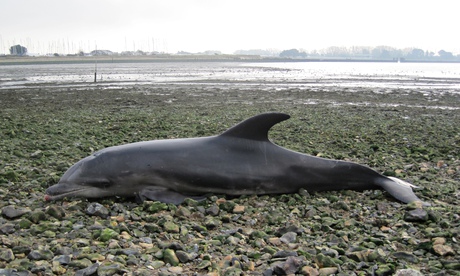
The beached cetacean was ominously still. My spirits rose as it appeared to shift slightly in the water, but as I waded out I realised that it was just the pull of the outgoing tide on its inert body. The dolphin was dead.
There was no mistaking the bulbous forehead, stubby beak and prominent sickle-shaped dorsal fin of a bottlenose dolphin. Measuring 2.6 metres from beak to tail, it was clearly a juvenile, as an adult bottlenose can reach 4 metres in length.
To accurately age a stranded dolphin, a veterinary pathologist will cut a tooth in half and count the growth layers that develop like the annual rings seen in a cross section of tree trunk.
Donning gloves to protect ourselves against zoonotic diseases, we gently rolled the dolphin on to its side to determine its sex. The genital slit was located closer to the navel than the tail and wasn’t flanked by mammary slits, so it was a male. As we righted the animal, its muscular bulk felt spongy beneath my fingertips, a sign of dehydration.
Exposed to the sun and wind, the dolphin’s skin was already losing its laminated sheen, and beginning to wrinkle, bubble and peel like a bad car paint job.
There was no obvious cause of death, no sign of entanglement in fishing gear or injuries from a boat strike. There were superficial abrasions on the edges of the tail flukes, pectoral fins and the tip of the beak, caused by the dolphin thrashing around on the rocky shore.
Its flanks were also scarred with sets of evenly spaced parallel lines, as though someone had gouged it with a comb, but these were tooth-rake marks, inflicted by other dolphins during fights and rough play.
It was impossible for us to tell whether the dolphin had succumbed due to an underlying injury or disease, or whether it had been affected by chemical pollution, noise disturbance or the ingestion of plastic debris, so we arranged for the body to be collected by the UK Cetacean Strandings Investigation Programme for post-mortem and tissue analysis.