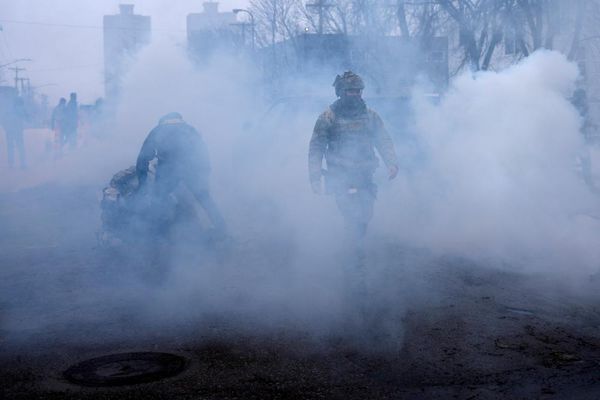
Earlier this year, the departing chief inspector of prisons, Nick Hardwick, described the former justice minister Chris Grayling’s attempts to interfere with his conclusion that overcrowding and a shortage of staff were contributing to worsening standards across the prison estate. In September, a report by Hardwick’s successor Peter Clarke on an inspection of Bedford prison said that standards there were “unacceptable” and fell short of “basic levels of decency”, partly because of staffing shortages. Last week, the head of the Prison Officers Association (POA), Mike Rolfe, said that staff across the country were on their knees, and that prisons were succumbing to a “bloodbath”. Last night, 200 prisoners were involved in a riot in Bedford prison that took more than six hours to get under control. Whatever else anyone thinks about Sunday’s disturbances, no one can say that they weren’t warned that it was coming.
To participate in a riot is obviously a mistaken response to the kinds of dismal conditions that Clarke’s report described. But it isn’t enough to say this. It’s possible to recognise the personal responsibility that any of the inmates involved must hold, and then to ask: if I were in those circumstances, what would I do? And what can be done to make such an eruption less likely in future?
Since the justice minister, Liz Truss, doesn’t seem to feel that the defence of the independence of the judiciary need take up too much of her energy, she should have ample time to consider these questions. She might start with the number of inmates held at Bedford, 493, and compare that with the number it is intended to hold, 322. Or she might go back to Clarke’s report and read again the paragraph about the effect of staff shortages on the conditions under which inmates are held, noting that for the fifth of prisoners who are unemployed, 21 hours a day locked in their cells is not unusual – with some banged up for 23. If you cage prisoners like animals, deny them the chance to do anything productive with their time or feel as if they are progressing towards a useful goal, you should expect them to respond in the same spirit.
Quite often since 2010, union warnings that cuts are making a difference to safety standards in all sorts of fields have been met with the cynical assumption that the truth has more to do with an attempt to preserve a cushy way of life. But the POA’s warnings are backed by concrete evidence. In the year to June, there were about 6,000 assaults on staff – an increase of 43%. Over the past four years they have risen 171%. Suicides and assaults generally are at an all-time high. In the second quarter of this year there were 9,500 detected cases of self-harm in three months and 31 self-inflicted deaths, also a record. These figures should be a source of shame, but the truth is that they are hardly noticed: the persistent and uncivilised decline of our prisons is simply not surprising any more. And when 7,000 officers have been made redundant in the past six years – or about 30% – it is entirely logical that the ability of the remainder to manage a safe prison estate has been drastically compromised.

Last week, Truss announced the recruitment of 2,500 new officers at the cost of £104m – a start, but a small one against the scale of the previous reduction (when it is, anyway, not as if the prison estate in 2010 could be characterised as a rehabilitative utopia). If she is unwilling or unable to find the money to make the more significant investment needed, what else is she going to do? Not take steps to reduce the prison population, she insists: such a step would be “arbitrary”. And yet when Hardwick was leaving, he argued forcefully that a large proportion of the prison population simply shouldn’t be there because they had mental health problems, or were guilty of minor crimes for which a custodial sentence was actively counterproductive. In these cases, it is incarceration that seems arbitrary, not the idea that there might be a better way to deal with the problem.
If Truss is really concerned about the risks that come with “arbitrary” changes to the prisons system, she will have to go much further in reversing the cuts that Grayling instituted years ago, and which were always motivated not by the security and rehabilitation of inmates – and hence the security of the rest of us – but by the bottom line.
In the meantime, we should get used to the kind of trouble that unfolded yesterday at Bedford. Blame the prisoners if you want, but they do not exist in a vacuum; their disorder is a howl of protest at a system that is simply not fit to keep them safe, and their plight is a stain on our national conscience.