
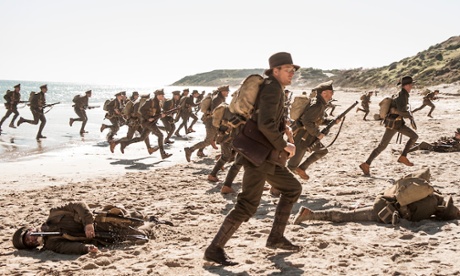
Each day after filming Deadline Gallipoli on location in South Australia, actor Joel Jackson would write down every detail of the day’s work, particularly noting his voice and his body movements.
“I kept a really precise diary,” Jackson says. “Instead of watching rushes, the diary was my feedback for the next day’s events. I was a sportsman before training to be an actor and the discipline and training carried itself along.”
In his first television role, the National Institute of Dramatic Art (Nida) graduate was cast as the legendary Australian war correspondent Charles Bean in Foxtel’s two-part miniseries about the four men who reported on events in Gallipoli in 1915.
Jackson was an unknown among a strong cast which includes Sam Worthington as Australian war photographer Phillip Schuler, Hugh Dancy as British writer Ellis Ashmead-Bartlett and Ewen Leslie as Australian journalist Keith Murdoch. From vastly different perspectives, the men all witness the mismanagement of the war campaign but the censors try to stop them from telling the truth to readers at home.
“This is a story about people who find themselves in the invidious position of having to report stuff that they know is not true; about the terrible kind of moral dilemma that confronts human beings,” says Penny Chapman, the show’s producer. “Not only are they having to put stuff out that’s not true but their job is to put out stuff that will encourage young men to sign up as cannon fodder.”
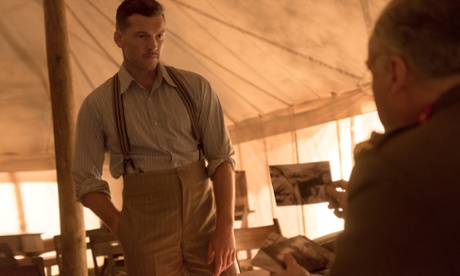
Worthington, who is also executive producer, believes the themes of Deadline Gallipoli are as relevant in today’s world of WikiLeaks and Edward Snowden as they were 100 years ago. “This is a fresh take on the Gallipoli story, with these four journalists fighting the upper echelons of the military to get the truth out and stop the carnage,” he said.
Jackson’s preparation included reading all Bean’s journals, which are available online through the Australian War Memorial. “I got Bean’s voice from reading them all out aloud before we went to Adelaide to shoot and I tried to copy his handwriting as best I could,” he told Guardian Australia.
The young West Australian says his discipline and preparation stem from stumbling into acting when his mother suggest he audition for Nida. “I love it, I really love what I do. For me it’s the chance to become someone else who has done something so admirable ... I could have been born 10 years ago and I wouldn’t have had this opportunity to play Bean. I am 23; it’s a privilege.”
He also found an acting companion in Dancy, whose blue-blooded character Ashmead-Bartlett is as opinionated as Bean is rigorous in sticking to the facts.
The two men took very different approaches to covering the war but both were transformed by the experience. “We both dug into our respective characters and the time period,” says Jackson. “We hung around each other as much as we could on set to establish what our differences are as counterparts.”
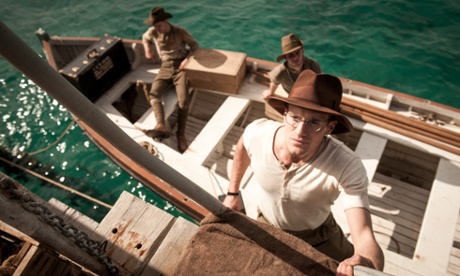
The story has given Jackson an insight into what makes a journalist. “It’s interesting what hits home and what doesn’t and what resonates and what doesn’t. Bean thought that writing facts down would resonate with people. So all his articles were very strict and very procedural – he wrote everyone’s first name and last name and rank and where they came from.
“And three quarters of the way through the campaign people stopped publishing his work. That’s why he took it upon himself to become a historian.” As Ashmead-Bartlet says of Bean’s work: “that’s not journalism; that makes you a diarist”.
Chapman, who agreed to produce Worthington’s project because she saw it as a different take on the Anzac story, says it’s a tale of the disobedience of Ashmead-Bartlet and Keith Murdoch who were determined to get the truth back home, but also the “terrible, terrible frustration” of Charles Bean.
“Bean finds himself not lying, but just telling the facts that he knows will get through the censors which end up being so boring that they stop publishing him,” Chapman says. “Bean goes from being an Anglophile to being a republican to knocking back two offers of a knighthood. He goes from being a man who writes critical reports of the Australian troops in Cairo to one who decides he is going to spend the rest of his life building a legend and celebrating these men.”
Deadline Gallipoli is also unique in that every battle scene is filmed from the perspective of a different war correspondents, giving it an intensity as you see the tragedy through their eyes as well as your own. “We said no scene was to be from any other point of view than the journalists,” Chapman says. “Once we applied that boundary the perspective came really alive.”
• Deadline Gallipoli is on Foxtel Showcase, Sunday 19 April and Monday 20 April at 8.30pm AEST












