Men go out to sea. Men encounter bad weather. Men get angry with each other. Men catch crab and get happier. Men don’t catch crab and get angrier with each other. That’s all there is to Deadliest Catch, yet it’s been enough to sustain it across 10 years, and 11 seasons – because the joy of the series is that it perfectly matches John Peel’s description of his favourite band, the Fall: “Always different, always the same.”
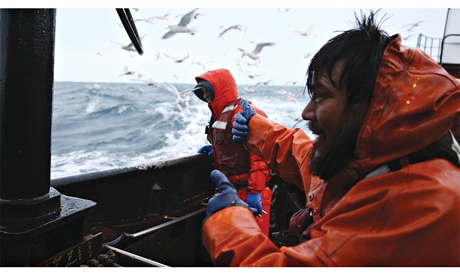
Deadliest Catch is that most reviled of things, a reality show, but it’s a reality show with knobs on. It’s filmed in winter, aboard the Alaskan crab boats dropping their pots amid the storms of the Bering Sea. The dangers, to both fishermen and film crews, are real, as is the tedium and misery of being on deck for hours on end – not five, six, seven, but 22, 23, 24 – hauling pots from the raging sea.
But Deadliest Catch, which airs on Discovery, isn’t really about crabbing. It’s about two things: families, and what happens to men where there is nowhere left for them to go. The crews of the boats on Deadliest Catch are drawn from the men who are running from something, or those who can’t leave. Most of the boats are centred around some difficult family relationships – the near-sadistic skipper Sig Hansen and his laconic deck boss brother Edgar on the Northwestern; the wisecracking Hillstrand brothers on the Time Bandit; the peripatetic captain “Wild” Bill Wichroski and his perpetually victimised son Zack. And each of them has the deckhands who have signed up – almost always to fail – because they are running from a desolate family life, from the law, from addiction. These are hard, hard men, who see softness as weakness, quick to anger and slow to forget.
At its best, Deadliest Catch makes for extraordinary television. The sixth season saw Captain Phil Harris of the Cornelia Marie discover, while at sea, that his deckhand son Jake was addicted to drugs; at the end of the series Phil suffered a stroke and underwent emergency cranial surgery, which could not save his life. All this was shown on the show, yet because of the bonds between the ship’s crew and the film crew, and because of our own knowledge of the Harris family, it never felt intrusive. It was one of the most profoundly moving series of TV episodes I’ve ever seen. The show’s producer, Thom Beers, said Phil had insisted on filming not stopping: he wanted the resilience of his family shown on screen.
Everything that happens at sea is compounded by the claustrophobia of the men’s situations. These are small boats, 100 feet or so (most of which is tanks for the catch), with a small crew – the skipper, five deckhands, an engineer. If one person isn’t getting on with another, there is no escape. Relationships become poisonous, and priorities become twisted. Those who don’t pull their weight – including virtually all the first-timers, or greenhorns – are first teased, then bullied mercilessly. The contempt of the crabbers for those who aren’t fit to pull a pot is painful, but there is no escape from it – once you’re on the boat, you’re there till it returns to port, no matter how agonising it might be for you.
The 11th season of Deadliest Catch has just started in the US. Some of the old regulars are now wondering if it’s time to quit and hand on to a younger generation, but something draws them back, and it’s not just the big money they can make from a big catch. They can see the romance, even if all the average TV viewer can see is a job that looks like a cold, wet hell.