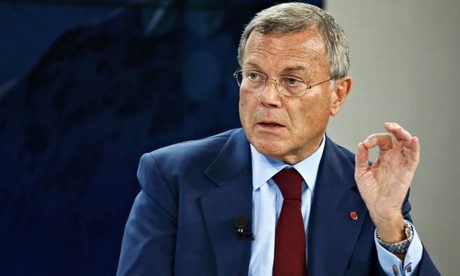
Sir Martin Sorrell, head of the world’s largest advertising group, has hit back at critics of global inequality, claiming there is “no proof” that equality brings prosperity.
The boss of WPP, speaking at the World Economic Forum (WEF) in Davos, said he had created a business that employs 179,000 people in 111 countries and invests $12bn (£7.98bn) in human capital each year. “I make no apology for that whatsoever,” he said.
Speaking at a BBC-hosted debate on inequality, he then challenged fellow panel member Christine Lagarde, the head of the International Monetary Fund, who had asserted that the gap between rich and poor was damaging global prosperity. “You have no proof that the reverse is true, that equality brings prosperity,” he said.
His comments follow an Oxfam study this week that warned the richest 1% of people in the world will own over 50% of its wealth by 2016.
Sorrell, a regular Davos attendee, has sparked several protests over FTSE 100 executive pay following rows over his own remuneration.
In 2014 Sorrell, whose net worth is estimated at £200m, survived a shareholder revolt after investors balked at a £30m pay and bonuses package only a year after the company rewarded him with a near £18m remuneration deal. He survived both disputes to become Britian’s best paid company boss.
He threw a champagne party earlier in the week in the tiny Swiss town attended by Britain’s chancellor George Osborne and former prime minister Tony Blair.
Elsewhere at Davos, inequality remained high on the agenda. Billionaire financier George Sorors warned that the European Central Bank’s €1.1tn quantitative easing programme announced on Thursday would increase the gap between rich and poor. “It will benefit the owners of assets,” said Soros, referring to the ECB using its balance sheet to acquire government bonds from financial institutions, in the hope they will invest the gains elsewhere. “Wages will remain under pressure, through competition and unemployment. This will reinforce a major concern between rich and poor. It will have political consequences.”
Also at Davos, the vice chairman of investment bank Morgan Stanley, Tom Nides, said President Obama’s state of the union address this week had sharpened Washington’s focus on inequality. “There is strong growth, but there is an anxiety that means we can’t take anything for granted,” said the senior investment banker.
Speaking to Reuters, he said: “The president said in his state of the union speech that while the economy was improving, it needed to improve for more people.
”There is a consensus that the middle class is not gaining as well as people at the top. And there needs to be a healthy debate around tax reform and making the system fairer.”
A senior figure at Oxfam also warned that the gap between rich and poor is growing rapidly. This week’s Oxfam study showed that the share of the world’s wealth owned by the best-off 1% has increased from 44% in 2009 to 48% in 2014, while the least well-off 80% currently own just 5.5%.
“The scale of global inequality is quite simply staggering and despite the issues shooting up the global agenda, the gap between the richest and the rest is widening fast,” said Winnie Byanyima, executive director of Oxfam International.