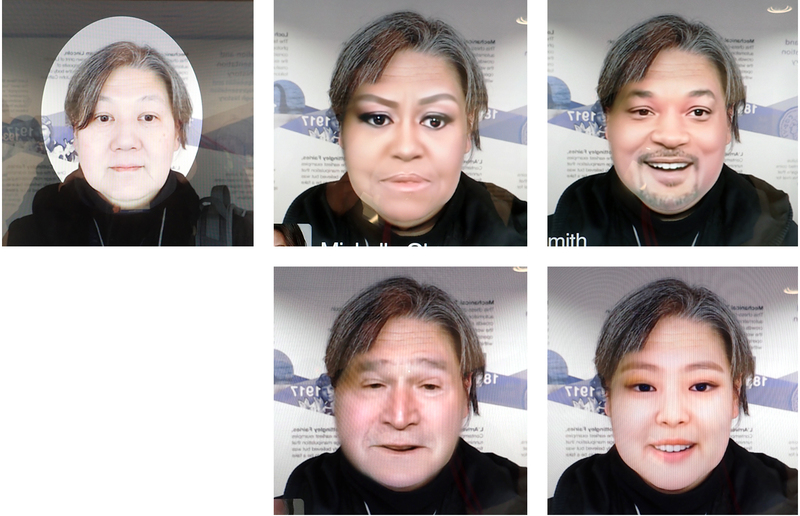
DAVOS, Switzerland -- I hadn't previously thought about wanting to become Michelle Obama, the wife of former U.S. President Barack Obama, but I briefly experienced being her here in Davos. Well, at least my face did.
As I stood in front of a monitor and tapped the screen, my face suddenly changed to that of Michelle Obama, then the actor Will Smith, former U.S. President George W. Bush and several other well-known people. When I talked or blinked, the face on the screen did so too. It was a bit creepy.
At this year's World Economic Forum Annual Meeting, climate change and environmental issues grabbed most of the attention, but the conference also featured discussions, displays and events on various other topics. Davos attendees got a firsthand look at so-called deep fake technology, in which artificial intelligence is used to create fake images that are extremely hard to tell from real ones. This is how I was "transformed" into a slew of high-profile faces. At the conference's main venue, Hao Li, an associate professor at the University of Southern California, set up a display explaining the new reality that rapid technological innovations are bringing about, such as the spread of fake news. Visitors to Li's display were stunned by how easily their appearance could change into a famous person.
Worries about advances in technology
Many major companies such as Google LLC, Facebook Inc. and IBM Corp. also attended the Davos Conference. Topics discussed at the conference included cutting-edge technologies like artificial intelligence, 5G cellular network technology, robots, and quantum computers that will be able to perform far more calculations than a supercomputer. It was striking that many events also detailed the potential effects of these technologies.
Some of the topics discussed were "Technology Governance: Global Priorities"; "Investing in the Next Digital Frontier"; "The Future of Human-Robot Interaction"; "Confronting the Weaponization of the World Wide Web"; "The Real-World Impact of 5G"; and "Misinformation in Markets and Media." Even a quick glance at the titles reveals that many people harbor vague anxieties -- and not just expectations -- about what information technologies, which are developing at an unprecedented speed, will bring.
Businesses are also aware of this point. While they lauded the possibilities such technologies could unleash, it was noteworthy that Microsoft Corp. President Brad Smith said people were becoming skeptical and trust was needed, and Google Chief Executive Officer Sundar Pichai said privacy cannot be a "luxury good." Pichai also said systems that help strengthen the privacy of all people must be built.
At first, changing my appearance through the deep fake technology was interesting, but the more I tried it, the weirder it felt. Who is the real me?
-- Hasegawa is a deputy managing editor of The Yomiuri Shimbun and the editor of the Yomiuri Shimbun Online website. Since joining The Yomiuri Shimbun in 1989, she has worked as a correspondent based in Manila, Geneva, Cairo and elsewhere. She took up her current post in 2019 after working as editor and then managing editor of The Japan News. Her interests include diving and cooking. This is the second time she has attended the Davos conference; she also participated in 2019.
Read more from The Japan News at https://japannews.yomiuri.co.jp/