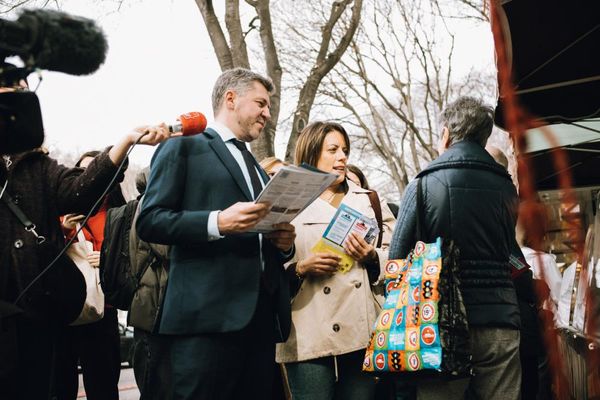
A late PS, from the Associated Press’s Pan Pylas on the moment Trump arrived at the World Economic Forum.
One way to get President Donald Trump to stop and talk at the World Economic Forum: wield a book about him.
On his way into the World Economic Forum, Trump stopped and talked for about ten seconds to one delegate who was brandishing a copy of “God and Donald Trump” by Stephen E. Strang. He then proceeded to hold the book aloft in his left hand.
Trump is the first U.S. president to attend the World Economic Forum since Bill Clinton back in 2000.
Trump is holding a series of meetings and is due to deliver a speech on Friday in which he will argue that what is good for the U.S. economy is beneficial for the global economy.
And finally, readers will be keen to know that Donald Trump is probably tucked up in bed.
Here’s the final dispatch:
Motorcade arrived at the Intercontinental at 9:23. Pool did not see POTUS get out. He will sleep here tonight.
That’s all from us until tomorrow! Thanks for reading and commenting. GW

Here’s some colour from Donald Trump’s dinner with business leaders, from the White House press pack:
President Trump’s eyes narrowed, as he looked a bit tired by the jetlag and long trip. But he seemed to enjoy the camaraderie with businessmen, joking with them about their success and lofty responsibilities, and nodding in agreement as they spoke about their large manufacturing capacity and thousands of US-based employees. Among the topics discussed: Kanye West’s role in designing Adidas shoes, Mack Trucks made by Volvo, Nestlé’s non-chocolate business portfolio.
Among Trump’s asides: “When he says he works for Siemens, he’s the president of Siemens!...Wow, that’s big!....Good luck with the G.E. purchase.”
Trump spoke about the thriving American economy – crediting his tax policies, deregulation and his role as a cheerleader for American business.
Soros then claims the bitcoin price will be propped by up by dictators, who use it to ‘build their nest eggs abroad”.
Q: As a former currency trader (who beat the Bank of England on Black Wednesday) what do you think of cryptocurrencies?
Bitcoin is not a currency, Soros replies.
A currency is supposed to be a stable store of value, and a currency that can fluctuate 25% in a day can’t be used to pay wages
It’s a speculation, based on a misunderstanding.
Soros suggest the EU should help Africa’s economy develop, if it wants to address the migration crisis.
European Union should be spending more on democratic development in Africa than on “dirty deals” with dictators to keep refugees from fleeing: Soros in Davos. #WEF2018 pic.twitter.com/hGGTnZ0U0c
— Kenneth Roth (@KenRoth) January 25, 2018
I was much better treated as a refugee myself than refugees are being treated today: Soros in Davos. #WEF2018 pic.twitter.com/ldGhYD9whS
— Kenneth Roth (@KenRoth) January 25, 2018
Onto questions.
Q: What should be done to tackle the technology giants?
It’s a very complicated issue, Soros replies. It requires the full-time attention of those who formulate and enforce new laws.
I put my faith in them, especially commissioner Vestigar who has done so much to enforce the laws - and made an award against Google.
Q: If you don’t like social media companies, why do you buy shares in them? calls out a diner from the back of the room.
Soros doesn’t reply (I’m not sure he heard). Instead he takes a question about migration, saying he cares about refugees because he was one himself; he came to Britain and was better treated than refugees arriving in Europe today.
Another punchy quote from Soros:
Pretty extraordinary attack on tech giants from Soros. Says if you combine subversion of democracy with countries like Russia or China then you get a totalitarian state beyond anything Orwell or Aldous Huxley could’ve imagined. #Davos2018 #WEF18
— Ben Marlow (@benjaminmarlow) January 25, 2018
On Europe, Soros suggests that a multi-speed, multi-track approach would be more successful.
This would allow Britain to rejoin the EU in the future without having to commit to joining the euro, explained Soros (who hasn’t given up hope that Brexit won’t happen).
Soros blasts social media giants
George Soros then turns his guns at the technology sector.
In a blistering attack, he accuses social media companies of “deliberately engineering addiction”, which is “particularly harmful” for adolescents.
He accuses them of inducing customers to give up their autonomy too.
Soros says there are similarities between internet platforms and gambling platforms - pointing out that casinos have developed techniques to hook customers so they keep gambling even when they’ve run out of money.
But... while tech giants may think they’re masters of the universe, they are actually just slaves to preserving their dominant position Soros continues.
It’s only a matter of time before the monopoly of the US IT giants is broken, he declares:
Davos is a good place to announce that their days are numbered.
Regulation and taxation will be their undoing.
I see Trump as a purely temporary phenomenon which will disappear in 2020, or earlier, Soros says - winning a laugh from his audience as they tuck into their chicken, potatoes and spinach.
Soros adds that he expects a Democratic landslide in 2018.
America must recognise the reality that North Korea has become a nuclear power, Soros continues.
There is no military action that can prevent what has already happened.
The only sensible strategy is to accept reality….and come to terms with North Koreas as a nuclear power.
That means working with China to find a solution.
Soros says that the survival of our whole civilisation is at stake, due to the rise of Kim Jong Un in North Korea and Donald Trump in the United States.
They both seem to be willing to risk a nuclear war to keep themselves in power.
Soros at #wef18: Kim Jong-Un, Trump risk nuclear war to stay in power. pic.twitter.com/HMcSMY6nGn
— Holger Zschaepitz (@Schuldensuehner) January 25, 2018
Soros: Donald Trump wants to create a mafia state
At another dinner in Davos, billionaire businessman-turned-philanthopist George Soros is giving his views on the state of the world.
He’s warning that open societies are in crisis, with various forms of dictatorship on the rise - such as Vladimir Putin’s Russia.
“In the United States, President Trump would like to establish a mafia state, but can’t”, Soros continues, because America’s institutions, constitution and its “vibrant civil society” won’t allow it.
If you’re just tuning in, here’s our news story about the prospect of Donald Trump visiting the UK later this year:
Companies whose execs Trump is schmoozing tonight in Switzerland: Anheuser-Busch, Deloitte, Nestle, Adidas, Nokia, SAP, Volvo, HSBC, etc.https://t.co/zhOzcOIbL4
— Jennifer Jacobs (@JenniferJJacobs) January 25, 2018
UK government officials have been updating the British press about Theresa May’s meeting with Donald Trump this afternoon, shortly after he arrived at WEF (and brought it to a standstill).
A UK govt source in the room at Davos says @realDonaldTrump got through 40 minutes with Theresa May without bringing up fake news, negative press coverage about him, the possibility of protests, the royal wedding or the embassy snub -- and didn't do all the talking.
— Alex Spence (@alexGspence) January 25, 2018
Interesting colour on Trump and May bilat: they greeted and parted with formal handshakes. No kisses or hand holding this time, and little banter. A #Davos chill. Suits both.
— Tom Newton Dunn (@tnewtondunn) January 25, 2018
Mark Knoller, CBS News White House Correspondent, has details of Trump’s dinner with European business chiefs:
Pres Trump making remarks at start of dinner in Davos with international business leaders. Says there's "a lot of respect for our country," also "a lot of money." Says business leaders happy with his policies of tax cuts and de-regulation. pic.twitter.com/sAubk3qdCV
— Mark Knoller (@markknoller) January 25, 2018
Dinner with Trump, the guest list
Donald Trump is now sitting down for diner with the bosses of some of Europe’s biggest companies.
Mark Tucker, the chairman of HSBC, and Punit Renjen, the chief executive of Deloitte, are flying the flag for Britain - according to this guest list from the White House press pack:
- President Donald J. Trump
- Secretary of State Rex Tillerson, Department of State
- Secretary Kirstjen Nielson, Department of Homeland Security
- General H.R. McMaster, National Security Advisor
- Gary Cohn, Director of the National Economic Council
- Kasper Rorsted, Adidas (Apparel)—Germany
- Joe Kaeser, Siemens AG (Tech)—Germany
- Heinrich Hiesinger, Thyssenkrupp AG (Industrials)—Germany
- Eldar Saetre, Statoil ASA (Energy)—Norway
- Mark Schneider, Nestle SA (Food and Beverage)—Switzerland
- Vas Narasimhan, Novartis AG (Pharmaceutical)—Switzerland
- Mark Tucker, HSBC (Financial Services)—UK
- Patrick Pouyanne, Total SA (Energy)—France
- Carlos Brito, Anheuser-Busch InBev NV (Food and Beverage)—Belgium
- Rajeev Suri, Nokia Corporation (Technology)—Finland
- Punit Renjen, Deloitte (Consulting)—UK
- Martian Lundstedt, AB Volvo (Auto)—Sweden
- Werner Baumann, Bayer AG (Pharmaceutical)—Germany
- Bill McDermott, SAP SE (Technology)—Germany
- Ulrich Spiesshofer, ABB Ltd (Manufacturing)—Switzerland
• This list was amended on 26 January 2018 to correct inaccurate details provided by the White House press office. The spelling of Carlos Brito’s first name was corrected from Carols, and the location of Anheuser-Busch InBev NV’s headquarters has been corrected from the Netherlands to Belgium.
Updated
President Trump is likely to face protests if and when his visit to the UK takes place, even if it is just a “working visit”.
For a start, Liberal Democrat deputy leader Jo Swinson pulled no punches, saying: “Trump is a dangerous, misogynistic racist and is deserving of the protests he will undoubtedly face.
“If and when he comes to the UK the Liberal Democrats will be at front and centre of the protests.”
White House: May and Trump discussed working visit
The White House says Theresa May and Donald Trump discussed plans for a “working visit” to London.
That may mean that it won’t be a full-blown state visit.
A working visit would mean less pomp and ceremony (and probably not a visit to see the Queen).
Here’s the official statement (which includes that all-important nod to the Special Relationship).
President Donald J. Trump met today with Prime Minister Theresa May of the United Kingdom. The President and Prime Minister discussed joint efforts to ensure the enduring defeat of ISIS and other jihadist terrorist organizations in Syria and Iraq. They discussed the importance of confronting Iran’s destructive behavior across the Middle East and fundamental flaws in the Iran nuclear deal.
The leaders committed to expanded trade between the United States and the United Kingdom, as well as how the two countries can work together to ensure all nations engage in fair and reciprocal trade practices.
The two leaders also discussed plans for a working visit to London in the coming months and affirmed the “special relationship” between the two countries is stronger than ever.
Donald Trump emerged from his meetings a little while ago, and briefly chatted with delegates who hadn’t been driven away by security.
He said his first day at Davos had been “really good” and “very successful”, before calling it a “very great day”.
Here’s the key quote (with thanks to the White House press corp)
“I think the real message is we want great prosperity and we want great peace and I think that’s the message. It’s been going really well. A lot of people are coming back to the United States.
We are seeing tremendous investment and today has been a very exciting day. Very great day and great for our country. Thank you very much.”
Here’s more details:
- Q: Is America great?
- Trump: “America’s great”
- Q: Is everybody else great?
- “Everyone’s great,” Trump said, turning his head toward the questioner as he walked through the convention hallway.
Draghi hits out at US comments on the dollar
Donald Trump may be in the spotlight in Davos today, but it was Wednesday’s comments by US Treasury secretary Steven Mnuchin about the dollar which caused ructions at the European Central Bank.
Mnuchin said that a weaker dollar was good for American trade, and ECB president Mario Draghi suggested this was not in the spirit of an agreement between governments made in October in Washington. Draghi said:
Ministers and governments recognised excessive volatily or disorderly movements in exchange rates could have adverse effects. [They agreed to] refrain from competitive devaluations and not target exchange rates for competitive purposes.
He said the current exchange rate volatility was partly due to”the use of language in discussing exchange rate developments that doesn’t reflect the terms of reference that have been agreed.”
Mnuchin’s comments yesterday sent an already weak dollar still lower. Marco Valli, chief European economist at UniCredit Bank, said:
[The ECB] remains fairly relaxed about the effects of a stronger euro, but bluntly criticised the recent foreign exchange messages from the US administration, seen as violating the long-standing international commitment to avoid competitive devaluation.
And of course Donald Trump has tweeted about his meeting with Theresa May:
Great bilateral meeting with Prime Minister Theresa May of the United Kingdom, affirming the special relationship and our commitment to work together on key national security challenges and economic opportunities. #WEF18 pic.twitter.com/FPP8aRDAyt
— Donald J. Trump (@realDonaldTrump) January 25, 2018
World leaders and execs arriving for reception with Pres Trump in Davos — IBM Ginni Rometty, Christine Lagarde, Ray Dalio, Marc Benioff, Maurice Levy, Lloyd Blankfein, ~70 others pic.twitter.com/MGg0WVJocm
— Henry Blodget (@hblodget) January 25, 2018
Theresa May’s meeting with Donald Trump at Davos took place shortly after she gave a special address to the World Economic Forum (highlights start here)
May focused on the opportunities and threats of new technology, and Britain’s efforts to equip its economy for the challenges ahead.
Paul Sheard, chief global economist at S&P Global Ratings, tells us that she missed a trick by not also talking about Brexit, and UK-US relations.
Prime Minister May made a strong pitch for the UK to be seen as a global leader in AI and regulation-friendly innovation, but I thought her not spending some time laying out the UK government’s latest thinking on Brexit - particularly what it aspires for the all-important future relationship - was a bit of a missed opportunity.
Updated
We don’t know what details still need to be finalised, so it’s possible that officials can’t actually get Donald Trump’s visit nailed down.
One possible hitch might be the certainty of large protests against the US president from British citizens appalled by his view on climate change, accusations of sexual harassment, the Muslim ban, his America First policies - to name just four.
Trump is reportedly rather worried about facing major protests - something he’s been spared in Davos, due to its ultra-tight security net.
Bloomberg reported this week that the US president had asked May to make sure he got a good reception.
In one phone conversation during 2017, Trump complained to May over the criticism he’d been getting in British newspapers.
Amid warnings that Trump would face protests in the streets when he arrived, he told the prime minister he would not be coming to the U.K. until she could promise him a warm welcome.

It’s official. Barring a few details, US president Donald Trump will visit the United Kingdom later this year.
May and Trump asked their respective officials to work on ‘finalising the details’ of a trip, at the end of their bilateral meeting here in the World Economic Forum.
A Downing Street spokesman says that:
The PM and President concluded by asking officials to work together on finalising the details of a visit by the President to the UK later this year.”
There’s no word on when it might happen, though.

Downing Street also say that the two leaders discussed Brexit, Iran, terrorism, and worries that jobs could lost at Bombardier’s factory in Northern Ireland due to the trade dispute with Boeing.
The spokesman says:
The two leaders began by discussing Bombardier, with the PM reiterating the importance of the company’s jobs in Northern Ireland.
The PM and the President discussed Iran, and the need to work together to combat the destabilising activity which it is conducting in the region, including ballistic missile development, and continuing efforts to ensure Iran does not develop nuclear weapons.
They also agreed on the importance of continuing to stand side-by-side in the fight against Daesh in Syria and elsewhere.
The Prime Minister updated the President on the good progress which had been made in the Brexit negotiations so far. The two leaders reiterated their desire for a strong trading relationship post-Brexit, which would be in the interests of both countries.
Updated
UK and US "finalising details" of Trump visit to Britain this year
NEWSFLASH: Theresa May and Donald Trump have asked officials to work on “finalising the details of a visit by the President to the UK later this year”, Downing Street said.
More to follow.
Swiss campaign group CAMPAX have hung a Trump protest banner on a mountain at Sargans - about 50 kilometres from Davos.

Here’s a photo of the Davos meeting room which Donald Trump and his delegation swept into, a couple of hours ago:
There’s still a huge crowd at the bottom of the stairs; I think there’s only one way out....

During his meeting with Benjamin Netanyahu, president Trump suggested that aid would be withheld from the Palestinians if they didn’t show respect.
He said “they disrespected our great Vice President” (Last November, Palestinian President Mahmoud Abbas didn’t meet Mike Pence during his visit to the Middle East).
Trump said (via the White House pool report):
“The money is on the table. And the money was never off the table.
[Yesterday, it was reported that former US secretary of state John Kerry had advised Abbas not to give in to Trump’s demands]
Updated
Israeli president Benjamin Netanyahu has returned from his meeting with Trump.
He says it was “excellent”.
Israel Prime Minister Netanyahu says meeting with US President Trump was “excellent” pic.twitter.com/ioQFhf9VV4
— Henry Blodget (@hblodget) January 25, 2018
Here’s the White House pool report on the Trump-May meeting:
President Trump and PM May sat beside one another in a WEF conference room with aides on each side. Among them on US side: Gary Cohn, HR McMaster, Tillerson, Sarah Sanders.
Highlights:
Trump “Its a false rumor” that there is tension in the US-UK relationship.
“We’re on the same wavelength in I think every respect”
The two are “liking each other a lot” and “joined at the hip” when it comes to the military.
He looked at her and said there was nothing that would happen where the US would not be there for Britain.
May also reaffirmed the special relationship.
When asked about a state visit, May said it’s being discussed now. Trump seconded that.
No answers to shouted questions about the far right video retweet [back in November, Trump retweeted several anti-Muslim videos]
Trump promises 'tremendous' trade boost with the UK
Donald Trump has also talked about the prospect of a trade deal with the UK, but only in very general terms.
Trade between the US and the UK is going to increase ‘many times’, Trump said during his meeting with May, adding:
The discussions...that will be taking place are going to lead to tremendous increase in trade between our countries, which is great for both in terms of jobs.
Q: But what about a state visit to Britain?
May and Trump say they’ll talk about that during their meeting at Davos.
President Trump and British PM Theresa May say they "will talk about that" when asked if there will be a state visit between the U.S. and the U.K. https://t.co/53mqRLu19F pic.twitter.com/KwDMGxJoq6
— CBS News (@CBSNews) January 25, 2018
Updated
.@tsipras_eu and @Lagarde around the room where @realDonaldTrump is meeting with leaders. Seems they went to meet with him. US Security team does not confirm who is in the room #wef18 #WEF2018 #davos pic.twitter.com/8WbEwhP2Z9
— Jorge Valero (@europressos) January 25, 2018
Updated
Several people have come down the stairs where Donald Trump’s meetings are taking place.
I’ve spied IMF chief Christine Lagarde, Europe’s Brexit negotiator Michel Barnier, and Labour’s shadow chancellor John McDonnell.
That doesn’t mean they’ve all been meeting the US president - there’s more than one room up there.
Q: How large an effect does your communication have on exchange rate?
When I said communication I didn’t mean ECB communication but other people’s communication.
We don’t target exchange rate. When someone says a good exchange rate is good, that is targeting exchange rate. That goes back to years ago before the [recent] terms of agreement were agreed.
Q:Why did you chooses September to end QE? Commodities are priced in dollars and could effect inflation data.
When we recalibrated programme last October we had a discussion whether it should be six or nine months, and how much. So after that we came out with this educated outcome.
In defining our objective we have different definitions, including underlying inflation which excludes energy etc. We target headline inflation, but we look at evidence from other definitions.
Q: Oil price has risen significantly since December, could that cancel out strong euro.
Yes, although it’s not easy to understand exactly the timing of these compensations. That doesn’t imply we accept a certain level of exchange rate as a good or bad thing.
And with that it’s over.
Updated
Draghi: ECB concerned about state of international relations right now
Q: how do you feel about ECB communications this year including from individual members, could it be improved. What level of concern was there today about a possible change in US policy [after US dollar comments]
Yes there was concern. It was broader than simply the exchange rate, but about broader state of international relations right now. If this leads to an unwarranted tightening of monetary policy we would have to think about our monetary policy strategy.
On communications, you see same thing in other jurisdictions. All the communiations since Dec have in common three characteristics. All based on commitment to objective of inflation target. None questioned the sequence whereby interest rates will stay at current levels well past end of asset buying programme. Well past was emphasised.
Q: Some commentators factoring in an interest rate rise this year? At its current level does euro reflect fundamentals?
Based on today’s data I see very few chances at all that interest rates can be raised this year. On euro, we should ask is it produced by strength of economy, or by statements, or by monetary policy elsewhere.
Q: Another question on the G30 membership, could it compromise ECB?
Draghi repeats his previous answer, but adds ombudsman said there was no evidence the meeting influenced ECB, and ECB must have contacts with other financial participants.
Q: Will differences of views within ECB deepen on exit strategy? At March meeting, will you give restatement of forward guidance.
I don’t think the differences are as substantive as they were on other occasions. Some are a little more confident, if they live where inflation is rising. But there are not deep existential differences.
But there may be differences on when to say certain things, when to move forward. Markets have expectations on path, but also on dates, timelines.
In March we will assess how things stand at that point in time.
ECB: Draghi press conference
Away from Davis briefly and back with the ECB, and president Mario Draghi said at his press conference that domestic price pressures remained muted, inflation has yet to show a convincing upward trend.
He said the recent foreign exchange volatility is a source of uncertainty. An ample degree of monetary stimulus is necessary.
On the economy, he said there could be positive growth surprise in the near term. But there were downside risks remain relating to global factors, forex.
More on inflation: he said it was expected to rise gradually over the medium term, supported by our measures, rising wage growth etc
He then repeats his usual call to governments to do more: To reap the ull benefits from monetary policy measures, other policy areas must contribute. Structural reform in euro area countries needs to be stepped up . On fiscal policies, the case is strengthened for rebuilding fiscal buffers, especially in in countries where debt remains high. Strengthening EMU remains a priority.
Now for questions:
Q: What will have to happen for the exchange rate to be a problem for the inflation target? And you said in December you would revisit guidance [on the bond buying programme] early this year?
Draghi says there is confusion about the guidance comment, there was no difference between what was said at the December meeting and what Draghi said at the press conference. All that was said was there would have to be discussions about the need to have a discussion in the early part of the year. That discussion hasn’t really started. We went through the events since October to now, trying to assess whether something has changed. There was not much of a change except the strengthening of the economy a little more than expected. By and large the risk to growth is balanced.
We can’t declare victory. Price pressures are muted. Underlying inflation is showing little signs of upward movement. So we simply restated policy.
He said the commitment to the inflation target remained firmer than ever. Monetary policy will remain accommodative.
On exchange rates he said there were three reasons for volatility. The improvement in the economy, the heightened market sensitivity to perceived changes in our communication. Finally the use of language in discussion exchange rate developments that doesn’t reflect the terms of reference that have been agreed in October in Washington [an agreement between governments on exchange rate policy]

Q:Dollar weakness is what you were probably referring to. It must not be helpful to hear a lower dollar is something [US officials] like. Are we heading to currency war scenario. Also, could you envisage ending QE programme in September.
We don’t target exchange rates, they are important for growth and price stability.
Movements justified by strength of economy are a fact of natiure. Are there other movements caused by use of language, not parts of terms agreed. Whether that has an effect on our inflation path...inflation is our main concern. Too early to assess whether pass through has already taken place, and what will be extent.
Some are questioning the extent of pass through, but large exchange rate movements are bound to have an effect. In Washington - ministers and governments recognised excessive volatily or disorderly movements in exchange rates could have adverse effects. [They agreed] we will refrain from competitive devaluations and will not target exchange rates for competitive purposes.
On second question, we didn’t have any discussion today, but we never stop the programme abruptly.
Q: Will you give up you membership of the G30, after ombudsman letter?
We received the letter from the ombudsman, we will respond in time. There is a procedure. We will assess the letter and the comments and respond.
Q: German pay negotiations. Could there be broad pay increases across eurozone economy following Germany?
We observe from a monetary policy angle, where we consider wage growth as a convincing sign of future inflation convergence to our objective. Whether it spreads, depends on conditions of labour market. Tight conditions in Germany, not so in other countries.
Q: Are there financial stability risks from long term accommodative policy?
Vice president Vitor Constancio answers. No one can talk about asset price bubbles in euro area. We have overstretched valuations in some places for commercial real estate, high yield corporate bonds but nothing else.... We see prices in market are close to fair value. Same is true of housing prices. Fundamental values are in line with fundamental. Prices of houses increasing by 4%, between 2000 and 2006 they were up 7%. So no general situation of overvaluation in residential properties.
Some countries have also taken macroprudential policies to combat excesses.
The effect on banks of negative rates, taking into account all our policies, they have been favourable to their profitability which is still low but increasing. So negative rates have been absorbed by banking sector.
Draghi talks about fiscal buffers. Interest rates will at some point stop being so low. At that point all governments will want to have policy space, so budget consideration now when the time is good is favourable.
NF
Updated
Trump: We love Britain
We’ve now got video footage of Theresa May and Donald Trump meeting.
Trump says he and May have a mutual feeling of ‘liking each other a lot”.
He says there have been a false rumour out there, which he wants to rebut.
He tells May:
We have great respect for everything you’re doing, and we love your country. We think it’s truly good.
Trump says that the US and the UK are working on economic development, trade and military issues.
We are very much joined at the hip when it comes to the military
WATCH LIVE: President Trump is meeting with British Prime Minister Theresa May at the World Economic Forum in Davos https://t.co/53mqRLu19F pic.twitter.com/idvMZ5qc6M
— CBS News (@CBSNews) January 25, 2018
Updated
Theresa May’s meeting with Trump is over - she’s departed the scene without speaking to the press.
Next up.... Israel’s president Benjamin Netanyahu. He’s gone up the stairs with a small group, presumably to meet Trump.
Curiously, Theresa May and a few advisors came down from the Trump meeting.....vanished into another room...reappeared and then went back up again.
OK, it looks like Trump and May have been holding their meeting - and it’s nearly over....
White House reporters are travelling with Trump - here’s one of the latest pooled reports:
Pool arrived at 2:40 at the conference center after brief motorcade through town that includes some small souvenir shops, ski shops, restaurants.
There were some JP Morgan flags posted on the route as well. The smattering of onlookers included a few waving American flags and some young kids in ski helmets.
A few more photos of Trump’s arrival:


I managed a short video clip of Trump’s arrival:
Welcome to Switzerland, Mr President. “Thank you very much. Great country”, Donald Trump replies #davos pic.twitter.com/D5QU1eRiHw
— Graeme Wearden (@graemewearden) January 25, 2018
Updated
Trump: "Thank you very much. Great country"
President Trump and his entourage then move up the stairs, to a constant clicking of cameras.
One delegate welcomes him to Switzerland.
“Thank you very much. Great country.” Trump replies.
He then continues up another flight of stairs, to an area where most delegates (and journalists) aren’t allowed. A security guard is now posted there to prevent any intruders.
Trump, in a scrum at Davos, just told a reporter that his message to the world is "peace and prosperity".
— Ben Smith (@BuzzFeedBen) January 25, 2018
Trump arrives to his audience; reporters shout out a few questions.
Asked what his message is to Davos, he replies “Peace and prosperity”.
There are a few laughs.
He is here and says “peace and prosperity” the crowd laughs. A tough audience for him here at #Davos2018 pic.twitter.com/AfTc1uWgOT
— Sally Bundock (@SallyBundockBBC) January 25, 2018
Updated
Here he comes......
The entire World Economic Forum has gone into a weird semi-lockdown.
Half the delegates are crowding around, in a hush, waiting for Trump. The rest are milling around in the corridors and lounges, or getting on with business.
Curiously, most delegates are waiting in silence.....
Trump is coming.... #davos pic.twitter.com/gUb1ZShBTz
— Graeme Wearden (@graemewearden) January 25, 2018
President Trump is about to arrive at the World Economic Forum. People are crowding around the security cordon and flocking on the balcony , desperate for a glimpse.
May: Must renew our commitment to collaboration.
Theresa May ends her speech by calling on the World Economic Forum to work together to solve the problems she identified.
The UK has a proud history of stepping up and delivering progress that can deliver for all, she says:
Let’s renew our commitment to collaboration - and set ourselves on a path to benefit all our people. Now, and for generations to come.
That’s it. No questions.
Theresa May says technology companies employ some of the brightest minds in the world - they should be able to design a system where unacceptable content is deleted automatically.
No-one wants to be known as a a platform for terrorism, or the best place for child pornography, she points out.
She says there are three key priorities:
- Considering whether new regulations are needed for these tech platforms
- Investors must think about the social impact of the firms they invest in.
- Working on the ethical implications of Artificial Intelligence
Theresa May is now challenging social media companies to do more to protect users - especially children.
We want Britain to be a “World leader in innovation-friendly regulation” she says (not the catchiest slogan).
That means being the safest place in the world to be online, while also being a great place to run a digital business.
Technology companies must “step up to their responsibilities”, the PM says sternly.
Companies simply cannot stand by while their platforms are used to facilitate child abuse, modern slavery, or the spreading of terrorist and extremist content.
May: Uber got things wrong
Theresa May singles out Uber as an example of the potential,and problems, created by technology.
It’s an innovative company, but it has also got things wrong - with safety issues and concerns about its treatment of workers
The solution isn’t to shut them down, but to improve the system so companies work better.
Employment law must protect workers and give businesses the flexibility it needs, says the PM - it can’t just be a one-way street.
Maybe 2/3 full was an overstatement....
It’s half empty as Theresa May takes the stage in Davos - here’s the pic. #wef18 #wef2018 #UK #Brexit pic.twitter.com/qmWLr0fcFU
— Ryan Heath (@PoliticoRyan) January 25, 2018
May is pitching to businesses here, saying the government is raising Britain’s digital skills for the 21st century.
We’re also at the forefront of low-carbon technologies, she declares.
And on artificial intelligence, we’re only at the beginning of what AI can achieve, says May.
"I believe we are only just seeing the beginning of what AI can achieve," says Theresa May. Don't know about you but I think she's on to something there.
— Tom Peck (@tompeck) January 25, 2018
Those of you up here in Davos mustn’t forget the plight of those who face losing their job after 20 years, says May.
May: Business and government must work together
We must channel the power of business and government together to harness technology, and make it a force for good, May continues - to address people’s concerns.
I understand the power of business as a force for good.
Free markets drive risk-taking that have delivered the great advances of our time.
But I also believe in the power of government, she adds.
Our new business strategy will make Britain one of the best place in the world to start and run a business, she pledges.
Turning to technology, Theresa May says the internet can deliver $2.2 trillion worth of GDP to developing countries.
And just last week, a drone saved two boys from drowning off Australia by carrying a float to them.
Medical tests show that technology can reduce breast cancer cases by a third.
But people are worried about the malevolent impact of technology, she says.
Britain will continue to be an advocate of free trade after Brexit, May insists.
And she challenges Davos delegates to live up to their commitments, in three ways:
- The commitments on steel must be implemented.
- Aid donors must match the UK and help developing countries
- The World Trade Organisation must do more to keep pace with the global economy - she singles out the service sector, and e-commerce
Theresa May begins by saying that last year, she warned that the benefits of free trade weren’t being shared fairly, and this risked undermining the global world order.
One year on, there are grounds for optimism. Global growth is strengthening.
The populism of the far left and far right has not made the progress some predicted, and in the UK, unemployment is at a 40-year low and government and business are working together well.
Klaus Schwab, the founder of the World Economic Forum, is introducing Theresa May now.
The room is roughly two-thirds full - respectable, not as much as for president Macron last night.
Schwab says many Davos attendees were impressed last year, by May’s passionate plea to address global slavery. That work continues this year, he says.
Watch the speech here
Theresa May's speech
Cowbells are ringing across the Davos congress centre (yes, really), to tell delegates that Theresa May’s speech starts soon.
The hall is filling up well, but it’s not packed out yet.
One delegate tells me she’s hoping to hear some clarity on Britain’s future after Brexit. “There’s a lot of uncertainty right now”.
Updated
Hammond's lunch: more highlights
At the CBI’s lunch in Davos, Philip Hammond insisted that Britain would leave the EU on 31st March 2019.
That’s a statement of political reality, the chancellor insists.
Hammond said Britain should go for something more ambitious than previous deals with the EU.
An off-the-shelf Norway or Canada agreement won’t work.
Unusually for trade talks, we’re starting from a point where we are already deeply interconnected with highly aligned regulatory systems and close co-operation on defence and security.
Should go for something much more ambitious than anything that’s previously been agreed.
Former UK cabinet minister and New Labour architect Peter Mandelson was also at the lunch, and pointed out that French president Emmanuel Macron had hosted 140 CEOs at Versailles the other day.
Mandelson warned:
For France, Brexit is a gift that keeps on giving.
Hammond hit back, though, saying you’d get more top CEOs in London on an average day (probably not all meeting a world leader, though!).
ECB leaves rates and QE unchanged
The European Central Bank has left interest rates unchanged and repeated that its bond buying programme will run until September or beyond if necessary.
The ECB added it could increase the programme from its current €30bn a month if circumstances change:
If the outlook becomes less favourable, or if financial conditions become inconsistent with further progress towards a sustained adjustment in the path of inflation, the Governing Council stands ready to increase the asset purchase programme (APP) in terms of size and/or duration.
On rates it said they would be kept at present levels “for an extended period of time, and well past the horizon of the net asset purchases.”
Of course the detail will come in president Mario Draghi’s press conference this afternoon, when analysts will be looking for more on the future of the QE programme and when rates might rise. But Draghi must be tempted to keep his cards close to his chest, and avoid anything which could push the euro higher when inflation is still below the bank’s target.
NF
Updated
Donald Trump and his team are staying at the Intercontinental Hotel in Davos.
That’s a sensible move from a security point of view; the Intercontinental is at the edge of Davos, rather than slap bang next to the conference centre like the Belvedere (scene of many parties and meeting).
It’s also up a steep hill, so easier to prevent protests .
The White House press pack report that they saw onlookers snapping pictures of the Trump convoy, but no demos on the route.
Hello... Business Insider’s Paul Colgan has spotted some anti-Trump protesters outside the conference halls.
Early days but this appears to be the size of the anti-Trump protest in Davos so far. #wef18 pic.twitter.com/9ZScfyeiRo
— Paul Colgan (@Colgo) January 25, 2018
There’s very tight security all around the Davos area, making it hard for demonstrators to travel up the mountain and exercise their democratic rights.
You’d almost think the global elite didn’t want to know what people really think of them....
Chancellor Philip Hammond is cracking some jokes at the CBI’s lunch with British business chiefs - including one at Theresa May’s expense.
He reminds his audience that it was a walk in the mountain air that inspired the prime minister to call a general election last year*. I’m discouraging her from taking any strolls, Hammond grins.
* - (wiping out her majority)
Updated
Piers Morgan interviews Donald Trump
Boris Johnson once said that he was put off from visiting parts of New York by the very real risk of meeting Donald Trump.
Well in Davos, you also run the very real risk of running into Piers Morgan.
The UK journalist and TV personality has done well, though, securing an exclusive sit-down interview with the US president.
It’s due to air on Sunday night, with clips released on Friday morning.
*BREAKING NEWS*
— Piers Morgan (@piersmorgan) January 25, 2018
I will sit down today in Davos with @realDonaldTrump for his 1st International TV interview since becoming President.
It will air exclusively on ITV, this Sunday night at 10pm. pic.twitter.com/GbOpzQfGJ4
First clips from my world exclusive interview with President Trump will air on @GMB from 6am tomorrow morning. #davos #trump pic.twitter.com/0lEmyqV2fe
— Piers Morgan (@piersmorgan) January 25, 2018
Updated

Davos delegates without a swanky lunch invite (or the time to go) are being fed individual jars of pasta dishes.
And it’s great fun to watch the global elite scrambling to over each other whenever the waiting staff emerge with a new tray of goodies.
Your humble correspondent finally gets a pot, balances it on his iPad - and is promptly mistaken for a waiter by a fellow delegate who tries to nab it off me. Maybe it’s time for a career change...
Updated
Trump has touched down in Switzerland, but there’s no sign of him in the Congress Hall yet.
Per pool, Trump has landed in Davos.
— Miriam Elder (@MiriamElder) January 25, 2018
Ireland’s leader, Leo Varadkar, is in Davos -- and refusing to accept that Apple got an unfairly good tax deal from the Irish government.
In 2016, the EC ruled that Apple had received €13bn of state aid. Last November, it referred Ireland to the European Court of Justice because Dublin hadn’t started reclaiming the cash.
According to Varadkar, this process will start soon.....but he’s not rolling over in the ECJ.
Irish PM Leo Varadkar says govt will start collecting Apple tax money “within months”, but says Ireland can “prove” in the ECJ that there was no special tax deal for Ireland. “We’re really one of the most transparent countries when it comes to tax.” #WEF18
— Tony Connelly (@tconnellyRTE) January 25, 2018
Varadkar on Apple: “We will collect it. What we had to do in order to collect it was set up an escrow account. That’s been established now and we anticipate collecting money in Q2 this year, so we will collect the money, but we are absolutely disputing the case.” #WEF18
— Tony Connelly (@tconnellyRTE) January 25, 2018
UK retail sales growth disappoints in January
Speaking of the CBI, UK retail sales have grown modestly in January so far, according to its latest distributive trades survey, but at a slower pace than anticipated.
The survey showed a balance of +12 for January, down from +20 in December. Sales for the time of year were the weakest compared to the norm for more than four years, said the CBI. Orders to suppliers also fell, and looking ahead retailers expect similar growth in sales volumes while orders are forecast to be flat. Anna Leach, CBI head of economic intelligence, said:
Retailers have seen fairly modest sales growth this month overall, but it is online retailers who have set the pace during the January sales.
Household spending will remain under pressure this year from higher inflation and low wage growth, which will continue to weigh on sales growth in the retail sector.
Post-Christmas #Retail sales growth disappoints, according to January #CBI_DTS https://t.co/9R6p4QDxDZ pic.twitter.com/mxZBTrYb3h
— CBI Economics (@CBI_Economics) January 25, 2018
NF
Updated
British business chiefs and media leaders have headed to a lunchtime event with chancellor Philip Hammond, hosted by the CBI.
It’s a traditional part of the Davos week for the UK delegation, but this year it could be a little frostier than usual.
That’s because CBI chief Caroline Fairbairn declared last week that Britain must remain in the customs union after Brexit.
I imagine the Treasury weren’t best pleased by this intervention (unless we’ve outsourced Brexit negotiations to the CBI...a safer bet than using Carillion, anyway).
But we understand that Hammond won’t use his speech to rebut Fairbairn’s call, and will cover other issues.... My colleague Larry Elliott’s there, so we’ll have more details soon....
Theresa May has given an interview to Bloomberg.
She spoke about the revelations about sexual harassment at a charity dinner in London, saying:
I was frankly appalled when I read the report of this Presidents Club event. I thought that that sort of attitude of the objectification of women was something that was in the past.
Sadly, what that event showed is that there is still a lot more work for us to do.
That chimes with Malala Yousafzai’s comments this morning.
Our Politics Live blog has more details:
We hear that Theresa May’s meeting with Donald Trump will take place shortly after her speech (which starts at 2pm, or 1pm GMT).
It’s likely to focus on foreign affairs issues like Syria and North Korea.
Theresa May has now ended her private meeting (perhaps a roundtable?) and swept the WEF congress hall in a gaggle of aides.
Down the stairs at pace, she’s quickly into another secure section of this rabbit-warren of a building.
Disappointingly she didn’t stop for questions - a camera had been lined up, just in case. Still, we’ll hear from her in a couple of hours.
Hammond: Brexit deal needs to cover services to be fair
Chancellor Philip Hammond has told the Davos panel on financial risks that Europe will lose out if the City suffers after Brexit.
New York and Singapore would benefit from new business, he says, not European cities.
The idea that you can recreate London’s financial centre anywhere else is a fantasy.
Hammond also says that financial services are very important to the UK side, and “the centre of our negotiating strategy”.
Those who say the financial sector will not be part of a deal have not been looking at the numbers, he says.
We have a trade deficit of £100bn with Europe, and a surplus in services of £40bn, Hammond explains, adding:
The only deal that can be done is one that can be fair to both parties
One that included trade and not services would not be fair to the UK.
Theresa May and her entourage have just swept through the Davos congress centre, into a private meeting room.
Alas media are certainly not allowed in to listen.
Updated
Treasury secretary Mnuchin: We want fair trade
Trump’s treasury secretary, Stephen Mnuchin is also on the panel on the future of finance.
Yesterday, Mnuchin sent the dollar tumbling by saying a weak currency is good for exports.
Today, he’s very relaxed about the whole issue, saying:
“In the short term where the dollar is is not a concern of mine. It is not something I spend a lot of time thinking about.”
Mnuchin also denies that America is trying to launch a trade war, insisting that the US doesn’t want less trade it wants “fair trade”.
The big debate on financial stability is also underway.
Christine Lagarde, managing director of the IMF, says trade is one of the factors leading to stronger growth.
When asked about the risks of a trade war, she says:
“Who would want to do anything that would lead to weaker growth?
Gore: Trump can't stop US climate change push
Al Gore, former US vice-president, has suggested that Donald Trump can’t disrupt the battle against climate change - especially if he isn’t reelected in 2020.
Speaking on a panel here in Davos, Gore says there is strong momentum to fight climate change.
Several governors of our largest states, hundreds of cities, and thousands of US businesses are now ensuring that the US will not just meet, but exceed, the commitments it made in the Paris Agreement.
Gore explains that America can’t legally leave the Paris Agreement (to act to limit rising global temperatures) until after the next presidential election.
And if there’s a new president (at which point Al Gore offers a silent prayer), they could give 30 days notice and America would be back in the agreement.

That’s the good news.
The bad news, Gore says, is that the maximum action that is political feasible falls far short of the minimum of what is needed to battle climate change.
So, we need to move the boundary of what politicians can do.
You can watch the panel live, here.
Back in the UK, and mortgage approvals by Britain’s banks fell to their lowest level since April 2013 in December, according to trade association UK Finance.
Banks approved 36,115 mortgages for housebuying, down from 39,007 in November and 19% lower than a year ago. Annual growth in consumer credit slipped from 0.8% to 0.7%.
And this could give the Bank of England a problem:
Mortgage approvals by the main high street banks plunged in December. RICS survey of new buyer enquiries consistent with further decline in lending in Q1. The MPC has seriously misjudged the ability of the housing market to withstand even modest increases in interest rates pic.twitter.com/nF8kfkTDeW
— Samuel Tombs (@samueltombs) January 25, 2018
#UK #Finance report #mortgage approvals for #house purchases fell sharply & for 4th month to 36,115 in December (lowest since April 2013) from 39,007 in November & 41,616 in August. Suggests November #BOE #interest rate hike reinforced pressures already weighing down on activity
— Howard Archer (@HowardArcherUK) January 25, 2018
NF
Updated
Newsflash: Theresa May has met with South Africa’s deputy president, Cyril Ramaphosa.....and there’s not a fondue dish in sight either.
Deputy President #Ramaphosa meets UK Prime Minister Theresa May at the #WEF in Davos. pic.twitter.com/YEOHNNyd6F
— Nelson Kgwete (@NelsonKgwete) January 25, 2018
Theresa May accused of favouring fondue over flesh-pressing
Theresa May’s former press chief has caused a stir this morning, accusing the PM of spending last year’s Davos “sitting in a hotel eating fondue” rather than meeting fellow world leaders and business chiefs.
Writing in The Times, Katy Perrior claims the PM struggled to schmooze at the 2017 World Economic Forum, and even turned up with the wrong sort of footwear (her new £120 snowboots should work better this time).
Perrior claiming business leaders were frozen out by May:
‘Elsewhere they get personal audiences with President Macron in France and Malcolm Turnbull in Australia but not so much as a digestive biscuit from the PM.
‘Does she have any idea how frustrating that is for them? Other world leaders are on a charm offensive, desperate to woo major businesses to their shores.
‘As we count down to post-Brexit Britain, she would do well to spend less time enjoying the fondue and more time meeting and greeting.’
Personally, I was disappointed not to see May meeting business chiefs and academics at Oxford University’s excellent Davos cheese and port party last night (maybe I left too early #bestbehaviour )
Perrior also claims May turned down the chance to meet Alibaba’s Jack Ma last year. He’s still at Davos, so there’s still time to make amends, prime minister...
Kristin Lemkau, JP Morgan’s chief marketing officer, sums up Davos so far:
Themes I’m hearing from Davos: gender/equality, AI, the world’s a mess, and the future of work. More interesting is how they’re all related. #WEF2018
— Kristin Lemkau (@KLemkau) January 25, 2018
Pound hits $1.43
Sterling continues to go from strength to strength. In Asia overnight it hit $1.4328, and although it has eased back from that, it is still up 0.11% so far today at $1.4255.
It is partly the expectation of an earlier than expected UK rate rise, given the recent strong data including Wednesday’s employment and wages figures. But of course there is also the weak dollar, hit recently by the expectation that Donald Trump’s tax cuts would raise the already hefty US deficit. More immediately Treasury secretary Steven Mnuchin told Davos the US wasn’t worried about a flagging greenback. Kit Juckes at Societe Generale said:
Steven Mnuchin (US Treasury Secretary) went to Davos and said that a weaker dollar ‘is good for us as it relates to trade and opportunities’. He also pointed out that that he isn’t concerned by where it is in the short term and that in the longer term, its strength is a reflection of the strength of the US economy. In other words, he said very little really, but he said it under snow-plastered slopes and he was speaking to a market where dollar bulls have been under the cosh. A few more capitulated.
Against the euro the pound is pretty flat, down just 0.01% at €1.1473 ahead of the latest European Central Bank meeting. But the euro is up against the dollar, 0.11% better at $1.2421.
The strength of the euro presents a problem for ECB president Mario Draghi. If he appears too bulllish at hinting at an end to the bank’s QE programme, the euro will appreciate even further. And that would keep a lid on inflation which is already below the bank’s target. Equally, he cannot ignore the improving European economy. Michael Hewson at CMC Markets explains:
With headline inflation remaining well below its 2% target rate at 1.4% and an economy that continues to show decent levels of economic activity the ECB is faced with having to navigate the minefield of guiding markets over the tightrope of communicating a credible timeline for stimulus reduction and interest rate policy, while trying to move CPI back to target against the difficulty of a rising currency.
Since the beginning of 2017 the euro has risen 18% against the US dollar and could well rise even further given yesterday’s remarks by US Treasury Secretary Mnuchin.
Last week ECB vice president Vitor Constancio along with Austria’s Ewald Nowotny expressed concern about recent exchange rate movements. These concerns are likely to have increased in recent days which will make today’s press conference by ECB President Mario Draghi much more interesting. He can’t very well ignore the improving outlook but if he comes across as too bullish the euro could well be well on the way to the 1.3000 level by the end of this quarter.
Naeem Aslam, chief market analyst at Think Markets, said:
Draghi would have to adopt a delicate approach and seek a strategy which stops the euro from firming further. The only way out of this situation for him would be to emphasize that the process of the rate hikes is not within sight yet. The market is expecting a rate hike in 2019 from the ECB, Draghi would have to pull a rabbit out of hat in order to convince the market that rate hike isn’t on the agenda and market participants are getting ahead of themselves.
We do think that overly dovish statement by the European central bank is priced in the euro to some extent. If Draghi fails to convince the market or if he doesn’t sound as dovish as the market is expecting, we think that the euro can take off from here. I think the risk to the downside for the euro are limited, it is the upside move which would be more exciting.
NF
Updated

Theresa May’s Conservative Party has confirmed she will hold social media giants to account in Davos:
Today, @theresa_may will put pressure on social media companies to stop providing a platform for terror, extremism and child abuse. We must meet the challenges of new technologies and seize the opportunities that they offer to improve our everyday lives. pic.twitter.com/O68RmmhZrR
— CCHQ Press Office (@CCHQPress) January 25, 2018
Updated
Bruce Carnegie-Brown, chairman of Lloyd’s, says that companies are taking out more insurance against cyber attacks.
“It is the fastest growing part of our business”, Carnegie-Brown says, adding:
“Companies are certainly becoming more concerned about the risks.”
Lloyd’s has 30% of the global market, Carnegie-Brown says, with 85% of the business coming from US firms. The insurance market is changing, he says.
“People are more concerned about cyber attack than a fire when it comes to the potential impact on their business.”
Carnegie-Brown says he has been floating the idea in Davos that governments might use part of their aid budgets to insure poor developing countries against the cost of natural disasters.
Lloyd’s will pay out almost $5b to the US states affected by the three hurricanes last year but says the world as a whole is under-insured.
Malala also warns that world leaders need to invest more in education, to help future generations.
Malala: Harassment against women is shocking

Malala Yousafzai, the world’s youngest Nobel Prize winner, is speaking at Davos right now, about the importance of giving girls equal rights to education.
She’s explaining that education can play a key role in improving giving the message of equality.
So what’s your message to Trump on the issue of gender equality, asks Miriam Elder of Buzzfeed.
Yousafzai says:
I get so disappointed to see that people in these high positions openly talk against women, do not accept women as equals, they harass woman.
It is just shocking to think that is is happening
I hope that women stand up and speak out against it.
I hope that people who are involved in such shameful things think about their own daughters, their own mothers, their own close female relations, and just imagine for a second, could they let it happen to them?
I don’t think they would accept that.
Malala, who was shot by the Taliban in 2012 after campaigning for girls education, says women must “raise up their voice”, and reach the ears and minds of those who still hold views which we hoped didn’t exist any more
Updated
Hammond: We're happy with sterling's strength
Just in: chancellor Philip Hammond says he’s “very happy” with the strength of sterling, which has hit its highest level since the Brexit vote.
Foreign exchange rates are a big story at Davos, after America’s Treasury secretary Stephen Mnuchin seemed to hint that Washington liked a weaker dollar
We're "very happy" with the strength of the pound at present, Philip Hammond says after it passes $1.43 https://t.co/0vYk6skfq1 #WEF18 pic.twitter.com/ywsJnTBVpH
— Bloomberg Brexit (@Brexit) January 25, 2018
Davos getting ready for Trump pic.twitter.com/lnWNYp056N
— Miriam Elder (@MiriamElder) January 25, 2018
Some of President’s Trump’s top officials are briefing the press again this morning.
Commerce secretary Wilbur Ross is in combative mood, denying that America is protectionist - even though it just slapped new tariffs on washing machines and solar panels from Asia.
Ross also says that America is “more interested” in bilateral trade deals than multilateral ones - which doesn’t bode very well for the ongoing NAFTA negotiations.
In Davos this AM, Commerce Sec. Wilbur Ross called the US "the least" protectionist country. "Regardless of the rhetoric" out there.
— Danielle Paquette (@DPAQreport) January 25, 2018
Wilbur Ross at #WEF18: The president is more interested in bilateral trade deals. Such accords have fewer moving parts, easier.
— Holger Zschaepitz (@Schuldensuehner) January 25, 2018
John McDonnell, Labour’s shadow chancellor, is also in Davos, and bringing a warning for the global elite:
McDonnell will be telling top business people and world leaders that they’re dangerously insulated from the problems outside WEF’s security cordon and swanky parties:
“Many of those attending the World Economic Forum have been patting themselves on the back as international growth figures have begun to pick up.
“But they should be worried. In the real world, outside the Davos bubble of Alpine restaurants and chalets, the global economic system they have built isn’t working for billions of people.
“And just as Davos faces the risk of an avalanche this week, growth for a few risks a political and social avalanche unless there is fundamental change to our rigged economic system.
Nearly Trump time at Davos #WEF2018. He's arriving later today. First meeting will be a bilateral with Britain's Theresa May (because obviously he can't set foot in the U.K. for fear of the protests)
— Kim Hjelmgaard (@khjelmgaard) January 25, 2018
Hammond: We must embrace AI, not fight it
Philip Hammond, the UK’s chancellor of the Exchequer, is also at Davos.
He’s been giving his views about artificial intelligence at a Microsoft breakfast, saying:
“We are at the point where computers move from being dumb and fast to being smart and fast.”
Hammond says AI is going to be disruptive and managing the process is the key to it being accepted, warning:
“To many it will seem to be a big threat to their prosperity and livelihoods”.
Losers would include members of the middle class but it was important to embrace the new technology rather than resist
it.
“Let’s not create a generation of 21st Century Luddites who feel the only chance of survival is to resist change.”
Hammond said AI would affect the jobs market, would disrupt business models and had ethical dimensions including privacy and the way new technology could be used in wars.
“The choice is simple: do we look inward or outward, look to the future or cleave to the past?”
Updated
Here are some photos of Donald Trump setting off to Davos last night:


Updated
The agenda: May and Trump to meet
Good morning from Davos.
It’s another big day at the World Economic Forum, with Theresa May giving a keynote speech this afternoon – and meeting Donald Trump on the sidelines.
The UK PM is expected to put technology giants under pressure to clean up their act and tackle extreme content.
She’ll say:
Investors can make a big difference here by ensuring trust and safety issues are being properly considered. And I urge them to do so.
These companies simply cannot stand by while their platforms are used to facilitate child abuse, modern slavery or the spreading of terrorist and extremist content.”
Her meeting with Trump will be a chance to talk trade after Brexit, discuss terrorism, and perhaps patch up that Special Relationship after the row over the US embassy.
As Beth Rigby from Sky News puts it:
The two leaders are expected to focus on areas where there is common ground in international affairs: North Korea, as well as eradicating Islamic State in Syria and northern Iraq.
They might touch on Iran. But the thornier issue of Russian aggression in Europe is less likely to be raised as the Prime Minister seeks to soothe relations and not stoke further tensions.
President Trump set off for Davos last night - part of the biggest US delegation ever. We’ll be hearing more from his team this morning.
There’s also masses of other events, covering gender equality, financial stability, tax avoidance and climate change.
Here are some highlights coming up today
- 9am Davos (8am UK): Malala Yousafzai on girls education
- 9.15am Davos: Debate: could rogue technology kill us all?
- 10.30am Davos: A speech by King Abdullah II of Jordan
- 11am Davos: Debate: How should leaders fighting climate change, with Greenpeace boss Jennifer Morgan and Al Gore
- 11am Davos: Debate: How to remake global finance, with IMF chief Christine Lagarde, chancellor Philip Hammond, US treasury secretary Steven Mnuchin, Larry Fink
- 2pm Davos: Special address by prime minister Theresa May
- 3pm Davos: Debate: Beyond the Paradise Papers: Can Global Tax Avoidance Be Stopped?
- 4pm Davos: A speech by Benjamin Netanyahu
- 6pm Davos: Are cryptocurrencies going to cause a financial crisis?
- 6.30pm Davos: A debate on global warming