This may be uncharted territory. Here we are in an Ashes summer with all the hullaballoo that entails and yet many are lamenting the imminent departure of the Kiwis, dismayed that there are only two one-day internationals left after such a tantalisingly short Test series. Don’t bring on the Aussies just yet.
At Trent Bridge England, 2-1 down in the five match series, embark on what is for them a sudden-death encounter. Just about all the tickets have been sold, the forecast is good, the outfield resembles a putting green and the pitch promises to be another belter. It should be fun unless the unfortunate responsibility of propelling the ball at batsmen breathing fire rests on your shoulders.
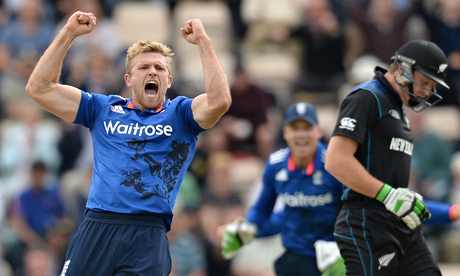
Among those with this dubious honour is David Willey, the 25-year-old all-rounder from Northamptonshire. Not that he appears cowed by that prospect. On Wednesday he plays his third one-day international; he will be entrusted with the new ball – because he is more likely to make it swing than any of his colleagues and he is that rarity in England, a left arm paceman, capable of getting the ball to jag back into the pads of unsuspecting right-handed batsmen.
It is quite a responsibility but Willey does not seem too flustered. If nothing else Paul Farbrace has the happy knack of taking the pressure off his players, which is a far more valuable asset at international level than on the county circuit.
Willey bowled well at Southampton, returning three for 69 from 10 overs. In this century there are no contradictions in that sentence. It is now possible to bowl well and concede 69 runs. He bowled over the wicket at the start and dispatched Martin Guptill with the dream delivery in his first over. He would return late in the innings bowling around the wicket in pursuit of reverse swing, which is difficult to find with these verdant outfields.
So Willey finished with modern figures and he is very much the modern cricketer. He looks as if he visits the gym on a regular basis; he possesses the broadest shoulders, which can send the ball a long, long way when he bats. He has had his stress fracture, which seems to be a rite of passage for any young pace bowler. For the first time in two years he is confident in his fitness – “touch wood”. Sustaining that was his prime goal for this season rather than an England call-up.
“For me the main thing was to stay fit. I have struggled for the best part of two years with injury so all this is a bit of surprise. But it is a fantastic opportunity,” he said with an engaging candour, which may be hereditary.
“Last summer I had a shoulder injury, which was related to a stress problem in my lower back the previous season.” It must be less painful and less complicated to earn a living as a batsman. The one oddity for a modern pace bowler is the welcome absence of visible tattoos on Willey’s torso.
Willey adheres to the mantra flooding from the England dressing room, no matter who is speaking: “We are all aggressive players and the captains and coaches have just encouraged us to go out and play the way we have been playing for our counties. Express ourselves and play with freedom,” he said.
Actually this observation has been made from the New Zealand dressing room as well. Their coach, Mike Hesson, has said, “This England team is very aggressive; they have hitters from one to 10. They haven’t nailed it quite yet – you’re never going to straight away. But on their day, crikey, they’re dangerous. They could have scared a few teams in the World Cup.”
All this talk of self-expression and freedom was never quite so prevalent when David’s father, Peter, was in the England dressing room. He tended not to gush too much or dwell on the benefits of “freedom of expression”. I suspect his words to his son before undertaking the ordeal of propelling a first international delivery were similar to those he uttered to me from mid-off on my debut: a wry “good luck”.
“My father keeps me quite grounded,” said young Willey, which is no great surprise to those who played with or against Peter. “He wants me to concentrate on all formats. Test cricket is the pinnacle and I would like to be play in that as well. Ever since I was young my father has told me how valuable left-armers are. He has always encouraged me to keep swinging the ball even if I’m not express pace.
“We had a typical father/son relationship. I didn’t listen to him at first but as I grew up I started to pay a little more attention. He’s been very good over the last few years and helped me a lot.”
Peter Willey, retired reluctantly from umpiring, has been watching his son – “I think my mum has dragged him around to watch some cricket.” David never saw his father play, but remembers being taken to Fenner’s to watch him umpire, which does not necessarily sound like a ball of fun – unlike the prospect of Wednesday’s match.
England are anticipated to be unchanged, leaving James Taylor on the sidelines again. The Kiwis, with dwindling resources especially after Trent Boult’s departure, are also likely to play the same side. They have suddenly become the pragmatists in this contest, which is what tends to happen when regarded as the favourites.
Likely teams
England Hales, Roy, Root, Morgan, Stokes, Buttler, Billings, Rashid, Willey, Wood, Finn
New Zealand Guptill, McCullum, Williamson, Taylor, Elliot, Santner, Ronchi, Wheeler, Southee, Wheeler, McClenigan