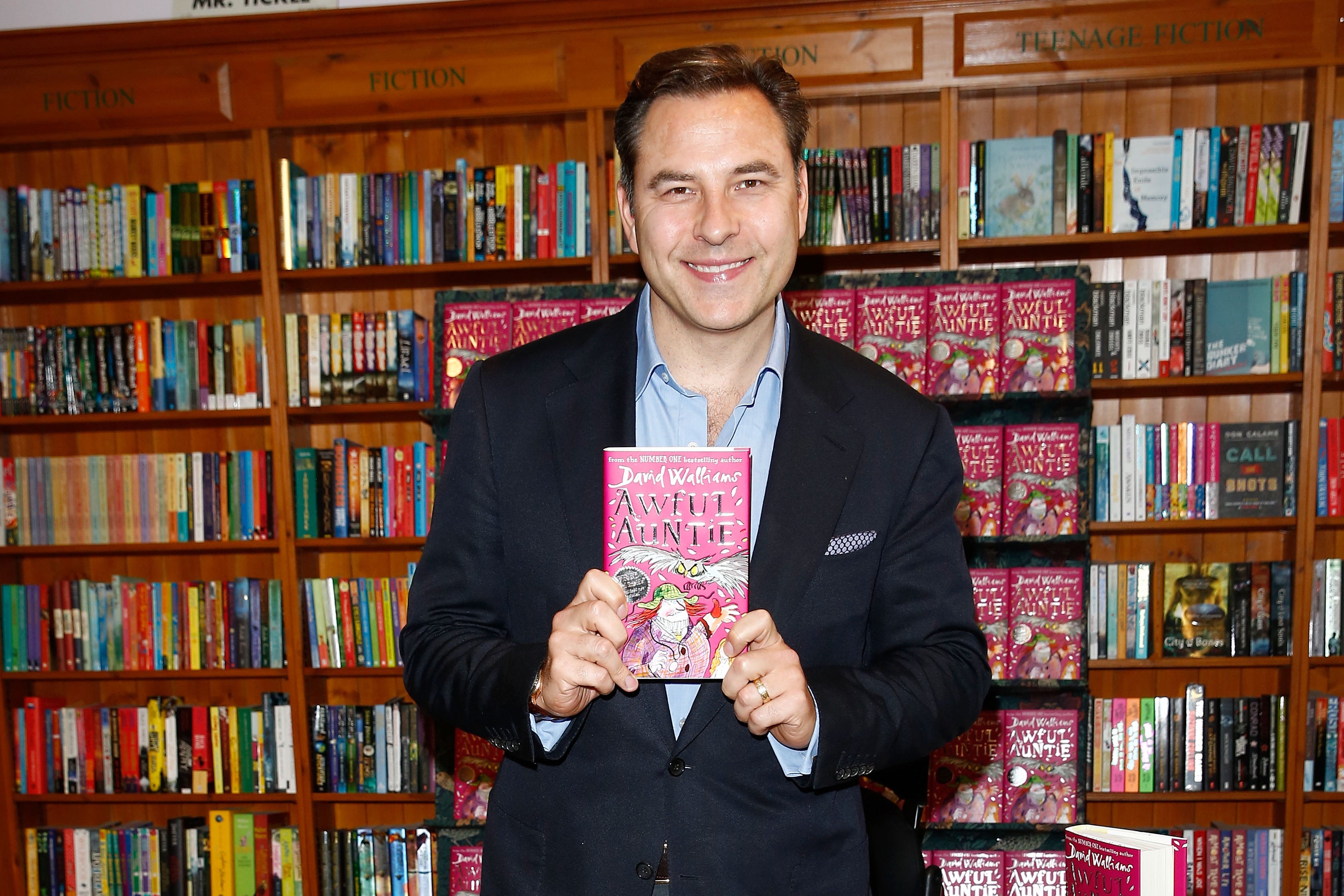
David Walliams’s children’s books are being looked at with renewed scrutiny after he was dropped by his publisher HarperCollins, following allegations of inappropriate behaviour being made against the author.
A junior colleague is said to have complained about his conduct, leading to other staff members being interviewed.
Former employees alleged to The Telegraph that they were advised to work in pairs when meeting with him and not to visit his home.
A spokesperson for Walliams said he “strongly denies” any claims and was not informed about or party to an investigation by HarperCollins.
Walliams has been faced with much public criticism over the years, including for using blackface in Little Britain, and for making obscene comments about contestants during his time on Britain’s Got Talent.
And despite his literary career being hugely successful – he has brought HarperCollins £100m in sales via dozens of books that have sold more than 60 million copies, and are widely used in schools – Walliams’s books have also repeatedly received negative attention for the stereotypes they reinforce, and have been accused of sexism, classism, fat-shaming and more.
Sexism
Walliams frequently writes about female characters without clothes on, who find themselves in humiliating circumstances. In his 2013 book Demon Dentist, Winnie, a social worker with “an abundant bum”, gets trapped in a wire fence, which she is pushed through.
In the story, Walliams writes: “It took a few moments for Winnie to realise she was now only in her underwear… standing there in her bra and knickers. The bra was quite the biggest Alfie had ever seen. It looked like it could comfortably hold two footballs, and was bright orange. The knickers, that might have doubled as a child’s play tent, were a shocking shade of pink.”
At another point, Walliams writes: “Winnie peered at the boy. She slid along the sofa, and her big fat face came close to his.”
Female characters throughout Walliams’s books are depicted as useless or absent, as having affairs or abandoning their children.
In Billionaire Boy, from 2010, there is a character called Sapphire Stone, a “Page 3 girl” depicted as a gold-digger.
Walliams writes: “Joe looked at the page. There was a photograph of a woman whose clothes seemed to have fallen off. Her hair was dyed white blonde and she had so much make-up on it was difficult to tell if she was pretty or not. Underneath the image it read, ‘Sapphire, 19, from Bradford. Likes shopping, hates thinking.’”
Fat-shaming
Repeated reference is made throughout Walliams’s books to how overweight (and therefore, in his stories, grotesque) certain characters are.
Auntie Dhriti, in 2015’s Grandpa’s Great Escape, cannot leave her flat because of her size. “She was always a large lady,” a character says in the story, “but since living above a sweet shop she has ballooned. I would have to hire a crane and knock down a wall if she ever wanted to pop out.”
Meanwhile Sheila, a stepmother character in 2012’s Ratburger, is described thus: “Zoe’s stepmother was quite short, but she made up for it by being as wide as she was tall.”
He adds that she is “so lazy she would order Zoe to pick her nose for her, though of course Zoe always said ‘no’. Sheila could even let out a groan while changing channels with the TV remote.”

The removal of Chinese character ‘Brian Wong, Who Was Never, Ever Wrong’
In 2021, it was announced that a story containing “harmful stereotypes” about Chinese people would be removed from Walliams’s 2016 book The World’s Worst Children.
Podcaster Georgie Ma had condemned the story, which centres on a studious young Chinese boy named Brian Wong, in an Instagram post that year.
Speaking to The Bookseller, Ma said that the story “normalised jokes on minorities from a young age”, and identified a number of “negative stereotypes” the story perpetuated.
These include the way the character was drawn (”He wears glasses, he looks like a nerd, he’s got small eyes”), jokes about his name, and his stereotyped character traits.
“The overall character plays on the model minority myth where Chinese people are nerdy, swotty and good at maths, we’re not confrontational and we’re high achievers,” said Ma.
In a statement at the time, HarperCollins said: “In consultation with our author and illustrator we can confirm that a new story will be written to replace ‘Brian Wong’ in future editions of The World’s Worst Children.”
Raj the shopkeeper
Raj is a character who features in many of Walliams’s books, and who has been criticised as a lazy stereotype. He’s a South Asian news agent who speaks in nonstandard English, and is famous for being a cheapskate who sells his customers food that is out of date.
In 2018, after a screen adaptation of the book The Midnight Gang aired on BBC One, Mohammed Shafiq, chief executive of Muslim rights group the Ramadhan Foundation, was among the first to condemn the portrayal.
“It’s a stereotypical character,” he said. “To target a community and suggest that community’s shopkeepers are involved in selling out-of-date food is deeply unacceptable.
“It’s distasteful. In most cases these shopkeepers have been the fabric of their community for decades and I am uncomfortable with that joke.
“I’d love to have a conversation with David Walliams about it just to understand what his rationale is.”
Gerry Gable, editor of Searchlight magazine and an anti-racism campaigner, also shared concerns.
“Walliams is planting in kids’ minds that Asian shopkeepers are villains or not to be trusted,” he said.
“The whole stereotyping is disgraceful. It’s the same kind of stereotyping you would have seen in anti-Semitic literature before the war about Jews cheating in business. I find it really alarming.”
In a 2023 podcast for Tortoise Media, journalist Claudia Williams said that senior publishing figures told her they would not want their children to read Walliams’s books. “One said they felt some elements of the books were racist and couldn’t believe they were allowed through the editing process,” she said.
Classism
In 2020, activist and food writer Jack Monroe branded the comedian’s stories as “sneering classist fatshaming nonsense”.
In a thread on X (then Twitter), which went viral, Monroe quoted several of Walliams’s books, including The World’s Worst Parents, which was published in the summer of 2020.
Monroe accused Walliams of “targeting the working class” and noted how much of his material was recycled from his controversial Little Britain series.
She condemned Walliams for depicting a single mother of two who lives in a tower block as one of the “world’s worst parents” when “all she does is love her kids and make them laugh”.
Monroe added: “I'm aware I probably come across as a joyless harpy, but a white wealthy man using working-class women as punchlines for his tired old jokes and then spoon-feeding them to children is grim.”
The Telegraph noted that this character’s only “crimes appear to be that she wears a ‘very bad, homemade outfit’ and is boring”.
BBC facing calls to axe David Walliams show from Christmas lineup
It’s baffling that David Walliams’s publishing deal lasted this long
Dilbert creator reveals he’s paralyzed from the waist down amid cancer diagnosis
How the ‘Queen of the Aga Saga’ moniker got Joanna Trollope all wrong
Joanna Trollope, bestselling British author, dies aged 82
Mary Beard and Jarvis Cocker join judging panel of 2026 Booker prize