
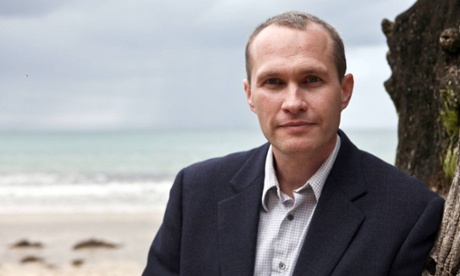
I’m very pleased to announce that we’ll be running a live Q&A with David Vann at 1pm on Friday 27 February.
Few fiction debuts in recent years have had the impact of David Vann’s Legend of a Suicide. “Nothing quite like this book has been written before,” said Alexander Linklater in the Observer , and that was possibly one of the quieter reviews of this - as the TLS put it - “future American classic”.
Better still, Vann has lived up to this extravagant promise. His following books Goat Mountain, Dirt and Caribou Island have all garnered praise for his “daring”, “stark” and “beautiful” writing.
He’s an impressive guest, in other words. He will be answering questions from 1pm on Friday, but please feel free to get yours in early. Anyone who has been following the Reading Group this month will know just how impressive Caribou Island is, how deep it goes and how many questions it raises. So you may want to ask more than one!
Meanwhile, anyone who has read Vann’s writing will also be excited to hear that he has a new book, Aquarium, on the way next month and that we we have 10 copies to give away to the first 10 readers in the UK to post “I want a copy please” – along with a nice, constructive question – in the comments section below. If you’re lucky enough to be one of the first 10 to comment, don’t forget to email Laura Kemp (laura.kemp@theguardian.com), as we can’t track you down ourselves. Be nice to her, too.

FlightyZoo, thank you! I couldn’t get Legend published for 12 years, so I blissfully wrote without any demands. When I was finally getting published and more books were bought on contract, my editors gave no direction, and I wrote only what I wanted. This changed only recently. Bright Air Black is too literary (“too much focus on language and landscape” according to my previous US editor), so most territories are hesitant to publish it. My UK editor is brave enough and was willing to publish last year if I wanted, but my agents wanted me to wait to have Aquarium come out everywhere at the same time. So I do feel pressure now, and I hate and resent this pressure. I no longer feel free to write whatever I want to, but I’m glad I felt free during the writing of my first 10 books. That’s quite a few to get through before being cramped up by market concerns. Aquarium is the 7th to be published and four more are coming out, the 11th one written under this pressure, and I can’t tell whether it screwed up the book or not. The truth is that publishers have no idea what will sell, and they shouldn’t let marketing have a say in anything, and they shouldn’t tell authors what not to write. It’s all fucked up.
Skinnyfists, I went to a great MFA at Cornell, then a Stegner at Stanford and also had undergrad CW courses with great teachers such as John L’Heureux, Michelle Carter, Grace Paley, and Adrienne Rich. MFAs are where young writers can go to meet older, more established writers. They also have time to focus on their writing, are in a community of likeminded writers, can find out what everyone is reading, where they’re submitting manuscripts, etc. It’s all great. I don’t think there are any negatives except that the semester pushes everyone toward story collections rather than novels. Programs can’t teach talent and can’t destroy talent, but they can help everyone become better readers and also have the best shot at their own writing. I recommend programs without hesitation.
MythicalMagpie, writing Caribou Island was in fact a question to understand how those final events could be possible, after the murder/suicide of my stepmother’s parents. My first four books of fiction (Legend, Caribou, Dirt, and Goat) are all indirect attempts to understand the violence in my family. They’re also unconscious attempts to be made whole and to remake or undo the past. Aquarium was inspired by my lifelong love of fish and the way they suggest aspects of human life. I wanted to use them as a landscape, a form of the unconscious, for writing about Caitlin and the old man she meets.
Drewgum, Sukkwan, which is part of Legend, wasn’t published until 12 years after I finished it. Six agents, including a big one, said they loved it but it could never sell. They said it was too literary, too dark, too strange in form, etc. But it’s the book which has gone into 20 languages and sold 250,000 copies in France alone, so agents and publishers really don’t know. They honestly don’t. They’re smart and hardworking and try hard, but they need to always remember that they don’t know what will sell so they should just publish the best work. That should be their only concern.
Sue Bodilly, thank you! Bright Air Black is set in the Mediterranean and Black Sea 3,250 years ago, so it departs from Alaska and California but is still focused on natural landscape. Aquarium is urban and has interiors but is in the northwest. I’ve just finished writing a novel in Florida which has less wild landscape. I sometimes think I’ll write a novel about New Zealand, where I’ve been a resident for 13 years, or England, which I also love and where I teach each fall, but I can never predict what I’ll write next.
samjordison replied:
The truth is that publishers have no idea what will sell, and they shouldn’t let marketing have a say in anything, and they shouldn’t tell authors what not to write. It’s all fucked up.
Awesome quote. (As a sometime publisher, I kind of have to agree... kind of... )
I’m definitely with you on the marketing. And on directing an author to write something. And that the only real bottom line should be the artistic one.
But, to defend my trade, I also think you can sometimes see things that writers can’t - and things that aren’t working as they should. In which case you have to say something... (Arguably, any good second pair of eyes could do that for an author. But it must help that publishers train themselves to read in a certain way....)
Yeah, that's certainly fair, and I've been lucky to have very smart editors. Their comments on my books have certainly helped me gain distance. And I think my agents were right, by the way, about publishing timing. Film rights have been picked up for Aquarium already, and it's nice to have reviews coming out at the same time on both sides of the Atlantic.
samjordison asked:
Thought I’d get a question in early. I’ve been really interested in the ambivalent relationship many of your characters have with the wilderness and in their yearning to find something authentic there... I can’t help wondering how you feel about it all personally. Do you seek the wild yourself? Or prefer to just visit it from the comfort of your desk?
I constantly want immersion in nature, esp through watersports (sailing, kayaking, kitesurfing, windsurfing, waterskiing, etc.) and hiking and mountainbiking, and I do feel refreshed and returned by nature, and I don't feel at home in cities, but I don't actually believe the romantic dream that our Imagination connects to Nature and that we can burn away the Mind of Experience and find our childlike genial springs. I don't think we should romanticize the paleolithic, either.
Dylanwolf asked:
Hello, David. Thank you for giving your time to the Guardian Reading Group. I much enjoyed reading Caribou Island for a second time. Would you say that Caribou Island is a novel specifically about that particular place, at that particular time and those particular people or did you intend to be exploring wider themes?
CI ended up being about the idea of Alaska, more than I had expected. The true story I had been exploring was set in California.
nightjar12 asked:
The characters in Caribou Island are almost all extremely self-absorbed and unforgiving showing little or no love for one another. Do you think that this is a result of living in a harsh, unforgiving environment or that people of that type are attracted to that kind of environment? (Or maybe you would have written them that way even if they lived in Florida?)
First of all, I just want to thank Sam for selecting my novel and also for posting such smart pieces about it. I especially liked “A Frontier Too Far”. That’s a great piece, very thoughtful. And I’d like to thank the rest of you for reading my book and for great comments posted on the site. Really interesting stuff, about Medea and connections with my other books, etc. It’s been a pleasure to read your thoughts, and I feel very lucky.
To nightjar12’s question about the characters seeming self-absorbed and showing little love for one another, they do love each other desperately, but Greek tragedy is about why we hurt the people we love most. The characters fail in many moments when they have opportunities with each other, and they act blindly. And, as suggested in your question, the environment is cold and isolating and does attract a fair number of people who want to be left alone, and it does help shape people in that direction, also.
tneigh asked:
We get to hear directly what most of the central family are thinking about one another, but not Mark. Is that because he has nothing interesting to say? Mark and his partner Tracy did seem to be getting a more central place in the plot when they are told by Carl of Jim’s sexual relationship with Monique and, it seems that Jim may have wasted his money in paying Monique. I was expecting this to be used in the latter stages of the book to complete Rhoda’s misery; is that wrong of me?
Tneigh, it certainly is reasonable to think that the info given by Carl about the infidelity will be passed along, but Mark’s approach to family is to recede as far away as possible. That’s how he can handle what would otherwise be too stressful. I think quite a few people take that approach to family. His thoughts about his parents wouldn’t be great to narrate, because he tries to avoid such thoughts, unlike Rhoda, who is constantly concerned about her parents.
MythicalMagpie said:
I’m going to have to ask.
Why no speech marks?
I've never thought they were necessary. Just extra garbage in the way. I did like Sam's interesting discussion on the topic. The truth is that I was being nice to James Ellroy because it was his night. But it's much easier to know who is saying what in my books than it is in his, even though he uses quotes. Because my characters are fighting, revealing themselves, engaged in drama.
MGFMSKM asked:
I felt like some of the central themes were struggling against growing old, idealistic self-deception and ultimate disillusion. I found it interesting that the touchstones of Gary’s idealistic self-deception - about living a more authentic life by building his cabin in the wild - were more rooted in Nordic sagas and Anglo-Saxon mythology, whereas more ‘American’ examples like Walden would be expected by many readers. I’d be interested to hear more about David Vann’s interest in Nordic and Anglo-Saxon literature, and what (if any) influence he felt it had on the book itself? Although I think it’s usually naive to ask an author why something isn’t referenced, Walden is conspicuous for the absence of any reference. I’d be interested to know if it was a conscious decision to omit Walden, or whether this is more coincidental?
MGFMSKM, Walden had a big influence on my when I was 15, and is still in the background, but it’s so simplistic and such a lie and not something I can believe now. I love Paul Harding’s writing, and he’s a kind of transcendentalist now, perhaps. Gary is more interested in the Anglo-Saxons, as I am. I’ve been working on my Beowulf translation for three years, almost finished with my final revision. It’s a literal translation, not verse, so it’s ugly to read but is as close as possible to presenting the syntax, lexicon, and poetic mind of the original. I’d like to note, also, that anyone who has read only Heaney’s translation hasn’t read Beowulf. He cuts lines, adds lines, flattens the poetry of the original with a tin ear, and has committed a literary crime, esp since his translation has ruled now for so many years. No Anglo-Saxonist I know can even read the entirety of Heaney’s translation. We’re all too furious after about five pages. Regarding the influence of Beowulf on Caribou Island, I used the paired heavy stress of accentual meter from Old English throughout the novel and tried to concentrate content by using sentence fragments and cutting out grammatical morphemes. The prose tries to feel atavistic, a direct apprehension of a brutal physical landscape, and landscape is at the center of all my novels, a kind of form of the unconscious of subconscious which is constantly shifting and changing shape and indicating pattern and meaning.
dgooding asked:
Hi David: in one of our previous reading groups we tackled Dashiell Hammett: reading his biography a couple of months ago, I discovered that he served during WW2 in the Aleutian Islands Campaign on Adak, which I understand is where you hail from. I am interested in reading more about this, so was wondering if you could recommend any good books or other reading material on the island during the Second World War, or anything about Adak in general?
dgooding, here’s a book I blurbed about the battle for the Aleutians:
Beautifully written, lyrical and elegiac, The Wind Is Not A River is a novel you must read, because the battle for the Aleutians too often has been erased or forgotten and because John Easley’s struggle to survive and his wife Helen’s struggle to find him form the most triumphant and heartbreaking love story I’ve read in years.
NoddyBankie asked:
I would like to ask - were you concerned at any time while writing the book that by creating such unlikeable characters that your reader would not engage with them? That is how I started out but soon found myself engrossed in them all. A sign of excellent writing.
Thank you. I wasn't worried at the time. In 2500 years of western literature, characters have not had to be likeable. It's a very recent and wrong idea that we have to like them or feel good after reading a book. Is it Oprah's fault? I don't know where the stupid idea comes from. But yeah, writers are supposed to go after the mystery of who we are, not fabricate something that people will like.
theorbys asked:
This month’s Caribou Island led me to read Goat Mountain and Dirt. And Legends will be next. Questions:
1) While I originally thought Irene had a lot in common with Medea, some one pointed out there was an excellent personage in Norse religion called Skadi who would perhaps be more consistent with the Norse/Icelandic/AngloSaxon themes and the icy North. Were you thinking of Skadi?
2) Gary and his struggles with building the cabin, along with Irene’s scathing comments seemed very funny in a very black humorous way. Also Galen had to struggle with the sheer physicality of everything he did, I know the situation was grim, but again it seemed like black humor. Also, but less, in Goat Mountain there were these struggles with the physical corpse, not to mention poison ivy, etc. All of the above a bit like Laurel and Hardy moving pianos. Did you intend it to be funny, however black the humor?
3) Your writing to me recalls Edgar Allan Poe. It is extremely concentrated and focussed, and of course deals with psychic disintegration, in absolutely terrifying and subjective circumstances. Has Poe been an important influence on your writing? I am thinking of literary masterpieces like Black Cat, Amontillado, Ligeia, or Tell-Tale Heart especially. And just to be clear, I personally regard Poe as a literary genius not a genre genius.
Aquarium and Black Air Bright sound great, and the latter I know is about Medea.
Theorbys, thank you for reading three of my books!
1. Irene is similar to Skathi in some ways, but I don’t find the Icelandic sagas as intimate or suggestive or inspiring as the older anglo-saxon works. The sagas are told in such summary at such a far remove, in my mind they really are not as great in any way, even though my grandmother was Icelandic and so of course I’d like to say everything Icelandic is best, ha.
2. Yes, I did find the books funny. I didn’t plan the humor, and it is dark. Dirt, to me, is funny throughout because of Galen’s warped view of himself and his New Age attempts, which were my attempts in high school (I actually tried to walk on water, over and over, thinking it might work). Dirt is the funniest book I’ll ever write, I’m sure, but most readers don’t see the humor. It’s the most misread of my books.
3. I did love reading Poe. I ended up being more influenced by Flannery O’Connor, who has another kind of darkness and tension, and a meanness. And I like Joyce Carol Oates, who has a similar psychological intensity. I think no writer is original, that we’re derivative of all the works we’ve loved, and thanks for reminding me of Poe. I haven’t often thought of that influence.
hermiona asked:
David, thank you for a marvelous book! Do you mind to give us a sequel:) I am very interested in Rhoda and Jim. What could happen to them? Could be there very much the same story as was with Irene and Gary? I hope not.
Ha. I hope Rhoda dumps Jim, and quickly. I don't think Rhoda is doomed to repeat her mother's life, by the way, and I don't think we're doomed in real life.
hermiona replied:
Thank you. I’m feeling better;-)
Ha. Rhoda is strong and good, and she sees Jim more clearly by the end, is having doubts, etc.
John Ryan said:
I was wondering if Mr Vann ever feels like there’s a place he wouldn’t go in his writing? As in a line he wouldn’t cross or a theme he feels like he can’t explore?
So far each of my books has crossed some taboo and made me uncomfortable. I write without thinking I'll publish, then I worry later and feel ashamed but publish anyway. But there probably are some topics I wouldn't touch. It's interesting to go to book festivals and find out that some people won't read Caribou Island because they've heard there's sex in it, for instance. Some countries are quite prudish. The US and Australia, for instance.
FlightyZoo asked:
Hey, David. This isn’t a question about Caribou Island, but more about yourself as a writer and writing in general. I recently read Legend of a Suicide and was just completely bowled over by it. It’s one of the most original books I’ve ever read and I was surprised to discover that it was your debut. It has inspired me, along countless other books, to push harder in my own writing and to work harder.
My question is: How much pressure from publishers, your friends, yourself, whoever, do you (and did) face in your writing? Are you ever asked to scale back the intensity that is so often apparent in your work or the uncomfortable truths and situations? Have you ever been told, despite what you believe in, that you shouldn’t be writing the things that you do write, and if so, how have you coped and worked around this ‘advice’? It’d be interesting to hear your response because so much of your work just seems fearless to me.
FlightyZoo, thank you! I couldn’t get Legend published for 12 years, so I blissfully wrote without any demands. When I was finally getting published and more books were bought on contract, my editors gave no direction, and I wrote only what I wanted. This changed only recently. Bright Air Black is too literary (“too much focus on language and landscape” according to my previous US editor), so most territories are hesitant to publish it. My UK editor is brave enough and was willing to publish last year if I wanted, but my agents wanted me to wait to have Aquarium come out everywhere at the same time. So I do feel pressure now, and I hate and resent this pressure. I no longer feel free to write whatever I want to, but I’m glad I felt free during the writing of my first 10 books. That’s quite a few to get through before being cramped up by market concerns. Aquarium is the 7th to be published and four more are coming out, the 11th one written under this pressure, and I can’t tell whether it screwed up the book or not. The truth is that publishers have no idea what will sell, and they shouldn’t let marketing have a say in anything, and they shouldn’t tell authors what not to write. It’s all fucked up.
Jericho999 asked:
Hello David,
I loved Legends Of A Suicide - thank you! It felt like a bolt from the blue... although I read that it took you a long time to get it published... which leads me to wonder at what stage you started to realise that this book was going to get a lot of traction. And how that felt?
It was published because it won a contest, then had a very small pub with an academic publisher and only three reviews, but the New York Times gave it a full page review and really gave it a life. I was so thrilled. And then I couldn't believe the reception in the UK the next year, much bigger, with 35 reviews and tons of interviews. I felt a part of a literary culture and conversation for the first time. And then the launch in Paris was even bigger, and I was basically in heaven, more than I ever imagined for my writing.
Skinnyfists asked:
Hi David, I would be interested to hear your thoughts on current trends with American writers - particularly the tension between writers who have done an MFA and ones with no formal training/qualifications. What do you think the value is of doing an MFA, and do you think there are any pitfalls with the professionalisation of such a craft? For example, if you take the great Don Delillo, you can’t see his novels having come out of an MFA course, they seem to be operating on some unique wavelength. But Ben Lerner (MFA) on the other hand is garnering lots of praise at the moment. So there seems to be parallel approaches.
Skinnyfists, I went to a great MFA at Cornell, then a Stegner at Stanford and also had undergrad CW courses with great teachers such as John L’Heureux, Michelle Carter, Grace Paley, and Adrienne Rich. MFAs are where young writers can go to meet older, more established writers. They also have time to focus on their writing, are in a community of likeminded writers, can find out what everyone is reading, where they’re submitting manuscripts, etc. It’s all great. I don’t think there are any negatives except that the semester pushes everyone toward story collections rather than novels. Programs can’t teach talent and can’t destroy talent, but they can help everyone become better readers and also have the best shot at their own writing. I recommend programs without hesitation.
MythicalMagpie asks:
It’s harder than I thought to ask a question this month. Not that there aren’t plenty I could think of, but because all of David Vann’s earlier novels have evolved from the aftermath of personal tragedies from his own family. That’s what gives the writing such power. I suppose I, somewhat voyeuristically, wonder if he has, through writing, found some answers to the inevitable questions why that those events must leave behind. Caribou Island felt like a quest for an explanation for Irene’s final violent and self-destructive acts. Is that a fair way to look at the novel?
I’m also wondering where the inspiration for Aquarium came from.
I want a copy, please. Strangely, I really like the way David Vann describes fish. It’ll be interesting to see how he handles the live ones after reading the evocative passages about fishing in Caribou Island.
MythicalMagpie, writing Caribou Island was in fact a question to understand how those final events could be possible, after the murder/suicide of my stepmother’s parents. My first four books of fiction (Legend, Caribou, Dirt, and Goat) are all indirect attempts to understand the violence in my family. They’re also unconscious attempts to be made whole and to remake or undo the past. Aquarium was inspired by my lifelong love of fish and the way they suggest aspects of human life. I wanted to use them as a landscape, a form of the unconscious, for writing about Caitlin and the old man she meets.
drewgum asked:
I read somewhere, I think, that Sukkwann Island sat in a drawer for years. What made you get it out again? And what possible reasons were you given for initial rejection?
Drewgum, Sukkwan, which is part of Legend, wasn’t published until 12 years after I finished it. Six agents, including a big one, said they loved it but it could never sell. They said it was too literary, too dark, too strange in form, etc. But it’s the book which has gone into 20 languages and sold 250,000 copies in France alone, so agents and publishers really don’t know. They honestly don’t. They’re smart and hardworking and try hard, but they need to always remember that they don’t know what will sell so they should just publish the best work. That should be their only concern.
Sue Bodilly asked:
My question to you is “I think you are a brilliant writer and wonder how you would tackle a story in another setting other than the wild and often violent landscape of Alaska and those parts of America - for instance, in Middle England, where you presently reside”. Thank you !
Sue Bodilly, thank you! Bright Air Black is set in the Mediterranean and Black Sea 3,250 years ago, so it departs from Alaska and California but is still focused on natural landscape. Aquarium is urban and has interiors but is in the northwest. I’ve just finished writing a novel in Florida which has less wild landscape. I sometimes think I’ll write a novel about New Zealand, where I’ve been a resident for 13 years, or England, which I also love and where I teach each fall, but I can never predict what I’ll write next.
samjordison asked:
Is your Beowulf translation something you’re aiming to publish?
I did the translation just because I loved the language and that particular work, but my UK publisher, Jason Arthur at Heinemann, is interested, actually, so it may be published, which I would love.
samjordison said:
This is really interesting too:
“So far each of my books has crossed some taboo and made me uncomfortable. I write without thinking I’ll publish, then I worry later and feel ashamed but publish anyway.”
El Doctorow said something very similar: “I have to feel that I’m transgressing. The only time it’s good is when I’m breaking some rule.”
Do you see writing as a kind of exploration of boundaries? Like you have to push onto the dark unknown part of the map for it to work? And if so, how do you sustain it? (Doctorow has managed for quite a few brillliant decades, I guess...)
I think writing is mostly unconscious or subconscious. I focus on landscape because it becomes this subconscious and can shift and transform and make pattern. And that pattern is without conscious denial or control and so crosses boundaries inevitably. But I think of it also as Greek tragedy, that taboo is always crossed, we hurt those we love most, we act unconsciously and out of control, etc.
Sue Bodilly replied:
That is one of the things I love about your books, that you are not afraid ultimately to push boundaries and tell it like it is – instead of leaving out the real gritty stuff for fear of offending or even being ostracised. That is why, often books that look good tend to leave you dissatisfied.
Thank you, Sue. I do love tragedy. I think we test ourselves against the characters in those moments, interested mostly in the shape and extent of our badness. I think of tragedy as reassuring, a safe demonland, but it does need to be a demonland.
I've had to take off my shirt because I've actually started to sweat from all the typing. Pretty funny. Webchat as workout.
If only I had this everyday, maybe the last vestiges of the muffin top would disappear.
Thank you all for such smart, thoughtful questions, and for reading my novel. And thank you again, Sam, for selecting the book!













First of all, I just want to thank Sam for selecting my novel and also for posting such smart pieces about it. I especially liked “A Frontier Too Far”. That’s a great piece, very thoughtful. And I’d like to thank the rest of you for reading my book and for great comments posted on the site. Really interesting stuff, about Medea and connections with my other books, etc. It’s been a pleasure to read your thoughts, and I feel very lucky.
To nightjar12’s question about the characters seeming self-absorbed and showing little love for one another, they do love each other desperately, but Greek tragedy is about why we hurt the people we love most. The characters fail in many moments when they have opportunities with each other, and they act blindly. And, as suggested in your question, the environment is cold and isolating and does attract a fair number of people who want to be left alone, and it does help shape people in that direction, also.
Tneigh, it certainly is reasonable to think that the info given by Carl about the infidelity will be passed along, but Mark’s approach to family is to recede as far away as possible. That’s how he can handle what would otherwise be too stressful. I think quite a few people take that approach to family. His thoughts about his parents wouldn’t be great to narrate, because he tries to avoid such thoughts, unlike Rhoda, who is constantly concerned about her parents.
MGFMSKM, Walden had a big influence on my when I was 15, and is still in the background, but it’s so simplistic and such a lie and not something I can believe now. I love Paul Harding’s writing, and he’s a kind of transcendentalist now, perhaps. Gary is more interested in the Anglo-Saxons, as I am. I’ve been working on my Beowulf translation for three years, almost finished with my final revision. It’s a literal translation, not verse, so it’s ugly to read but is as close as possible to presenting the syntax, lexicon, and poetic mind of the original. I’d like to note, also, that anyone who has read only Heaney’s translation hasn’t read Beowulf. He cuts lines, adds lines, flattens the poetry of the original with a tin ear, and has committed a literary crime, esp since his translation has ruled now for so many years. No Anglo-Saxonist I know can even read the entirety of Heaney’s translation. We’re all too furious after about five pages. Regarding the influence of Beowulf on Caribou Island, I used the paired heavy stress of accentual meter from Old English throughout the novel and tried to concentrate content by using sentence fragments and cutting out grammatical morphemes. The prose tries to feel atavistic, a direct apprehension of a brutal physical landscape, and landscape is at the center of all my novels, a kind of form of the unconscious of subconscious which is constantly shifting and changing shape and indicating pattern and meaning.
Dgooding, here’s a book I blurbed about the battle for the Aleutians:
Beautifully written, lyrical and elegiac, The Wind Is Not A River is a novel you must read, because the battle for the Aleutians too often has been erased or forgotten and because John Easley’s struggle to survive and his wife Helen’s struggle to find him form the most triumphant and heartbreaking love story I’ve read in years.
Theorbys, thank you for reading three of my books!
1. Irene is similar to Skathi in some ways, but I don’t find the Icelandic sagas as intimate or suggestive or inspiring as the older anglo-saxon works. The sagas are told in such summary at such a far remove, in my mind they really are not as great in any way, even though my grandmother was Icelandic and so of course I’d like to say everything Icelandic is best, ha.
2. Yes, I did find the books funny. I didn’t plan the humor, and it is dark. Dirt, to me, is funny throughout because of Galen’s warped view of himself and his New Age attempts, which were my attempts in high school (I actually tried to walk on water, over and over, thinking it might work). Dirt is the funniest book I’ll ever write, I’m sure, but most readers don’t see the humor. It’s the most misread of my books.
3. I did love reading Poe. I ended up being more influenced by Flannery O’Connor, who has another kind of darkness and tension, and a meanness. And I like Joyce Carol Oates, who has a similar psychological intensity. I think no writer is original, that we’re derivative of all the works we’ve loved, and thanks for reminding me of Poe. I haven’t often thought of that influence.