Afternoon summary
-
The SNP has said that George Osborne’s plan for a budget surplus law will set austerity “into concrete”. The SNP MP Pete Wishart told the World at One:
This is setting austerity into concrete. This will be paid on the backs of the most marginal and vulnerable in our society.
And Paul Johnson, director of the Institute for Fiscal Studies, told the same programme it would take fiscal policy back to the nineteenth century. He said:
It will certainly mark a very big change with the past. And I don’t just mean the recent past but over the last 100 years and more, when we’ve only really rather rarely run surpluses - for three or four years after the Second World War, for two or three years at the beginning of this century. Actually to put surpluses into law as something you want to run every year in normal times would take us back to the practice of the second half of the 19th century.
- The Law Society has said it is “deeply concerned” about an announcement today from the Ministry of Justice saying it is pressing ahead with legal aid cuts. The details of the cuts are set out in this ministerial statement (pdf).
-
Lord Ashcroft, the former Conservative deputy chairman, has offered to pay £100,000 for Labour’s Edstone.
If the @UKLabour Party would like to auction the "EdStone" may I start the bidding at £100000.
— Lord Ashcroft (@LordAshcroft) June 10, 2015
That’s all from me for today.
Thanks for the comments.
Updated
A Labour leadership round-up
Here’s a round-up of some of the latest news and blogs about the Labour leadership campaign.
-
Andy Burnham continues to lead the field as more MPs have publicly declared who they are supporting.
More leader noms for Burnham & Cooper this AM - now 55 & 43. Kendall stuck on 36, Corbyn +1 on 12, Creagh 6. Still plenty of MPs undeclared
— James Tapsfield (@JamesTapsfield) June 10, 2015
The New Statesman has an up-to-date list of which MPs are nominating which candidates.
-
Lord Prescott, the Labour former deputy prime minister, has said the party’s leadership election rules are “bizarre” because they make it too hard for candidates to get on the ballot paper. Candidates have to be nominated by 15% of MPs (35 in this parliament). In an article for the New Statesman explaining why he is backing Stella Creasy for deputy leader, as well as Burnham for leader, he said:
I think she’s got a lot to offer and I’m impressed she’s prepared to do the job full-time to get Labour ready for the electoral battles ahead.
But under our frankly bizarre leader and deputy leadership rules, the bar is too high to get on the ballot. We need as wide a field as possible. And Stella deserves to put her case to Labour members and supporters.
If I was still an MP, I would willingly nominate her myself.
But as I’m not, I really hope Labour MPs will nominate Stella so party members can have that real choice and debate on how we can become a campaigning movement again and start the journey back to Government. I also believe a Burnham-Creasy leadership could make a great team to appeal across the country.

- The New Statesman’s Stephen Bush has tweeted an early finding from research into Burnham.
Early observation from doing first interviews for Burnham profile: all of his civil servants seem to have really liked him.
— Stephen Bush (@stephenkb) June 10, 2015
Andy is a comprehensive-school lad from Liverpool who made it into the cabinet. He can take the tough decisions we need to rebuild trust on issues like the economy and immigration. Andy tells a strong story about the kind of country he wants to build; one that gives hope to people; that shows they’ll be rewarded for getting on; that supports them to own their own home and get on wherever they are and wherever they live. I want people to emotionally connect with the Labour Party and show that we get them and get their lives. With Andy I believe we can do that.
The most telling thing said by any of the candidates [at yesterday’s hustings], though, was Burnham’s assertion that 2015’s “was the best manifesto that I have stood on in the four general elections in which I have been a candidate”.
This is lala land. Labour has just lost an election that it could have won because it had the wrong leader and the wrong policies and the front runner to take over says how totally marvellous it all was and that perhaps if everyone tries a bit harder next time the British electorate will put its palm to its face and say, Oh yes we meant to vote Labour all along.
The New Statesman has released some excerpts from its interview with Tim Farron, the favourite to win the Lib Dem leadership contest. In its, he says he is opposed to fracking (“It’s another fossil fuel”) and the like-for-like replacement of Trident (“It’s an act of aggression and will be seen as so by a global community that’s looking for people to disarm, not rearm to the max”).
He also says he would only form a coalition agreement with a party that agreed to electoral reform.
I would not sign off any agreement with any of the other parties that did not entail [electoral reform], end of story. Massive, massive red line, don’t even pick up the phone.
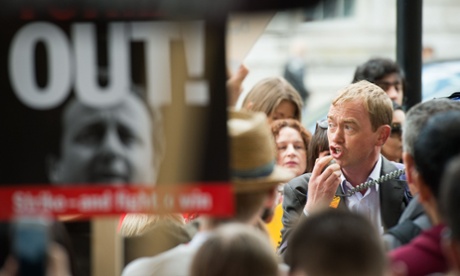
The New Statesman is backing Tim Farron, not his rival Norman Lamb, for the Lib Dem leadership. Here is an extract from the editorial in this week’s magazine.
Next month Liberal Democrat members will elect a leader to inherit what remains of their party. The two candidates, representing a quarter of their number in the Commons, are Tim Farron, the former party president, and Norman Lamb, the former health minister. It is Mr Farron (interviewed in this week’s magazine) who offers the Lib Dems their best hope of recovery. Unlike Mr Lamb, he is untainted by service in the Tory-led government and voted against policies such as higher tuition fees and the bedroom tax. He won his constituency of Westmorland and Lonsdale from the Conservatives in 2005, ending nearly a century of rule by a single party, and transformed it into one of the safest Lib Dem seats in Britain through Stakhanovite campaigning. He is devoted to the causes the Lib Dems must embody if they are to survive, let alone flourish: constitutional reform, civil liberties, environmentalism and social justice. Like his late mentor Charles Kennedy, he is a sincere and humane communicator. The revival of the Lib Dems will be the work of many years; Mr Farron is the best man to begin the long journey back across the wasteland.
Lunchtime summary
-
David Cameron has announced plans intended to “significantly” reduce non-EU economic migration, including a “skills levy” on firms that recruit workers from outside the EU. He announced the plans at PMQs, where he said the government would be writing to the migration advisory committee (MAC) asking it to consider new rules for non-EU migration. (See 1.04pm.) The “skills levy” idea is a straight lift from the Labour manifesto. Simon Walker, the Institute of Directors director general, said it was a mistake. In a statement he said:
Business cannot have a deaf ear to the public’s concerns on immigration. However, focusing on the supposedly lower cost of migrant labour is a red herring. Among the 50% of IoD members who hire from abroad, just 4% say that the cost of labour has anything to do with it. The fundamental concern is about finding people with the skills needed by employers.
Proposals to further increase the cost of visas is essentially a tax on employing people from abroad. This seems particularly odd given how dependent the UK economy is on international skills and expertise. The prime minister is absolutely right to focus on upskilling the domestic workforce, but there’s no quick fix and it could appear misguided to risk harming the economy today in the hope of seeing results a decade down the line.
-
Harriet Harman, Labour’s acting leader, has urged Cameron to stop gloating and to “show a bit more class” at PMQs. Addressing him, she said:
You won the election, you’re the prime minister. You don’t need to do ranting and sneering and gloating. You can just answer the question - and frankly you should show a bit more class.
Her exhortation was not entirely successful. After responding to her some of questions without political point-scoring, Cameron concluded their exchanges with a relapse into taunting. He told Harman:
I’m sorry if you think I’m gloating. It must be the first time someone has ever been accused of gloating while quoting the leader of the opposition. For instance, you said the other day ‘people tend to like a leader who they feel is economically competent’. I think you have been talking a lot of sense and I am going to be quoting you as often as I possibly can.
-
Harman has criticised the government for using the EU referendum bill to ensure that the normal purdah rules - designed to stop the government influencing an electoral contest - will not apply during the referendum. Signalling that Labour may unite with Tory rebels to try to change this aspect of the bill, she said a “blanket exemption” was wrong and that there should be something in the bill to ensure “the government doesn’t inappropriately use public funds or the government machine in the short campaign”. But Cameron defended the bill as drafted. He told Harman:
When the negotiation is complete and the government has a clear view, I don’t want us to be neutral on this issue, I want us to speak clearly and frankly on this issue. When it came to the Scottish referendum, I actually felt in the last few weeks before the referendum the UK government was often being advised it couldn’t take a view on the future of the UK. I think that was a ridiculous situation, which is why we have put forward the change to the purdah rules.
The Cameron statement is now over.
I’ll post a summary shortly.
Philip Davies, a Conservative, asks why Britain spends so much international aid on corrupt countries.
Cameron says he agrees with Davies on many issues, but not this one. Aid spending can make a real difference to failing states, he says. Helping these countries is in the national interest, he says.
David Nuttall, a Conservative, asks Cameron to press for an independent investigation into corruption in the EU.
Cameron says this is an important issue. The European court of auditors does look at corruption and waste in the EU, he says.
Here are two blogs with verdicts on PMQs.
Harman’s tactic ensured a better performance than last week. And Cameron would be wise not to gloat - he does after all have a majority of just 12. But whether Labour should seek to interrupt its opponent when he is making a mistake is open to question. Others will argue that Harman should focus on defeating Cameron on substance, rather than tone.
The SNP’s Philippa Whitford asks Cameron if he will fight the investor-state dispute settlement (ISDS) measures in TTIP.
Cameron says all trade deals have clauses like this. But Britain has never lost a case, he says.
He says the SNP should focus on the important TTIP issue, such as changing the law that says goods traded in the US have to be shipped using American ships.
Cameron says, at the G7, some other others were seeking “tips and ideas” about how they could win their forthcoming elections.
Labour’s Jeremy Corbyn asks if the G7 leaders discussed why Islamic State (Isis) so well armed. And did they discuss how Western policy over the last 15 years has encouraged the growth of Isis.
Cameron says Isis is well-funded because it has taken over oil fields and countries.
But he disagrees with Corbyn on the other point. The growth of Islamist extremism predates the Iraq war, he says.
Labour’s Ann Clwyd asks what Cameron is doing to stop the flogging of the blogger Saudi Raif Badawi.
Cameron says this did not specifically come up, but the government has made its views on this known to the Saudis.
Jim Shannon, the DUP MP, asks when the schoolgirls abducted by Boko Haram will be returned to their homes.
Cameron says some have returned home, but many have not. This point illustrates why he was so keen to raise the issue of corruption, he says. People in countries like Nigeria need more efficient government bodies.
Cameron says Sepp Blatter should “get on and resign”. Fifa needs new leadership. “The sooner that happens, the better.”
Cameron says the fight against Islamic State will not succeed unless the Iraqi government unites Sunnis and Shia against it. He says the UK government is encouraging the Iraqi government to reach out to the Sunnis.
Jonathan Edwards, the Plaid Cyrmu MP, asks what Cameron is doing to guard against mission creep in Iraq. Cameron says one thing he can do is report back to the Commons regularly. Helping to train the Iraqi army to deal with IEDs is a good idea, he says. This is not about trying to re-invade a country, he says.
Christopher Chope, a Conservative, asks why the G7 did not agree to increase sanctions on Russia, instead of just to roll over existing ones.
Cameron says there has been some evidence of things getting better in Ukraine. If they got worse, sanctions could be tightened.
The Labour MP Keith Vaz says migrants are crossing the Mediterranean at the rate of 600 a day. Does Cameron agree that current measures are not working?
Cameron says the key thing is to get a reliable partner. It it important to get a functioning government in Libya, he says.
Cameron announces plans to cut non-EU migration - Details
Number 10 has released details of the plans to tighten immigration from outside the EU that David Cameron announced at PMQs. (See 12.25pm.) Cameron said the government would be writing to the migration advisory committee (MAC) asking it to consider new rules for non-EU migration.
Here is the news release with the details. And here is an extract.
In considering how to significantly reduce non-EEA economic migration, the MAC will advise the government by the end of the year on:
- restricting work visas to genuine skills shortages and highly specialist experts
- putting a time limit on how long a sector can claim to have a skills shortage
- a new skills levy on Tier 2 visas to boost funding to UK apprenticeships
- raising salary thresholds to stop businesses using foreign workers to undercut wages
Whilst the bulk of the Committee’s proposals will be delivered by the end of the year, the Home Secretary has asked it to fast track proposals on raising the salary thresholds of Tier 2 visas in time for the Autumn Immigration Rule changes, to make sure that our immigration system is focused on attracting the brightest and the best skilled workers.
Updated
Angus Robertson, the SNP leader at Westminster, asks what safeguards Cameron has achieved to ensure that TTIP does not cover the NHS. If Cameron is right in saying there is no threat to the NHS, then why not make that explicit?
He also says Britain’s record on taking refugees from Syria is “appalling”. Britain should take more, he says.
Cameron does not accept what Roberstson says. Cameron claims that Britain’s record in terms of helping refugees from Syria is very good. If Robertson thinks a resettlement programme is the answer to the crisis, he is wrong.
On TTIP, Cameron says Robertson, like Labour, is raising false fears. The only body that can privatise the NHS in Scotland is the Scottish government.
He says the SNP should focus on getting a better deal from TTIP. He recently visited a Scottish knitwear manufacturer who had to pay large tariffs when exporting to the US. TTIP should be about cutting these tariffs, he says.
Cameron is replying to Harman.
He says he enjoyed the last bit. Harman was back to the punch and judy politics she refrained from at PMQs. But she got her facts wrong. There were no journalists on his plane.
He says he is cautious about doing more to compensate EU countries affected by Russian sanctions. All countries are affected, he says.
He says he agrees that Iraq needs to reach out more to the Sunni tribes.
On TTIP, he says the NHS is protected anyway. Labour should not raise a threat that does not exist. Instead Labour should urge America to put more on the table, so that it benefits people in Britain.
He says he dealt with the European stuff in PMQs. Harman says it is back to the 1990s. But he disagrees; he has made the historic decision to let the people decide, he says.
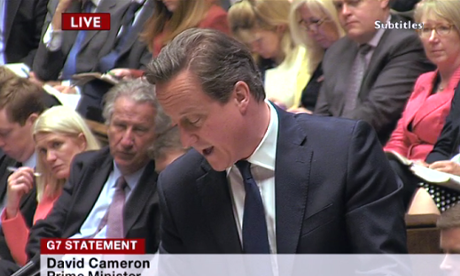
Harriet Harman is responding to Cameron.
Will Cameron be arguing at the next EU summit for sanctions to be strengthened?
What will be done to help EU states most affected?
Is there a case for accelerating the recruitment of Iraqi forces?
Is the government getting the Iraqi government to do more to reach out to Sunni tribes?
On TTIP, did Cameron seek assurances from President Obama that it will not cover the NHS?
Harman says most of the press coverage from the G7 was about the Tories and Europe.
Cameron spent the flight to Germany telling journalists that he would sack ministers who did not support his EU plans.
Cameron then blamed the journalists for mis-hearing. He said, if they were not clear, people should ask.
She says she is going to ask. What will Cameron demand? Does he agree with Boris Johnson that ministers should be allowed a free vote? Will Iain Duncan Smith be allowed to turn up the volume?
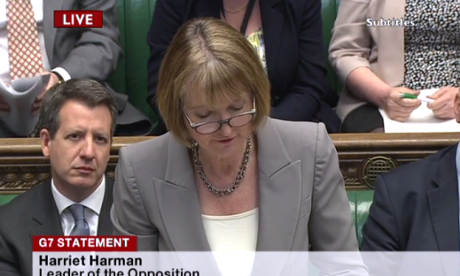
Cameron says this was the second G7 summit without Russia.
The G7 was clear that diplomatic efforts must restore Ukrainian sovereignty.
Sanctions will remain until the terms of the Minsk agreement are met.
Britain is back, Cameron says. It is playing a leading role around the world.
Cameron says the G7 leaders also discussed the fight against Islamic State.
And they discussed measures to combat people smuggling.
He says he met the Nigerian president, and discussed how Britain could help in the fight against Boko Haram. The national security council has agreed to make this a priority. Training will be offered to the Nigerian army.
Cameron's statement on the G7 summit
David Cameron is giving a statement on the G7 summit.
He says the G7 leaders agreed to push ahead with the US/EU trade deal. And they reaffirmed commitments on aid.
On green growth, there were important agreements on the targets due to be agreed at Paris at the end of this year.
He says he added a new element to the agenda: fighting corruption. Cutting corruption by 10% could increase global wealth by £380bn a year, he says. Some progress was made on tax and transparency.
Britain has become the first major country in the world to establish a central register of who owns companies. Other countries are following, he says.
There will be a major anti-corruption strategy in London next year, he says.
Cameron says the education bill ensures intervention takes place more quickly when schools are failing.
Updated
Labour’s Karl Turner asks when Cameron is handing the baton to Boris.
Cameron says it is good to have Boris back in the Commons. He is looking forward to Boris passing the baton to another Tory mayor of London.
Fiona Bruce, a Conservative, asks Cameron if he supports assisted dying legislation.
Cameron says, like Bruce, he does not support the assisted dying bill. It would lead to pressure being put on the elderly.
Rob Marris, a Labour MP, is going to introduce a private member’s bill on this, based on Lord Falconer’s assisted dying bill from the Lords. MPs will vote on it because Mares came top in the private members’ ballot.
Cameron says the challenge for the years ahead is to increase productivity. That will involve changes to planning laws, and investing in entrepreneurship and training.
Philip Davies, a Conservative, says there has been ridiculous scaremongering about what would happen to trade if we left the EU. Can Cameron confirm that the Germans would still want to sell cars to Britain if it left the EU.
Cameron says it is not just a matter of being able to trade; it is important to have a say over how the market works too.
Douglas Carswell, the Ukip MP, says in his Bloomberg speech Cameron says social and employment law would be repatriated to the UK. Why is he no longer asking for this.
Cameron says Carswell has made history. As a party of one, he has already had a backbench rebellion.
He says he is asking for a whole range of things, including changes that would affect competitiveness.
Labour’s Grahame Morris asks when the government will publish the Treasury’s assessment of the costs of leaving the EU.
Cameron says he wants the widest possible debate about Europe. He would encourage all organisations to publish information on this topic.
Andrea Jenkyns, a Conservative, asks what the government can do to cut immigration from outside the EU.
Cameron says the home secretary has written to the migration advisory committee to ask it to advise on how it can restrict the influx of skilled Labour into the UK.
Cameron signalled that he would do this in his immigration speech after the election, but he provided some fresh details of the new conditions that would apply. I will post them later.
Snap PMQs Verdict
Snap PMQs Verdict: Harman’s attempt to shame Cameron into being more constructive at PMQs was rather good, and for some of the time it seemed to work, but Cameron was back to his old tricks by question 6. But complaining about Cameron “gloating” is a bit like Tony Blair complaining about William Hague’s jokes - a defensive response to a tactic deemed effective. Otherwise, it was also interesting to see Harman hint that Labour could back amendments to beef up the purdah rules in the EU referendum bill. Given how many Tory MPs feel strongly about this, this raises the prospect of a government defeat.
Updated
Angus Robertson, the SNP leader at Westminster, asks Cameron to praise employers who deliver the living wage.
Cameron says that is the Conservative position. He hopes this isn’t gloating, but Number 10 is a living wage employer too.
Robertson says the Scottish government is an accredited living wage employer. When will the UK government follow this. Scotland benefits from the money it gets from the UK. SNP consensus on full fiscal autonomy has broken down. He quotes an SNP MP saying it would be a disaster. If Scotland had full fiscal autonomy, it would not be able to afford the living wage, he says.
Harman says it does not help working people to make promises and then not keep them. How will Cameron guarantee that the 30-hour free childcare plan won’t just lead to fees going up.
Cameron says there will be a review of how this will be implemented. Families will have more choice on childcare. Harman said people were relieved Labour were not in government. That applies to this.
Harman replies:
He can’t help himself but gloat, can he?
Perhaps we can have answers, not gloating, she says. What can be done to help grandparents. Can they share parental leave?
Cameron says this is the first time someone has been accused of gloating while quoting the leader of the opposition. He says Harman said people like leaders who are economically competent. She is talking a lot of sense, and he will be quoting her more.
Updated
Harman says it is not about a blanket exemption. There could be an alternative approach. On timing, will Cameron rule out holding it on the same day as other elections?
Cameron says the timing should be determined by the outcome of the negotiation. He says he thinks people can decide two things at the same time. The AV referendum took place on the same day as local elections.
Harman says she will explore this more in the G7 statement. Before the election, Cameron said his tax-free childcare policy would be launched in the autumn. Is he on track to meet that promise.
Cameron says he wants to help people with the cost of childcare. More details will be included in the budget.
Harriet Harman says MPs voted the for the EU referendum bill last night. Why won’t Cameron let 16 and 17-year-olds vote? They voted in the Scottish referendum.
Cameron thanks Labour for voting for the referendum. They oppposed the bill for five years. He says it was the biggest mass conversion since that Chinese general baptised his troops with a hose. On votes at 16, the Commons should vote on this.
Harman says Cameron does not need to do “ranting and sneering”.
Frankly, he should show a bit more class.
She says she and he want a Yes vote. So why is Cameron changing the law to scrap purdah rules. Will he think again?
Cameron says, because the EU issue is so pervasive, he does not want ministers to be prevented from talking on EU matters during the four-week campaign. And, when the government has a clear view, he does not want the government to be neutral. He wants the government to express its view. During the Scottish referendum, he says the government was often warned about taking a view because of the purdah rules.
PMQs
James Berry, a Conservative, says the great British jobs boom is admired around the world. Does David Cameron agree Crossrail 2 would help?
David Cameron says there are 2m more people in work. The government will push forward with plans for Crossrail 2. He praises all those involved with Crossrail 1. The tunnelling phase is complete.
PMQs will be starting soon. On the Today programme this morning Sir Gerald Kaufman, the Labour MP and father of the Commons, said PMQs was becoming increasingly pointless. He said:
For years now prime minister’s questions has been an exchange of pointless and useless declamations, with the prime minister preparing what he’s going to say regardless of the questions that are put. He uses that opportunity - I don’t blame him, waste of space though he is - to make certain points which he wants to do which he believes will reverberate around the country. They won’t. Nobody’s interested. Nobody cares any more.
The Labour MP Paul Flynn made a similar point in the Commons yesterday. Raising a point of order, he asked John Bercow, the Speaker.
Last week the prime minister asked the acting leader of the opposition four questions, almost more than she asked him. Just before the end of the last parliament, he answered a question by raising nine issues none of which was the subject of the question asked. Prime minister’s question time is becoming an exchange of crude insults and non-answers ... Might it not be a good idea to change the name of prime minister’s questions to prime minister’s answers, so that at least the prime minister would get the point?
Bercow said that it might be useful to get the procedure committee to look at reforming PMQs, or to convene cross-party talks on this, but that this was not something for him to initiate.
The SNP says research published by Edinburgh University today supports its case for 16 and 17-year-olds to be allowed to vote in the EU referendum. Here is the key finding.
Two thirds of 16 and 17 year old Scots surveyed said they would have been “very likely” to vote had they been eligible to do so in the General Election. Only 39 per cent of 16-17 year olds elsewhere in the UK said the same. In Scotland, 16-17 year olds were allowed to participate in the independence referendum in 2014, but not in the recent General Election.
Scottish 16 and 17 year olds are also more likely to have taken part in other forms of non-electoral political engagement, such as petitioning and writing to a Member of Parliament. A total of 57 per cent reported that they had done so, compared with 40 per cent in the rest of the UK.
And this is from Jim Eadie, the SNP MSP.
From across party lines members of the Scottish Parliament have learned from the independence referendum experience and now unanimously back extending the right to vote in Scottish Parliament and local government elections to include 16 and 17-year-olds.
But sadly David Cameron’s planned European Union referendum bill clearly fails to meet the gold standard set by the independence referendum in Scotland.
Graham Brady, the chair of the Conservative backbench 1922 committee, has joined those urging David Cameron to let his ministers have a free vote on the EU referendum. He has set out his reasons in an article for the Daily Telegraph. Here’s an extract.
There are three reasons why I would urge the government to treat EU membership as a matter of conscience for front and backbenchers alike. First, making it clear now that this freedom will be allowed at the end of the negotiations will act as a pressure release and set the tone for a mature and rational debate. Secondly, while this is an issue that is more important than party politics – which will divide any serious party – it is also right that we should have a view to the need for reconciliation after the referendum ...
Thirdly, on such a totemic issue, it is only if it is clear that ministers are free to speak their minds that the public will know that they are genuinely urging a course of action that they believe in – not advancing an argument because it is a condition of their continued ministerial office.

Here is some Twitter reaction to the Times’s revelations.
From the FT columnist Janan Ganesh
This, by D Miliband, is the second rule of politics, after "Most things don't matter." pic.twitter.com/UukUo8gJi1
— Janan Ganesh (@JananGanesh) June 10, 2015
From the Labour blogger Luke Akehurst
The worst bit of Times coverage is revelation about being motivated to help solely bottom 25%. Don't we want better life for whole UK?
— Luke Akehurst (@lukeakehurst) June 10, 2015
From the Telegraph journalist Tim Stanley
But would David Miliband have been any more appealing in Glasgow? Or won back Kentish Ukippers? Then there's that banana photo...
— Tim Stanley (@timothy_stanley) June 10, 2015
In parallel universe Ed Miliband is telling us David Miliband lost 2015 because out of touch, insufficiently radical, cant hold a banana etc
— Tim Stanley (@timothy_stanley) June 10, 2015
From the RSA’s Anthony Painter
#Labour is having the debate it should have had in 2010 now. Until it catches up with the times - and gets ahead of them- it has no chance.
— Anthony Painter (@anthonypainter) June 10, 2015
Labour is dismissing George Osborne’s proposed budget surplus law as a stunt, without committing itself to voting for or against it. This is from Chris Leslie, the shadow chancellor.
We need to deal with the deficit, and no-one would disagree with a surplus when economic circumstances allow or that investment is needed if the economy is in a downturn. But rather than giving speeches full of distraction techniques the chancellor should be focusing on driving up productivity, setting out how he will pay for his multi-billion-pound election pledges and explaining who will bear the burden of the still unexplained cuts planned.
Sensible reductions in public spending and a balanced approach are needed - but the public need straight answers from the chancellor now rather than politics.

And here are some of the best quotes from the Times’s “what went wrong for Labour” article (paywall).
From the late Lord Gould, Tony Blair’s pollster. This is what he said in 2011 to Ed Miliband’s pollster, James Morris.
I agree we concede and move on but this seems to be conceding on everything except the economy and I would do the opposite.
From Lord Mandelson, recalling watching the results on election night
It was almost as if New Labour hadn’t existed and we had never won three elections in a row. I felt as if the clock had been turned back and all the years of change and broadening our appeal were being flushed away.
From Alistair Darling, the Labour former chancellor
We didn’t offer a compelling vision of the future. You can’t win on a series of ‘retail offers’ like ten bob off your next electricity bill ... [Labour now] cannot assume we are at the bottom of the sea.
From Alan Milburn, the Labour former health secretary
The last five years have been a ghastly experiment in kidding ourselves that something fundamentally had changed in the laws of politics, and it hadn’t.
From Gordon Brown
Gordon Brown had once asked a group of aides why they had joined the Labour party. “To help the bottom 25 per cent,” replied Stewart Wood, who became one of Mr Miliband’s closest advisers. “Yes,” said Mr Brown, “but we mustn’t say that or we will never win.”
Recently the Guardian published a 6,500-word article by Patrick Wintour giving the inside story of what went wrong for Labour under Ed Miliband, and why it lost the election. If you haven’t read it already, you should.
Today the Times has published the results of a similar project (paywall). It has been written by Rachel Sylvester and Michael Savage, who spoke to more than 40 senior Labour figures as part of their research. Obviously, it is not half as good as the Guardian version, but it is well worth reading, and it includes plenty of new material.
Here are some of the new revelations.
- Ed Miliband was planning to use his conference speech in 2011 to announce a plan to force top universities to take five pupils from every state school. The idea was dropped at the last minute, which meant the “predators v producers” became the main story.
- Alastair Campbell tried to persuade Miliband to address the charge that the last Labour government spent too much by setting up a commission to investigate. It could have been chaired by a figure like Jim O’Neill, the former Goldman Sachs banker, or Lord Browne of Madingley, the former BP chief. “It would almost certainly have cleared Labour of blame, with a minor dispute around whether the party could have spent less in 2007. The idea was not taken up.”
- Ed Miliband was repeatedly told by Labour’s pollsters, James Morris and Stan Greenberg, that he should do more to acknowledge the importance of the deficit. For example, “a 2010 note insisted the party should be arguing that ‘the deficit is the No 1 challenge facing the country’”.
- Shortly after being appointed shadow chancellor, Ed Balls produced a five-point plan for growth without consulting Miliband.
- Balls had grave reservations about Miliband’s plans for an energy price freeze and a tuition fees cut, and stopped Miliband proposing a corporation tax increase.
-
Miliband was encouraged to make a trip to Germany to boost his foreign policy credentials, but dropped the idea because he could not be sure of getting a press conference with Angela Merkel.
David Miliband's Times interview - Summary
Here are some of the key quotes from the Times’s interview with David Miliband (paywall).
-
Miliband said Labour should have admitted that it spent too much.
The facts are that public spending in Britain did not cause the financial crisis but if we had spent less we would have had more room for manoeuvre.
The Tories accuse us of not fixing the roof while the sun was shining. The right metaphor is that we didn’t take out sufficient insurance against the foundations falling through . . . would it have been prudent to have spent less? The answer is obviously yes.
-
He said the Tories were trying the make themselves “the natural party of government”.
The Tories are on a mission to make themselves the natural party of government. We’ve got to take that deadly seriously. The way we do that is to do things within our own control — how we position ourselves, how we organise ourselves, how we think and engage.
-
He said Labour’s problem was that voters thought it had gone backwards from the Tony Blair era.
We’ve got to understand the past and we’ve got to anticipate the future. Over the past ten years we’ve gone from winning three elections in a row to losing two elections in a row . . . And the absolutely key problem that we’ve had in the last two elections is that people perceived us to have gone back on the New Labour settlement, that in trying to address its weaknesses we have lost its strengths ...
We should liberate ourselves from the delusion that running away from three election victories is a route to success . . . it’s 50 years since Labour won a majority at a general election without Tony as leader. It’s important to have this in mind.
-
He said the trade unions had to modernise too.
The challenge for the unions is the same as the challenge for the Labour party, which is how do you become a living breathing movement, not an ossified machine? In an age of transparency and openness, machine politics will get found out.
-
He said that he suspected Labour would lose the election.
“I had spent the previous two or three weeks wondering whether in fact I was wrong to believe that you couldn’t suspend the laws of political gravity because the polls obviously suggested that things were close, but . . . the politics of our offer and our positioning made me very fearful of the consequences, and that was borne out.”
- He said he had not decided which Labour leadership candidate to back.
-
He would not rule out a return to British politics. This is what he said when asked about the prospect.
This isn’t the place to venture into my career choices,” he replies. “I’ve got a big job to do here [in New York, where he is head of the International Rescue Committee.] I’m very committed to doing it. I hope that I can use my voice now and again in the British scene. In terms of what I do next I’ll have to take some time to think about that.”

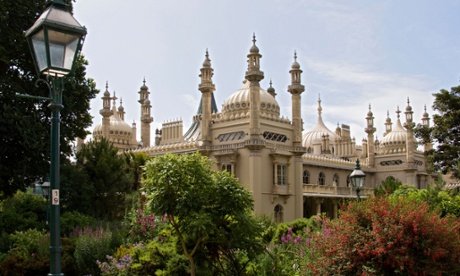
I’m still going through the Times’s “what went wrong with Labour” investigation for a summary, but I see that one revelation has already made the Brighton and Hove News.
An aide of Labour leader Ed Miliband’s cancelled a photoshoot outside the Brighton Pavilion over fears it might be mistaken for a mosque, The Times reports today.
In the European parliament a vote on TTIP (the transatlantic trade and investment partnership) has been postponed. This is from the Press Association.
MEPs narrowly voted to postpone today’s consideration of the EU-US Transatlantic Trade and Investment Partnership (TTIP) following the announcement that there would be no vote.
European Parliament president Martin Schulz said the delay was required because more than 200 amendments had been tabled that should be considered by the committee on international trade.
But critics hailed the move as a recognition of the growing strength of opposition to aspects of the proposed deal, including the potential impact on the NHS and other public services.
The formal support of the parliament is seen as an important element in pushing forward the deal, though it is not required at this stage.
Labour has backed the deal but leadership contest front-runner Andy Burnham told GMB trade union members yesterday that his support was not guaranteed without stronger guarantees that the NHS would be protected.
Unions have led opposition in the UK to the proposals, including the investor-state dispute settlement mechanism (ISDS) which critics say will dangerously increase the power of multinational firms by allowing them to sue national governments.
MEPs voted by 183 to 181 against, with 37 abstentions, to postpone the debate after MSchulz put off the vote.
Trade committee chair Bernd Lange said: “We will use the additional time we gained to work towards reaching a stable majority for the TTIP resolution.
“The EP (European parliament) can only come forward with a strong message for the TTIP negotiators if our resolution is supported by a broad majority.”
Nigel Farage, the Ukip leader, says the EU is “running scared” of public opinion on this issue.
EU running scared of European public on TTIP, corporatist agenda cracking http://t.co/7J1IbLgKIi
— Nigel Farage (@Nigel_Farage) June 9, 2015
17 years as an MEP and never seen such public disquiet re: an EU issue. The result? Debate & vote on TTIP suspended. They've got the wind up
— Nigel Farage (@Nigel_Farage) June 10, 2015
I've never received so much communication from the public on a proposed piece of legislation #TTIP
— Nigel Farage (@Nigel_Farage) June 10, 2015
The EU parliament suspended today not just the vote, but the debate on #TTIP too which I think was cowardly in the extreme.
— Nigel Farage (@Nigel_Farage) June 10, 2015
We’ve covered David Miliband’s comments in his CNN interview here, but there is one other quote worth flagging up. Miliband said the Labour leadership should learn from what Labour figures are doing in local government.
Those local government leaders are making their voice heard to a national party that needs to catch up with the way Britain has changed, the way politics has changed and the kind of agenda that needs to be set in an age of economic insecurity which is what exists across Europe at the moment.
You can watch an extract from the interview here.
On Twitter my Guardian colleague Owen Jones has responded to David Miliband.
Trying to imagine how a David Miliband led Labour party would have stopped Labour voters fleeing to the SNP, UKIP or the Greens. Failing.
— Owen Jones (@OwenJones84) June 10, 2015
Agenda for the day
Good morning. Two stories are dominating the news this morning.
-
David Miliband has criticised the stance adopted by Labour under his brother Ed’s leadership. He has given an interview to the Times, which has published his comments as part of a lengthy investigation into why Labour lost, and also to CNN. This is what he told CNN:
What I think is important for all the candidates [to replace Ed Miliband] is to reflect on the very clear lessons of two devastating electoral defeats for the Labour party in the last five years, which have come for a very clear reason.
And the reason is that the public have concluded that instead of building on the strengths and remedying the weaknesses of the Blair years, the party has turned the page backwards rather than turning the page forwards.
I will post some highlights from the Times investigation (paywall) later.
-
Conservatives have defended George Osborne’s plan to pass a law saying that in normal circumstances the government will have to run a surplus. Osborne will unveil more details in a speech tonight. In an interview on the Today programme, David Gauke, the Treasury minister, said dismissed claims this would stop the government promoting growth.
Of course growth is very important and the idea that there is a contradiction between taking a fiscally conservative approach and getting to grips with public finances and growing the economy is simply not true. In 2014 we were the fasting growing major economy in the western world whilst pursuing measures to reduce our deficits. The two can run together ... What we want to do, and what we need to do as a country is pursue policies that help growth but also ensure that we have got sound public finances. If we can pursue both of those, then that’s the way that we can ensure that we get a sound future and we can reduce debts, and interest and what we pass on to a future generation.
And on the Today programme Lord Lawson, the Conservative former chancellor, defended the plan.
Ex-Conservative chancellor Lord Lawson backs @George_Osborne's legislation for balanced budgets over economic cycle pic.twitter.com/0UMQhzrTfU
— BBC Radio 4 Today (@BBCr4today) June 10, 2015
Later David Cameron will be in the Commons for two key events.
12pm: Cameron takes PMQs.
12.30pm: Cameron makes a Commons statement on the G7 summit.
I will be covering both in detail.
As usual I will be covering the breaking political news as it happens, as well as bringing you the best reaction, comment and analysis from the web. I will post a summary at lunchtime and another in the afternoon.
If you want to follow me on Twitter, I’m on @AndrewSparrow
Updated