HOUSTON _ Let's start with this right off the top. Yuli Gurriel's racially offensive dugout antics Friday night during Game 3 of the World Series were not going to be tolerated by Major League Baseball, regardless of any nuanced interpretation or misguided perspective on his part.
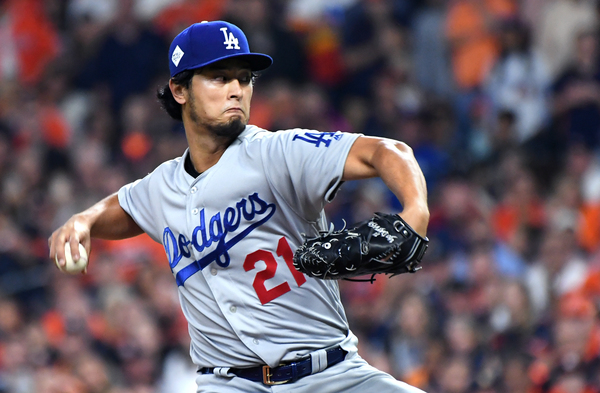
Here are the undisputed facts. Gurriel was caught on camera making a racist gesture that he later admitted to, while also saying the term "Chinito" _ a Spanish-language slang reference to Asians _ after his second-inning home run off Yu Darvish, who is of Japanese and Iranian descent.
Gurriel showed remorse with a clumsily translated apology, but it ultimately was left up to Commissioner Rob Manfred to defuse the volatile situation, and that's what he tried to do before Saturday night's Game 4 at Minute Maid Park.
Manfred huddled with all the involved parties Saturday morning, including a meeting with Gurriel, then quickly called for a 3 p.m. CT news conference. The verdict? A five-game suspension, without pay, that Gurriel will serve at the start of the 2018 season. The suspension will cost him $320,855.62 of his $12 million salary, and Gurriel also has to go to sensitivity training during the offseason.
In our view _ and I'm not among the group racially targeted by Gurriel's actions _ it's a fitting and adequate punishment, based on precedent. The reasonable comparisons are the Blue Jays' Kevin Pillar, who received a two-game suspension last May for shouting a homophobic slur at a Braves pitcher, and the Blue Jays' Yunel Escobar, who was banned three games in 2012 for having an anti-gay slur written on his eye-black stickers.
As Manfred pointed out, Gurriel's suspension far exceeds those two episodes, so at least the commissioner recognized the need to step up the disciplinary measures. Part of that certainly had to do with the ultra-high profile nature of Gurriel's crime, in the middle of a World Series game, with a global audience. But Manfred also must have felt the need to tack on the extra games to rationalize why he didn't suspend Gurriel immediately, which some are convinced he should have done.
We agree with Manfred in this case. As offensive as Gurriel's behavior was, it didn't directly affect the competitive nature of this Series, such as a malicious slide that results in injury, a dangerous beanball incident or fighting with an opposing player. Those should be weighed when it comes to immediate penalties against a player and how it handicaps a team.
With Gurriel, the severity of the suspension actually does its job in delivering a message, both to the Astros' first baseman, and leaguewide, to prevent such offensive activities from happening again. Major League Baseball is a diverse organization, with a huge Asian fan base, and Manfred had to come down swiftly and decisively during his sport's jewel event.
"There is complete unanimity _ me, my office, both owners, both clubs and the MLBPA _ that there is no place in our game for the behavior or any behavior like the behavior we witnessed (Friday) night," Manfred said. "There is no excuse or explanation that makes that type of behavior acceptable."
Manfred no doubt was referring to Gurriel's insistence on not meaning to offend anyone, as well as maintaining that the term "Chinito" was merely a way of referring to an Asian person in general _ not an insult to Darvish. Though most of this was lost in Friday's poor translation, Gurriel apparently was trying to tell a teammate about his lack of success against Japanese pitchers, and evidently was excited by breaking through against Darvish in Game 3.
That doesn't give him a pass here, obviously. But Gurriel did offer a sincere public apology and planned to deliver one privately to Darvish. As for Manfred's own breakdown of the penalty, a four-point outline, there's only one we're not exactly square with. The forfeited salary is good _ players aren't paid during the World Series _ and we understand Manfred respecting Darvish's wish to move forward rather than allow this to be a continuing distraction.
Deferring the suspension to 2018 also made it easier for Manfred to negotiate a more amenable deal with the Players' Association, thus circumventing the appeal process. If Manfred pushed for an immediate ban, the MLBPA may have fought it _ this is the World Series, after all _ and the subsequent legal tangle could have delayed his suspension to next season, anyway. Instead, the union announced there would be no appeal.
Where Manfred lost us was the claim of not wanting to penalize the other 24 Houston players with an instant ban of Gurriel, who was hitting .340 (18 for 53) with a homer and five RBIs this postseason. They'll definitely feel his loss during opening week next season, so what Manfred actually was trying to do was preserve the integrity of this World Series _ which he didn't come out and say. Otherwise, Manfred got this right.
"I think that it gives us all some closure," said Dodgers manager Dave Roberts, whose mother is Japanese. "The way that it was dealt with I support."