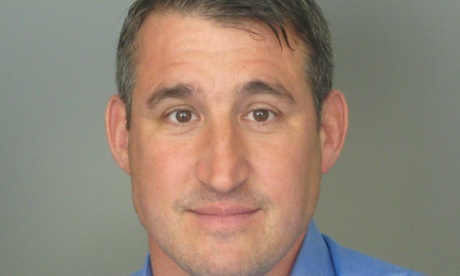
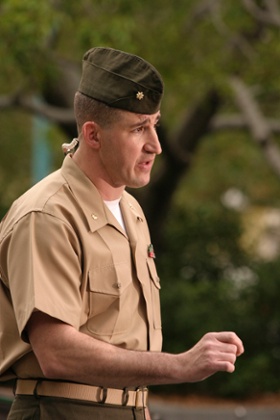
Dan Mori no longer trails the glamour of his rank: a major in the US Marines fighting for the release from Guantanamo of an Australian demonised in Washington and Canberra as the worst of the worst.
He still has the military haircut and that big boyish face, but these days Mori is a civilian lawyer in Melbourne, back in the public eye because he has published his own account of the four-year battle for the release of his client, David Hicks.
The book, In the Company of Cowards, appears in bookstores as another little cohort of crazy Australians go off to fight jihad, not in Afghanistan this time, but in Syria and Iraq. They may face trial one day and the message of Mori’s book is that, come the day, they too will deserve due process.
Mori speaks and writes as a lawyer, an American lawyer. Two and a half years working in William Street, Melbourne, haven’t wiped away a Massachusetts upbringing and a patriot’s devotion to the American Revolution. He regards due process as something his country stands for.
“There are certain values that we hold and nothing should take those away from us,” Mori told Guardian Australia after he had appeared one day in a Melbourne bookshop spruiking his book. “They make us who we are.”
Australian lawyers don’t often quote Tom Paine. Mori chose a few lines of the great radical as an epigraph for his book: “He that would make his own liberty secure, must guard even his enemy from oppression; for if he violates this duty, he establishes a precedent that will reach unto himself.”
This is not another life of Hicks. “Anyone who wants to know David’s story can read his book,” Mori writes. “I try to address how an Australian was left by the Australian government at Guantanamo Bay (GTMO) to face made-up charges before an illegal United States military commission.”
In the Company of Cowards is a lawyer’s account of court victories that turned to ashes; of incompetence and political malice on both sides of the Pacific; of the Howard government’s indifference to ordinary principles of justice; and of Mori’s rescue of this prisoner from his Cuban jail more by winning over the Australian public than persuading the military officials of Washington.
From July 2003 when the army assigned him to Hicks’s defence, Mori was puzzled by two big questions. What was his client supposed to have done: “Hicks had not blown up anything, planted any bomb or even hurt anyone.” And why was this Australian national being treated so badly?
Americans accused of training with al-Qaeda were not incarcerated at GTMO. Tony Blair made sure British prisoners were brought home. The Saudis got their men out. But David Hicks was left year after year, uncharged with any crime, in brutal isolation. “An Australian deserves the same justice system as an American and a British citizen,” says Mori. “Australians are not second class.”
Great victories in the US supreme court saw no GTMO prisoners freed. But as Washington went back to the drawing boards after each of these defeats, Mori had what he needed: time to convince prosecutors there was no real evidence against his client, and time to persuade Australia to take Hick’s predicament seriously.
That meant wooing the media. “I was a novice,” Mori now says. “I did not realise the time and effort that it would take dealing with the media. Reporters are busy and if you want them to get beyond the first layer and look at the second and third layer you had to do the research for them. You couldn’t just talk to a reporter and say this is unfair. You also had to provide them the source documents and sort of lay it out, one, two and three.”
The sight of a man in khaki courting the Australian press was one of the great culture shocks of the Howard years. And he courted – indeed seduced – the lawyers of Australia. Mori knew the press needed authorities to quote other than him. So he set about winning over the attorney generals, the bar associations of the states, the Law Council of Australia and the Australian branch of the International Commission of Jurists.
“Once they got educated they felt they could weigh in on it,” he says.
Mori only campaigned in Australia. “Nobody in the United States cared about GTMO detainees after the Bush re-election.” And to reach the middle ground in Australia, he threw overboard Hicks’s Adelaide lawyer Stephen Kenny. The issue wasn’t legal ability but political persuasion: “We needed something different, lawyers with experience in the military who could not be brushed off as lefties.”
Meanwhile Hicks was being held in solitary confinement, which grew worse with the years. He was shackled. The food was appalling. His access to books was always limited – Mori reports him being denied To Kill a Mockingbird and The Fatal Shore – but by July 2006 he was allowed to have only a short religious text in his cell. The light blazed 24 hours a day, seven days a week. Mori writes: “The isolation was breaking him.”
Mori squarely blames Howard and his attorney general, Phillip Ruddock. He writes that the conditions of Hicks’s imprisonment “appeared to go unchallenged by the Australian government”. He argues that the US authorities would have been happy by this time to return Hicks as they had returned Mamdouh Habib to Australia, and all the British prisoners to Britain. As far as Mori is concerned, his client’s true jailers were Australian.
In the Company of Cowards doesn’t solve the mystery of how Hicks, in the end, was charged or why he was suddenly offered a sweet plea bargain. Mori suspects the deal was done between Howard and Dick Cheney during the US vice president’s visit to Australia in February 2007. An election was approaching. Hicks was a barnacle.
Mori was one face in the crowd at the Guantanamo airstrip the night an Australian plane landed. “Lines of armed military staff formed as if Hannibal Lecter were being moved.” Hicks emerged from an armoured vehicle. At the foot of the steps, Australian police asked that his shackles be removed. “Somewhere on his way up those steps,” writes Mori, “he ceased being a detainee of the United States and regained his rights as a citizen of Australia.”
Mori nowhere declares his client blameless. He writes: “I am not making light of Hicks being over in Afghanistan, and I think that the hardest thing for Australians to understand was why he would go over there in the first place. But from a legal mindset, I still could not find a crime, and it seemed that the prosecution was stretching in its shading of the facts.”
Hicks had finally faced two charges. The first, of attempted murder, didn’t survive. It helped that Mori armed reporters with the right questions and the chief prosecutor Morris Davis admitted there was no evidence Hicks had fired a shot at anyone.
In the end, Hicks pleaded guilty only to a charge of “providing material support for terrorism” which had become a crime under US law only after Hicks’s capture. Mori knew the charge was bogus – and it has been since declared so by the US Supreme Court – but Hicks was too broken to survive the years an appeal would take. So he pleaded guilty.
Mori argues that when all the legalese is stripped away, Hicks was only ever being prosecuted for being there – not for anything he did, but simply for being in Afghanistan at that time. It was the most they could ever prove and that wasn’t a crime.
Mori has a complex response to Tony Abbott’s new security laws that might make merely being in Syria or Iraq a crime. “Criminal law should be based on conduct not ideology or religion or geography,” he says. But if Australians have been put on notice that they can’t be there and can’t support a prescribed group, then that’s the law. Prosecution follows.
What bothers him is the T word: “It’s such a broad generalisation.” And the language of “support” for terrorism troubles him: where in in all the talk about “supporters, financers, associates, offshoot groups” should criminal liability lie?
But terrorism must not go unpunished? Mori beams with mischief: “Unless you wanted to fight against that horrible British government that was oppressing those colonials in America…”
Mori enjoys Melbourne – “the city that came up with the right turn from the left lane only” – and his work in the social justice department of Shine Lawyers. He one of the team defending Daniel Snedden (aka Captain Dragan) resisting for the last eight years extradition to Croatia to face a war crimes trial.
He won’t talk about Hicks. He is not his lawyer now. He very deliberately left Hicks space to write and promote his own book. Now it’s Mori’s time. His face is being seen again with its absurd military haircut. “When I first got here, I tried to grow it out and it’s a lot of hassle. Much easier not having to spend money on hair product.”
A return to Massachusetts is not out of the question. He has family back in New England. His kids are now nine and six. He wonders what their home town will be. “I’ve got to decide as my kids get older where I want to raise them. It’s tough.”