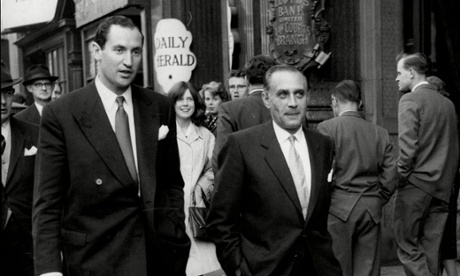
There are very few husband-and-wife teams who build a successful law practice, let alone a big London one, but David and Iris Freeman did just that. A man of considerable impish charm and presence, Freeman, who has died aged 86 after suffering from leukaemia, was one of a generation of entrepreneurial Jewish solicitors – including Lords Nathan, Goodman and Mishcon and Sir David Napley – who became prominent both in and outside the profession. However, his was the only leading commercial firm that began as a one-man practice.
Over the years he developed an all-round commercial operation of the highest quality. In the 1960s came a property boom, and Freeman advised developers, banks and insurance companies. One of his most important cases came in 1964 when in Hedley Byrne & Co Ltd v Heller & Partners Ltd the House of Lords ruled in a case over a bank reference that a party could bring an action over negligent misstatement when no contract existed.
At the same time he was building a media practice, first as adviser to the Evening Standard and then to the whole Express group, as well as acting for Tommy Steele and the Animals. However, he declined an invitation to become involved in managing the Beatles. He was involved in the Robert Maxwell Pergamon inquiry, which established that those criticised in a draft report should have the right of response before its publication.
In 1967 his friend Goodman, whom he had met while doing national service, recommended that he should advise the prime minister, Harold Wilson, over a publicity postcard promoting the Move’s new record Flowers in the Rain depicting a naked Wilson. It was described by Quintin Hogg QC, later Lord Hailsham, in the high court as a “violent and malicious personal attack”. As part of the libel settlement, the band agreed to devote all royalties from their record to charities of the prime minister’s choice. That year Freeman again acted for Wilson, this time in actions against the Daily Express and Daily Mail over comments made in a Nigel Dempster column regarding Wilson’s alleged property interests.
A man with an astute financial brain, Freeman extended his practice into the world of corporate insolvency, and in 1966 was involved in the fallout following the collapse of Emil Savundra’s Fire, Auto and Marine insurance company, when around 400,000 motorists were left uninsured. In 1977 he was appointed a Department of Trade inspector into the affairs of AEG-Telefunken (UK) Ltd and Credit Collections Ltd.
In 1950 Freeman had married Iris Alberge, a child psychologist. Both believed their job was to bring up their children personally, and the dinner table became a debating society. In time she became articled to him and qualified at the age of 40. She then became a partner in the firm and they turned their attention to the burgeoning field of employment law: the many senior executives they acted for included George Davies when he was sacked by Next and for Peter Robinson in his dispute with Woolwich Building Society in 1996, securing a substantial compensation package. Iris wrote a well-received biography of the former Master of the Rolls, Lord Denning, and at the time of her death in 1997 was writing one on Goodman.
By the time Freeman retired at the age of 65, he had seen his practice grow to one with more than 50 partners and an international reach. He continued to act as consultant until 2003.
David was born in Cardiff, the son of Rebecca and Meyer, secular Jews from the Netherlands and Russia. Meyer, a tailor’s cutter, supplemented his income by playing the piano accompanying silent films. Five years later the family moved to Bounds Green, north London and then to nearby Golders Green. A keen Scout, described by his scout master as “the most competitive and ambitious young man I have ever met”, David delivered messages at night during the blitz.
David had wanted to become a barrister, but that was not a financial proposition for his parents. His headteacher at Christ’s college, Finchley, had told his father that he should study for a history scholarship at Balliol. His father, however, thought that it was time he should get a job.
During his national service (1946-48), in which he became a lieutenant, he volunteered to serve in Malaya, but instead he was sent to the Catterick army base in North Yorkshire to learn logistics. On returning to civilian life, Freeman entered into articles with the two-partner firm Benson Mazure. There was no requirement to work under supervision for a period of time after qualification, and he immediately set up his own practice in Cannon Street before moving to Maddox Street in the West End and ultimately to Fetter Lane, near the law courts. His first clients came through his mother’s family, but with hard work, the economy on the up and, acting now as solicitor to young businessmen, after five years he was able to move from a rented one-room flat to a semi-detached house on the borders of Hampstead.
His two sons went to Balliol before becoming articled to him. Both left on the day they qualified in order to develop business interests. He had suspected they were not committed to a legal practice and later joined them in some of their non-property investments. The David Freeman student outreach and support officer was later endowed in his name at Balliol.
Outside the law his interests included reading, particularly history. Always a socialist, in his youth he had been a devoted member of Victor Gollancz’s Left Book Club. He was also a governor of the Royal Shakespeare Company (1979-96). Keen on golf, he was a member with a handicap of 22 at Huntercombe, in Oxfordshire, near where he had a house. Although a non-practising Jew, he maintained a keen interest in Jewish affairs.
In 2003 he chaired a panel with the Cambridge professor of archaeology Lord Renfrew inquiring into the provenance of bowls from the early centuries AD, which might have been removed illegally from Jordan or Iraq. It found that there was no basis for concluding that title was vested other than in the owners, the Schøyen Collection, based in London and Oslo.
Freeman is survived by his second wife, Connie Levy, whom he married in 2001, and by two sons and a daughter from his first marriage, 12 grandchildren and four great-grandchildren.
• David John Freeman, solicitor, born 25 February 1928; died 23 February 2015